


The Taiwanese have an unclear understanding of what China means, while people in the US have a comparatively clear sense of what they like and dislike about its authoritarian regime, President Chen Shui-bian (陳水扁) said.
"The public is highly divided over whether China is a friend or foe, a foreign country or the motherland," Chen said in the latest edition of his A-bian e-newsletter, which is available online from today.
"In order to prevail in the volatile cross-strait climate, we must know who we are, what we want, what we believe in and have a clear sense of national identity," he said.
Citing an article written by Eric Larson -- a senior analyst and pollster at RAND Co, Chen said Larson's study indicates that 64 percent of US citizens believe China poses an economic threat to them and 50 percent think China poses a military threat.
About 48 percent of US citizens believe China's economic development has a positive impact on the international community, while 46 percent think it has a negative effect.
In addition, 55 percent say China's economic growth is obtained using unfair means, while only 34 percent think China uses a fair and just approach.
There are three main reasons behind the US' dislike of China, Chen said, quoting the report.
First, China is not a democratic country, but a one-party dictatorship. Secondly, China poses a military threat to the region, especially to Taiwan. Finally, China uses means such as manipulating its currency and condoning of rampant counterfeiting which results in a trade deficit and massive losses for the US.
Chen said that US citizens' clear-cut sense of what they like and dislike about China derives from their distinct comprehension of the national interest and their sturdy belief in freedom, democracy and human rights as well as faith in the market economy.
In comparison, Chen said, the people of Taiwan have a relatively vague perception of their giant neighbor.
"Without a doubt, the Chinese market is full of business opportunities, but we cannot turn a blind eye to China's one-party system, its warmongering attitude, its violation of human rights and suppression of political dissidents," he said.
"A government cruel to its people is destined to be a country hostile to its neighbors and poses a serious threat," he said.
"While China wants the international community to be friendly toward it, it has to be friendly to the world first," he said. "It is up to it whether it wants to be a friend or foe to the world."
Meanwhile, in a letter to the Wall Street Journal on Thursday, Chen said that China, as an emerging economic and military power, is using its growing influence to change the status quo in the Taiwan Strait.
Chen listed the different ways that China has increased its pressure on Taiwan in the hope that it will abandon its hope for total independence from China.
China has consistently blocked Taiwan from joining international organizations and has deployed more than 800 missiles targeting the island, increasing their number by 100 to 125 per year, Chen said.
By increasing trade with Taiwan, he added, China has made Taiwan more economically dependent on China and "put Taiwan's economy at risk by causing structural unemployment and a stagnation in wage levels."
Politically, for the past six years, China "has refused to interact" with Taiwan's democratically elected government, while choosing to meet earlier this month with the opposition Chinese Nationalist Party (KMT), Chen said.
The meeting was "an attempt to undermine [Taiwan's] Democratic Progressive Party government ... very cynically timed to draw attention away from the passage last year of China's so-called `Anti-Secession' Law," he said.
China's rapid military buildup and "misplaced" concerns over Japan's desire to play a leading role in world affairs is upsetting the balance of power in the region, Chen said.
"I must point out that it is China -- and not my government -- that is determined to alter the status quo in the Taiwan Strait and Northeast Asia," he said.
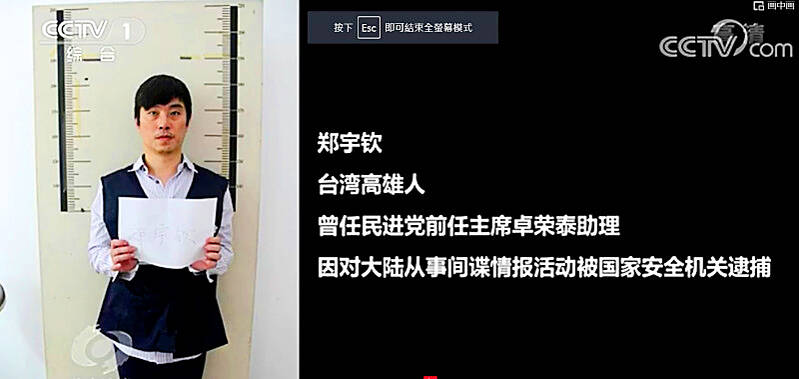
Former Czech Republic-based Taiwanese researcher Cheng Yu-chin (鄭宇欽) has been sentenced to seven years in prison on espionage-related charges, China’s Ministry of State Security announced yesterday. China said Cheng was a spy for Taiwan who “masqueraded as a professor” and that he was previously an assistant to former Cabinet secretary-general Cho Jung-tai (卓榮泰). President-elect William Lai (賴清德) on Wednesday last week announced Cho would be his premier when Lai is inaugurated next month. Today is China’s “National Security Education Day.” The Chinese ministry yesterday released a video online showing arrests over the past 10 years of people alleged to be
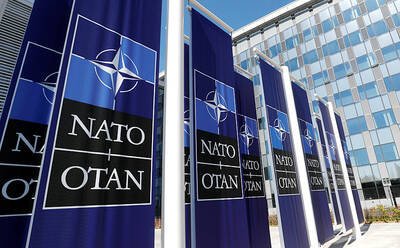
THE HAWAII FACTOR: While a 1965 opinion said an attack on Hawaii would not trigger Article 5, the text of the treaty suggests the state is covered, the report says NATO could be drawn into a conflict in the Taiwan Strait if Chinese forces attacked the US mainland or Hawaii, a NATO Defense College report published on Monday says. The report, written by James Lee, an assistant research fellow at Academia Sinica’s Institute of European and American Studies, states that under certain conditions a Taiwan contingency could trigger Article 5 of NATO, under which an attack against any member of the alliance is considered an attack against all members, necessitating a response. Article 6 of the North Atlantic Treaty specifies that an armed attack in the territory of any member in Europe,
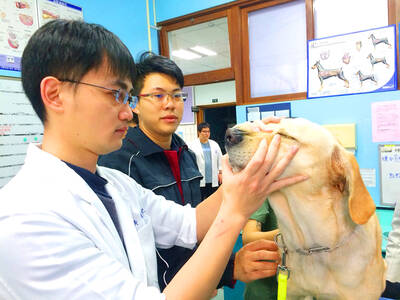
LIKE FAMILY: People now treat dogs and cats as family members. They receive the same medical treatments and tests as humans do, a veterinary association official said The number of pet dogs and cats in Taiwan has officially outnumbered the number of human newborns last year, data from the Ministry of Agriculture’s pet registration information system showed. As of last year, Taiwan had 94,544 registered pet dogs and 137,652 pet cats, the data showed. By contrast, 135,571 babies were born last year. Demand for medical care for pet animals has also risen. As of Feb. 29, there were 5,773 veterinarians in Taiwan, 3,993 of whom were for pet animals, statistics from the Animal and Plant Health Inspection Agency showed. In 2022, the nation had 3,077 pediatricians. As of last
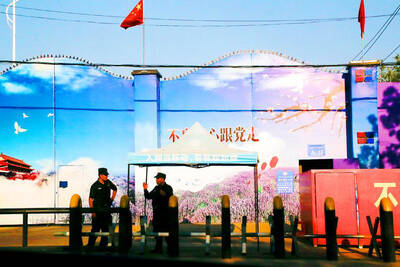
XINJIANG: Officials are conducting a report into amending an existing law or to enact a special law to prohibit goods using forced labor Taiwan is mulling an amendment prohibiting the importation of goods using forced labor, similar to the Uyghur Forced Labor Prevention Act (UFLPA) passed by the US Congress in 2021 that imposed limits on goods produced using forced labor in China’s Xinjiang region. A government official who wished to remain anonymous said yesterday that as the US customs law explicitly prohibits the importation of goods made using forced labor, in 2021 it passed the specialized UFLPA to limit the importation of cotton and other goods from China’s Xinjiang Uyghur region. Taiwan does not have the legal basis to prohibit the importation of goods


 RSS
RSS