


Taiwan would have admitted it was part of China if it had accepted Beijing's "free" offer of two giant pandas, President Chen Shui-bian (
"China's offer of two giant pandas as a `gift' which would be `free and unconditional,' was in fact part of its `united-front' tactic according to which it views Taiwan as part of its territory," Chen said.
"Of course, pandas are cute, but they are live animals, not toys. They do not need to be kept in a zoo and should definitely not be used as a political tool," he said.
The Taiwan Forestry Bureau announced last Friday that it was opposed to importing the pandas because they were an endangered species and would not receive proper care here.
Citing an article in the April 3 edition of Newsweek entitled "China's Panda Politics," Chen said the giant pandas would only be happy in their natural habitat.
The Newsweek report noted that the pandas were highly symbolic.
"Accepting the pandas as a gift could be tantamount to accepting Beijing's claim that Taiwan belongs to mainland China," the report said.
According to the 1975 Convention on International Trade in Endangered Species, the report said that Beijing could make an outright gift of pandas to any zoo within China.
"Foreign zoos are different: they can get the animals only on loan, in the form of a scientific exchange. For US zoos, the price of those `scientific' deals can be well over US$1 million a year," the article said.
Japan's Tokyo Shimbun on March 30 also questioned China's "panda politics," saying it was a "money-making" business.
The report said that each of the four zoos in the US that kept giant pandas had to pay US$1 million a year for a pair and an additional US$600,000 a year for each panda cub.
On top of the rental fees, zoos were required to pay an additional "animal protection" fee of US$1 million, the report said, meaning that the four US zoos had shelled out US$33 million between 2000 and 2003 for the honor of displaying giant pandas.
Chen called on the public to refrain from looking at the panda saga from a political point of view, saying that the professional opinions of the evaluation committee should be respected.
With the ubiquity of the Internet, Chen said it was not necessary to keep animals in zoos for educational purposes.
Chinese Nationalist Party (KMT) Chairman Ma Ying-jeou (
"We doubt the that professional concerns carried much weight in the decision [to reject the pandas]. The government should not fear pandas. The animals are neither missiles nor members of the Chinese Communist Party," Ma said yesterday before participating in a forum at the Taipei Youth Center.
The KMT chairman said countries such as Thailand had received pandas from China free of charge, and that the issue should not be a concern for the government.
"The whole thing should be considered from a professional angle -- that is, whether Taiwan is capable of taking care of pandas," he added.
Additional reporting by Mo Yan-chih
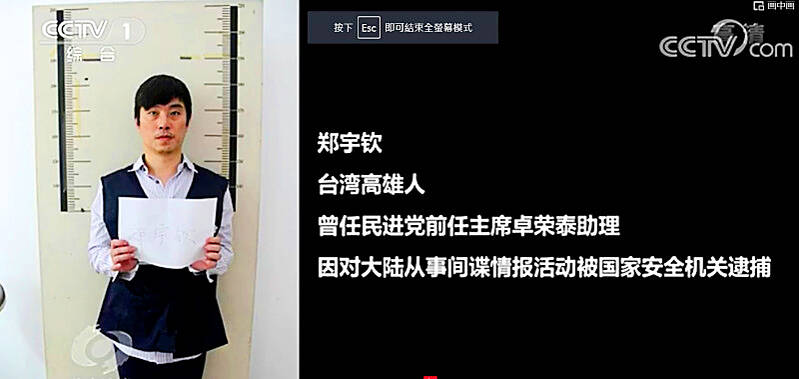
Former Czech Republic-based Taiwanese researcher Cheng Yu-chin (鄭宇欽) has been sentenced to seven years in prison on espionage-related charges, China’s Ministry of State Security announced yesterday. China said Cheng was a spy for Taiwan who “masqueraded as a professor” and that he was previously an assistant to former Cabinet secretary-general Cho Jung-tai (卓榮泰). President-elect William Lai (賴清德) on Wednesday last week announced Cho would be his premier when Lai is inaugurated next month. Today is China’s “National Security Education Day.” The Chinese ministry yesterday released a video online showing arrests over the past 10 years of people alleged to be
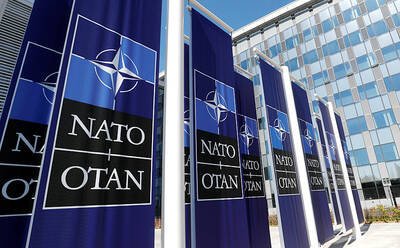
THE HAWAII FACTOR: While a 1965 opinion said an attack on Hawaii would not trigger Article 5, the text of the treaty suggests the state is covered, the report says NATO could be drawn into a conflict in the Taiwan Strait if Chinese forces attacked the US mainland or Hawaii, a NATO Defense College report published on Monday says. The report, written by James Lee, an assistant research fellow at Academia Sinica’s Institute of European and American Studies, states that under certain conditions a Taiwan contingency could trigger Article 5 of NATO, under which an attack against any member of the alliance is considered an attack against all members, necessitating a response. Article 6 of the North Atlantic Treaty specifies that an armed attack in the territory of any member in Europe,
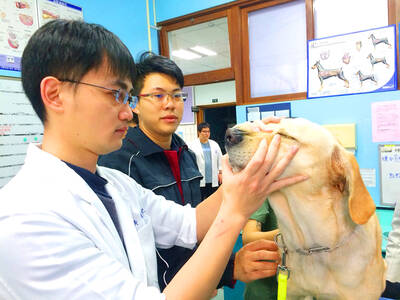
LIKE FAMILY: People now treat dogs and cats as family members. They receive the same medical treatments and tests as humans do, a veterinary association official said The number of pet dogs and cats in Taiwan has officially outnumbered the number of human newborns last year, data from the Ministry of Agriculture’s pet registration information system showed. As of last year, Taiwan had 94,544 registered pet dogs and 137,652 pet cats, the data showed. By contrast, 135,571 babies were born last year. Demand for medical care for pet animals has also risen. As of Feb. 29, there were 5,773 veterinarians in Taiwan, 3,993 of whom were for pet animals, statistics from the Animal and Plant Health Inspection Agency showed. In 2022, the nation had 3,077 pediatricians. As of last

XINJIANG: Officials are conducting a report into amending an existing law or to enact a special law to prohibit goods using forced labor Taiwan is mulling an amendment prohibiting the importation of goods using forced labor, similar to the Uyghur Forced Labor Prevention Act (UFLPA) passed by the US Congress in 2021 that imposed limits on goods produced using forced labor in China’s Xinjiang region. A government official who wished to remain anonymous said yesterday that as the US customs law explicitly prohibits the importation of goods made using forced labor, in 2021 it passed the specialized UFLPA to limit the importation of cotton and other goods from China’s Xinjiang Uyghur region. Taiwan does not have the legal basis to prohibit the importation of goods


 RSS
RSS