


It was 2am. Wu Han-lin (
Wu recalled that moment years later when he won a prize in the Youth Public Participation Awards for helping students in his community in Pingtung City stay away from drugs and violence.
The government-sponsored awards were given out for the first time this year on March 25 at Zhongshan Hall in Taipei, to a student and non-student in five categories.

PHOTO: LO PEI-DER, TAIPEI TIMES
Wu, who won in the non-student community action category, once lived a life bordering on juvenile delinquency. Now, his behavior has changed so much that he plays an active role in helping students in his hometown community.
With tears in his eyes, Wu said that he never expected that a "bad kid" like him would win such an honor.
Wu comes from a family of five and his high school years were rife with booze, drugs, fights and gambling.
He did not like school and enjoyed hanging out with his buddies. They joined the "Eight Generals" troupe organized by a local temple.
Such troupes are a form of temple-procession art that combine self-flagellation with martial arts and dance. Members traditionally acted as religious policemen entrusted with the task of arresting evil spirits. In recent years, however, many of the groups have been taken over by gangs and now attract tattooed, teenage gangster wannabes.
Drinking, smoking and doing drugs were common activities for troupe members, Wu said.
Amphetamines were popular and cheap at that time and easy to get. Wu first tried drugs when he was 12.
"We were hiding at a deserted campus snack bar. I was so high that I couldn't sleep that night, but I was like a flattened balloon when the drugs faded," he said. "I slept like a log afterwards and couldn't get up to go to school the next morning."
Wu said that he did not particularly like drugs, but was afraid that others would think that he was a coward if he didn't take them.
The gambling ring and pool hall were among his favorite hangout places. Wu gambled away the money he won from billiard games.
Wu bid good-bye to his stormy adolescence at the age of 18 when his mother died of uterine cancer and his father sent him into the military.
A couple years later, after he got out of the military, his life took a dramatic turn when Chiang Jia-huang (
"At first, I thought it was a good way to release my energy, but later I found out that it was great to be able to do something for other people," he said. "What really changed me was when he told me that people had to make themselves useful for others. It suddenly hit me that I used to be a useless person. How can I make myself useful?"
Wu, now the director of the association, leads members to collect recyclables and sell them to raise funds for community scholarships. The association also offers after-class assistance to students.
Traumatic past
Lu Li-wei (
"When he didn't have money to buy alcohol or when he was drunk, we knew we would be in big trouble," Lu said.
Lu said that one autumn day, his unemployed father was so drunk that he chased them with a knife. Lu's mother was once beaten by his father so badly that she had to get 12 stitches on her head.
Lu was very shy and did not feel comfortable talking to people until the fifth grade, one year after his father died of liver diseases caused by alcohol abuse. He first began volunteering at a hospital near his home seven years ago, after his mother encouraged him to spend his free time caring for hospital patients.
The 18-year-old Lu still works part-time in the emergency ward and hopes to become an art therapist helping needy people in remote areas.
He is still emotional when talking about his late father, but he said he is gradually coming to terms with his traumatic past.
Big difference
When Hsu Hsiao-wei (
In addition to cleaning the school, participants also tidy up public roads and beaches, collect recyclables and visit senior citizens' homes, orphanages and physically disabled people.
Hsu, who won an award in the non-student volunteer service category, said that she had not expected "fools" like them to win the award.
Inspired by Jane Goodall, a British primatologist who came to the school in 2002 and last year, Hsu said that people must be taught to help and care for others.
"I think it is a very serious thing if students have a technological brain but lack a compassionate heart," the 32-year-old civics teacher said.
Like most high school students elsewhere in Taiwan, Hsu's students are preoccupied with their heavy school workload. To encourage them to participate in volunteer work, Hsu gives them generous "bonus points" as an incentive.
"It doesn't matter whether they do it for 24 hours or 20 minutes, I want them to know that their small contribution makes a big difference," she said.

THE HAWAII FACTOR: While a 1965 opinion said an attack on Hawaii would not trigger Article 5, the text of the treaty suggests the state is covered, the report says NATO could be drawn into a conflict in the Taiwan Strait if Chinese forces attacked the US mainland or Hawaii, a NATO Defense College report published on Monday says. The report, written by James Lee, an assistant research fellow at Academia Sinica’s Institute of European and American Studies, states that under certain conditions a Taiwan contingency could trigger Article 5 of NATO, under which an attack against any member of the alliance is considered an attack against all members, necessitating a response. Article 6 of the North Atlantic Treaty specifies that an armed attack in the territory of any member in Europe,
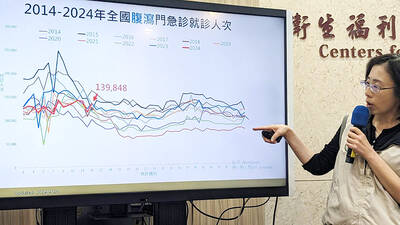
FLU SEASON: Twenty-six severe cases were reported from Tuesday last week to Monday, including a seven-year-old girl diagnosed with influenza-associated encephalopathy Nearly 140,000 people sought medical assistance for diarrhea last week, the Centers for Disease Control (CDC) said on Tuesday. From April 7 to Saturday last week, 139,848 people sought medical help for diarrhea-related illness, a 15.7 percent increase from last week’s 120,868 reports, CDC Epidemic Intelligence Center Deputy Director Lee Chia-lin (李佳琳) said. The number of people who reported diarrhea-related illness last week was the fourth highest in the same time period over the past decade, Lee said. Over the past four weeks, 203 mass illness cases had been reported, nearly four times higher than the 54 cases documented in the same period
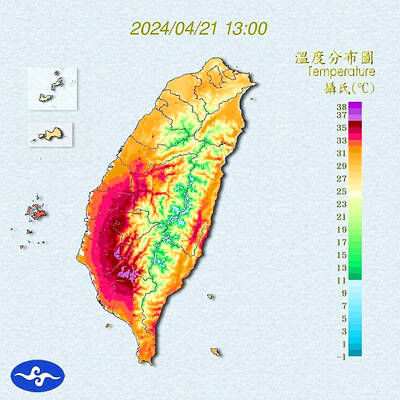
Heat advisories were in effect for nine administrative regions yesterday afternoon as warm southwesterly winds pushed temperatures above 38°C in parts of southern Taiwan, the Central Weather Administration (CWA) said. As of 3:30pm yesterday, Tainan’s Yujing District (玉井) had recorded the day’s highest temperature of 39.7°C, though the measurement will not be included in Taiwan’s official heat records since Yujing is an automatic rather than manually operated weather station, the CWA said. Highs recorded in other areas were 38.7°C in Kaohsiung’s Neimen District (內門), 38.2°C in Chiayi City and 38.1°C in Pingtung’s Sandimen Township (三地門), CWA data showed. The spell of scorching
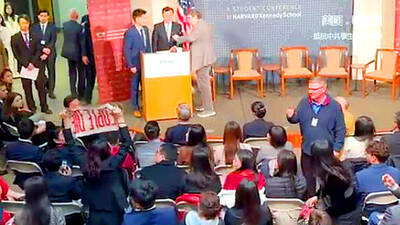
A group of Taiwanese-American and Tibetan-American students at Harvard University on Saturday disrupted Chinese Ambassador to the US Xie Feng’s (謝鋒) speech at the school, accusing him of being responsible for numerous human rights violations. Four students — two Taiwanese Americans and two from Tibet — held up banners inside a conference hall where Xie was delivering a speech at the opening ceremony of the Harvard Kennedy School China Conference 2024. In a video clip provided by the Coalition of Students Resisting the CCP (Chinese Communist Party), Taiwanese-American Cosette Wu (吳亭樺) and Tibetan-American Tsering Yangchen are seen holding banners that together read:


 RSS
RSS