


There will never be a military conflict in the Taiwan Strait and it is a mistake for the US government to think that maintaining the "status quo" is the only way to handle the Taiwan issue, Senior Adviser to the President Koo Kuan-min (
"China will not attack Taiwan because it needs five to 10 years of peace to develop itself into an economic and military power so it can dominate the Asian region," Koo said.
Although a military confrontation is likely given the volatile state of cross-strait affairs, there won't be war in the Taiwan Strait because China would not want to drive away foreign investors and risk an economic collapse, Koo said.

PHOTO: LO PEI-DER, TAIPEI TIMES
If, unfortunately, the worst-case scenario happens, Koo said, "I would welcome it."
"Taiwan's biggest crisis is there is no national consensus on the nation's future under China's military threat," he said.
"But if China were to launch a military attack against Taiwan, a consensus would be formed within a week," Koo said.
That was Koo's answer to US officials at the National Security Council, who asked his opinion on the possibility of war in the Taiwan Strait, when he visited Washington in 1995.
Koo visited Washington again last October to discuss the issue of maintaining the "status quo" in the Taiwan Strait with council officials. The 80-year-old Koo said that he told them he might not live another 10 years to see his theory proven true, but it was time to review the "status quo" and "four nos and one not" pledge President Chen Shui-bian (陳水扁) made in his first inaugural address in 2000.
"The gravity of the `status quo' has shifted to China over the past years. The US government understands that it must redefine the 'status quo' in the Taiwan Strait," he said. "That is why they are willing to compromise on the National Unification Council (NUC) controversy."
The reason that the US government wanted Chen to reiterate the "four nos and one not" promise was because the US government believed the Taiwan issue can only be handled by maintaining the "status quo."
NUC controversy
A top go-between in the NUC controversy, Koo said that the page on the NUC controversy was closed and the US government had found the results acceptable.
While Chinese Nationalist Party (KMT) Chairman Ma Ying-jeou (
"It is impossible for two countries to share the same interest 100 percent," he said. "Sometimes ambiguity is necessary to make both parties happy and benefit from it."
Koo admitted that he is worried about US-Taiwan relations because the DPP administration did not begin interacting with the US government until it came to power in 2000.
In light of the lack of diplomatic ties, Koo proposed that the administration take advantage of the private sector.
"I told the president after the matter [NUC controversy] was over that we are very fortunate that things didn't get out of hand," he said. "But we have to more aggressively communicate with the US government."
If it were not for the personal connections established between private individuals and US officials, Koo said that the matter would not have ended smoothly.
Koo called on the US government to establish an official communication channel with the Democratic Progressive Party administration, including regular meetings between high-level US and Taiwanese officials.
Koo called Ma "absurd" for blaming Taiwan's shrinking international presence on the NUC controversy, saying that Ma should have criticized Beijing's "Anti-Secession" Law rather than denounced the president.
Ceasing the function of the NUC and the application of the unification guidelines was the most peaceful and cost-effective means to obtain the best political effect in countering the Anti-Secession Law, Koo said.
It is true that some US officials and think tanks, whom Koo de-scribed as the "red team," opposed the idea of ceasing the function of the NUC, but Koo said that they represented neither the US government nor the international community.
Taiwan's sovereignty
While Ma argues that Taiwan is already an independent state and does not need to declare independence again, Koo dismissed this perspective as "naive." Koo said that even though over 90 percent of Taiwanese recognize Taiwan as an independent state, the problem lay in the fact that Taiwan was not a completely independent, sovereign country.
What the public wants to know is how this situation can be remedied to make Taiwan a genuinely normal and independent country.
Koo also dismissed Ma's argument that the pro-independence force was a reaction to China, saying it was but a natural and inevitable development for an immigrant society like Taiwan to want to be free of a traditional society like China.
"The KMT used to be a security force, but now it, together with its political ally, the People First Party, has become a dangerous force," he said.
A private group recently argued that Taiwanese sovereignty lies in the hands of the US and that if the US yields on the issue, Taiwan will be an independent country.
Commenting on the theory, Koo said that it was a warranted theory based on the US' War Law, and it was the same theory used by former US secretary of state Colin Powell when he said that Taiwan did not enjoy sovereignty.
However, it is not an easy task to resolve Taiwan's sovereignty problem with some 60-year-old legislation, considering the many changes that have taken place in the Taiwan Strait over the years, he said.
Describing the overly rosy coverage by pro-unification newspapers of Ma's just-concluded US trip as "impractical," Koo dismissed media speculation that the US government's arrangement for Ma to meet with high-level officials, including Deputy Secretary of State Robert Zoellick, was a deliberate move to embarrass Chen.
"I saw then-US deputy secretary of state Richard Armitage when I visited Washington in October 2003. What does that make me?" Koo said.
Koo said that he told Armitage during the meeting that he had three wishes. First was to see Taiwan's representative office in the US become "Taiwan Institute in America" (TIA), as opposed to the American Institute in Taiwan (AIT).
For the US government, the name change is a small favor, but for Taiwan, Koo said, it was an important matter. Judging from the US government's understanding of Taiwan's current situation, Koo said that this should be achievable.
Second, Koo said that he would like to see the US government stop serving as Beijing's hit man in supressing Taiwan because such a strategy was bound to incite anti-US sentiment among the Taiwanese.
When Koo placed full-page advertisements in the Washington Post and the New York Times calling on the US to abandon its "one China" policy in 2004, he said that he privately received positive responses from US President George W. Bush's administration officials.
Third, Koo said that he jokingly asked Armitage whether he would be invited to Bush's re-election party.
Three possibilities
Koo also criticized Ma for his lack of a political stand by describing the "Republic of Taiwan" as China's main enemy and the "Republic of China" as its minor enemy.
"I don't know whether he's speaking on behalf of Taiwan or Beijing," Koo said.
On the issue of the deadlock over Taiwan's sovereignty in cross-strait negotiations, Koo said the administration might want to address the problem from a different perspective: brotherhood.
If both sides see each other as members of a family, Koo said that Taiwan will be proud of its big brother's success and China will likewise be proud of its little brother's achievements.
China's hard and soft strategies, including military intimidation and the enactment of the Anti-Secession Law, have proved to be a failure and only created backlash among the Taiwanese.
Before Taiwan sits down and talks with China, Koo said that the administration had to make clear its requests and bottomline.
"If I were the president, I would ask China to accept Taiwan as a nation and help Taiwan join the UN. That is the bottomline," he said. "Of course, there's a large gap between Taiwan's and China's bottomline of `one country, two systems,' but that is why we have to talk and find a solution based on the principle of brotherhood."
Koo said that China would only be willing to talk with Taiwan under three circumstances.
First, Taiwan enacts a new constitution, changes the national title and declares independence in one or two years. Second, the US recognizes Taiwan as a country. And third, China is so overwhelmed with its internal problems and turmoil that it wishes to swiftly resolve the Taiwan problem.
Any other circumstance other than these three would merely be wishful thinking, Koo said.
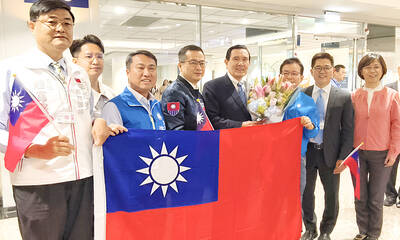
Former president Ma Ying-jeou’s (馬英九) mention of Taiwan’s official name during a meeting with Chinese President Xi Jinping (習近平) on Wednesday was likely a deliberate political play, academics said. “As I see it, it was intentional,” National Chengchi University Graduate Institute of East Asian Studies professor Wang Hsin-hsien (王信賢) said of Ma’s initial use of the “Republic of China” (ROC) to refer to the wider concept of “the Chinese nation.” Ma quickly corrected himself, and his office later described his use of the two similar-sounding yet politically distinct terms as “purely a gaffe.” Given Ma was reading from a script, the supposed slipup
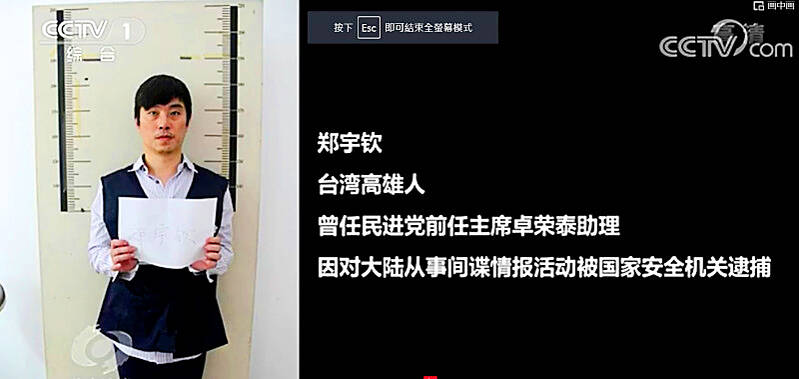
Former Czech Republic-based Taiwanese researcher Cheng Yu-chin (鄭宇欽) has been sentenced to seven years in prison on espionage-related charges, China’s Ministry of State Security announced yesterday. China said Cheng was a spy for Taiwan who “masqueraded as a professor” and that he was previously an assistant to former Cabinet secretary-general Cho Jung-tai (卓榮泰). President-elect William Lai (賴清德) on Wednesday last week announced Cho would be his premier when Lai is inaugurated next month. Today is China’s “National Security Education Day.” The Chinese ministry yesterday released a video online showing arrests over the past 10 years of people alleged to be
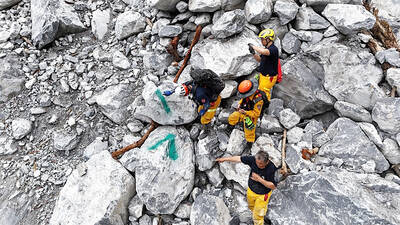
The bodies of two individuals were recovered and three additional bodies were discovered on the Shakadang Trail (砂卡礑) in Taroko National Park, eight days after the devastating earthquake in Hualien County, search-and-rescue personnel said. The rescuers reported that they retrieved the bodies of a man and a girl, suspected to be the father and daughter from the Yu (游) family, 500m from the entrance of the trail on Wednesday. The rescue team added that despite the discovery of the two bodies on Friday last week, they had been unable to retrieve them until Wednesday due to the heavy equipment needed to lift
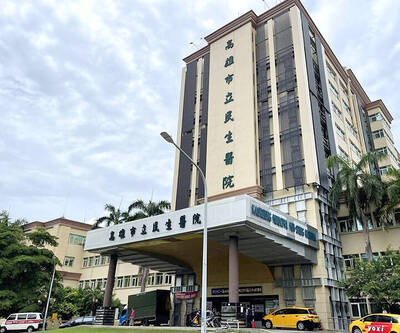
MIX-UP: Kaohsiung Municipal Min-Sheng Hospital director Yen Chia-chi was suspended from his duties after surgeons operated on the wrong patient last week The Kaohsiung Department of Health yesterday fined Kaohsiung Municipal Min-Sheng Hospital NT$500,0000 for misidentifying two patients and consequently causing one of them to undergo the wrong surgery last week. The hospital’s director Yen Chia-chi (顏家祺) was suspended from his duties. The surgeon who was scheduled to operate on the patient was given a major demerit and is subject to subsequent disciplinary actions. Demerits were given to the anesthesiologist, the nurse in the operation room, the nurse in the ward and the worker who helped transfer the patient from the ward to the operation room for having failed to verify the patient’s identity. Meanwhile, the


 RSS
RSS