


Mainland Affairs Council (MAC) Chairman Joseph Wu (吳釗燮) yesterday said Chinese Nationalist Party (KMT) Chairman Ma Ying-jeou's (馬英九) modus vivendi proposal was "passe" and "impractical," as long as Beijing refuses to forsake the "one China" principle.
"I think it's a bit strange for Ma to propose this idea when both China and Taiwan used to oppose it," Wu said yesterday at a press conference.
Wu said the idea of modus vivendi, a temporary agreement before a permanent settlement is reached, was not created by Ma. It was first proposed by the US academic Harry Harding in 1989 and was also similar to an "interim agreement" proposal by Kenneth Lieberthal, another US academic, as a solution for China and Taiwan, he said.
However, regardless of whether it is modus vivendi or an "interim agreement," as long as China sticks to the "one China" principle, plans for a temporary settlement won't work, Wu said.
Wu said that although Ma agreed to a "one China" principle -- which refers to China as the "Republic of China" -- the idea contradicts the guidelines of Beijing's 11th Five-year Plan for National Economic and Social Development, which stipulates that "Taiwan is an inseparable sacred territory of the People's Republic of China."
Under such circumstances, Wu said, "I wonder if Ma thinks there is still room for Taiwan to have its own interpretation of the `one China' principle."
Wu said he doubted that the proposal for a modus vivendi deal would be accepted by the Bush administration, as the idea had first been brought up in the 1990s, but was rejected by the KMT government and China at the time.
Wu said he didn't think the US government was trying to isolate the administration of President Chen Shui-bian (
"I don't think the US government would try to isolate the DPP government by strengthening relations with the opposition party in Taiwan as it is basically against the interests of both the US and Taiwan," he said.

THE HAWAII FACTOR: While a 1965 opinion said an attack on Hawaii would not trigger Article 5, the text of the treaty suggests the state is covered, the report says NATO could be drawn into a conflict in the Taiwan Strait if Chinese forces attacked the US mainland or Hawaii, a NATO Defense College report published on Monday says. The report, written by James Lee, an assistant research fellow at Academia Sinica’s Institute of European and American Studies, states that under certain conditions a Taiwan contingency could trigger Article 5 of NATO, under which an attack against any member of the alliance is considered an attack against all members, necessitating a response. Article 6 of the North Atlantic Treaty specifies that an armed attack in the territory of any member in Europe,
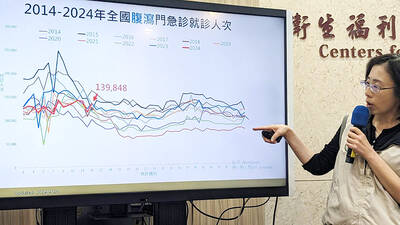
FLU SEASON: Twenty-six severe cases were reported from Tuesday last week to Monday, including a seven-year-old girl diagnosed with influenza-associated encephalopathy Nearly 140,000 people sought medical assistance for diarrhea last week, the Centers for Disease Control (CDC) said on Tuesday. From April 7 to Saturday last week, 139,848 people sought medical help for diarrhea-related illness, a 15.7 percent increase from last week’s 120,868 reports, CDC Epidemic Intelligence Center Deputy Director Lee Chia-lin (李佳琳) said. The number of people who reported diarrhea-related illness last week was the fourth highest in the same time period over the past decade, Lee said. Over the past four weeks, 203 mass illness cases had been reported, nearly four times higher than the 54 cases documented in the same period
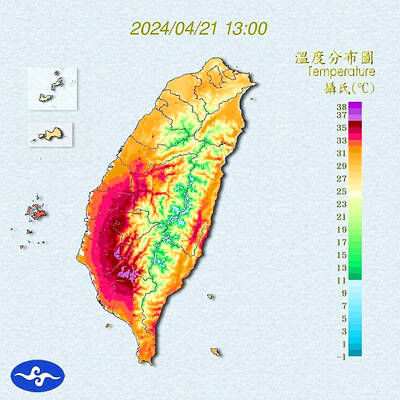
Heat advisories were in effect for nine administrative regions yesterday afternoon as warm southwesterly winds pushed temperatures above 38°C in parts of southern Taiwan, the Central Weather Administration (CWA) said. As of 3:30pm yesterday, Tainan’s Yujing District (玉井) had recorded the day’s highest temperature of 39.7°C, though the measurement will not be included in Taiwan’s official heat records since Yujing is an automatic rather than manually operated weather station, the CWA said. Highs recorded in other areas were 38.7°C in Kaohsiung’s Neimen District (內門), 38.2°C in Chiayi City and 38.1°C in Pingtung’s Sandimen Township (三地門), CWA data showed. The spell of scorching
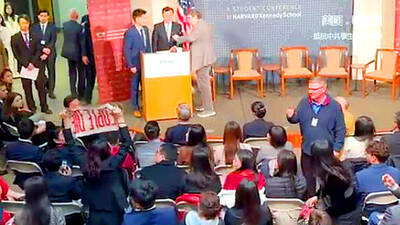
A group of Taiwanese-American and Tibetan-American students at Harvard University on Saturday disrupted Chinese Ambassador to the US Xie Feng’s (謝鋒) speech at the school, accusing him of being responsible for numerous human rights violations. Four students — two Taiwanese Americans and two from Tibet — held up banners inside a conference hall where Xie was delivering a speech at the opening ceremony of the Harvard Kennedy School China Conference 2024. In a video clip provided by the Coalition of Students Resisting the CCP (Chinese Communist Party), Taiwanese-American Cosette Wu (吳亭樺) and Tibetan-American Tsering Yangchen are seen holding banners that together read:


 RSS
RSS