


While the administration is considering whether to ask the legislature to re-examine the just-passed budget plan, political observers yesterday pointed out that even if there is little chance that such a request would be successful, the Democratic Progressive Party (DPP) might want to go ahead as a political gesture.
"The legislature has clearly violated the power of the executive branch by cutting and freezing a record high amount of this year's government budget as well as making irrational legislative resolutions," said Chen Yi-shen (
"It is the government's constitutional right to ask the legislature to re-examine, and hopefully overturn, the passed budget plan," Chen said.
The move would be meaningful in highlighting the political predicament the DPP government has been facing since it came to power six years ago, he added.
The Constitution mandates that if the government wants to overturn a law, treaty or budget plan passed by the legislature that it deems difficult to implement, the Executive Yuan must send a request to the president within 10 days of receiving the written text of the law from the legislature.
If the president agrees with the executive branch, he must then send the request to the legislature. Lawmakers are required to reach a final decision within 15 days of receiving the request.
If lawmakers fail to reach a final decision before the deadline, the passed law or budget automatically becomes invalid.
If more than half of the legislature vetoes the government's request, the premier must accept the law or budget plan, which would then go into effect three days after it is promulgated by the president.
If lawmakers are upset by the Cabinet's attempt to reject a law, treaty or budget plan, they can then call for a no confidence vote against the premier. However, a petition to call such a vote must be endorsed by one-third of lawmakers. Seventy-two hours after the petition is filed, a no-confidence vote must be called within 48 hours.
If more than one-half of the lawmakers vote in favor of the no-confidence motion, the premier must resign within 10 days. He can request that the president dismiss the legislature as a retaliatory measure. If the no-confidence motion fails, lawmakers cannot petition for another no-confidence vote against the same premier within one year.
If the request is filed, it would mark the first time in history that the executive branch has asked the legislature to reconsider a passed budget.
The DPP, however, stands little chance of succeeding unless it can manage to win the support of all independent lawmakers or secure votes from pan-blue lawmakers.
The legislature currently has 220 occupied seats, with the pan-blue coalition of the Chinese Nationalist Party (KMT) and the People First Party (PFP) holding a slim majority of 111 and the ruling DPP and its ally, the Taiwan Solidarity Union (TSU), taking up 100.
There are nine independent lawmakers, with eight belonging to the Non-Partisan Solidarity Union caucus and one acting alone.
If the government eventually decides to file the request, Cabinet Secretary-General and Spokesman Cho Jung-tai (卓榮泰) has hinted that the Cabinet may focus on certain budget items, such as the arms procurement or scientific development.
Even though the DPP has a lot of problems with the pan-blue camp's domination in the legislature, this is not their only problem, political analyst Hsu Yung-ming (徐永明) said.
"The DPP must address the problem of internal rifts because the Executive Yuan sometimes has its own agenda, which may run counter to that of the DPP caucus," he said.
In addition, problems between the DPP and TSU are expected to surface in the run-up to future elections, including the year-end Taipei and Kaohsiung mayoral elections and next year's legislative elections.
Whether the pan-green camp cooperates in the legislative polls will have a crucial impact on the election outcome, as the pan-blue alliance is also facing the same problem.
Insofar as it is likely that both major parties, the DPP and the KMT, will move toward the political center, the TSU and PFP may benefit, thus counteracting what observers have said will be the negative impact of the new legislative electoral system on smaller parties, Chen said.
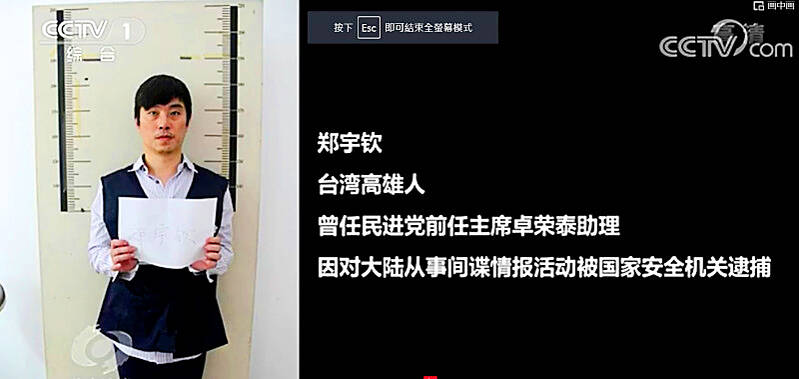
Former Czech Republic-based Taiwanese researcher Cheng Yu-chin (鄭宇欽) has been sentenced to seven years in prison on espionage-related charges, China’s Ministry of State Security announced yesterday. China said Cheng was a spy for Taiwan who “masqueraded as a professor” and that he was previously an assistant to former Cabinet secretary-general Cho Jung-tai (卓榮泰). President-elect William Lai (賴清德) on Wednesday last week announced Cho would be his premier when Lai is inaugurated next month. Today is China’s “National Security Education Day.” The Chinese ministry yesterday released a video online showing arrests over the past 10 years of people alleged to be

THE HAWAII FACTOR: While a 1965 opinion said an attack on Hawaii would not trigger Article 5, the text of the treaty suggests the state is covered, the report says NATO could be drawn into a conflict in the Taiwan Strait if Chinese forces attacked the US mainland or Hawaii, a NATO Defense College report published on Monday says. The report, written by James Lee, an assistant research fellow at Academia Sinica’s Institute of European and American Studies, states that under certain conditions a Taiwan contingency could trigger Article 5 of NATO, under which an attack against any member of the alliance is considered an attack against all members, necessitating a response. Article 6 of the North Atlantic Treaty specifies that an armed attack in the territory of any member in Europe,

LIKE FAMILY: People now treat dogs and cats as family members. They receive the same medical treatments and tests as humans do, a veterinary association official said The number of pet dogs and cats in Taiwan has officially outnumbered the number of human newborns last year, data from the Ministry of Agriculture’s pet registration information system showed. As of last year, Taiwan had 94,544 registered pet dogs and 137,652 pet cats, the data showed. By contrast, 135,571 babies were born last year. Demand for medical care for pet animals has also risen. As of Feb. 29, there were 5,773 veterinarians in Taiwan, 3,993 of whom were for pet animals, statistics from the Animal and Plant Health Inspection Agency showed. In 2022, the nation had 3,077 pediatricians. As of last

XINJIANG: Officials are conducting a report into amending an existing law or to enact a special law to prohibit goods using forced labor Taiwan is mulling an amendment prohibiting the importation of goods using forced labor, similar to the Uyghur Forced Labor Prevention Act (UFLPA) passed by the US Congress in 2021 that imposed limits on goods produced using forced labor in China’s Xinjiang region. A government official who wished to remain anonymous said yesterday that as the US customs law explicitly prohibits the importation of goods made using forced labor, in 2021 it passed the specialized UFLPA to limit the importation of cotton and other goods from China’s Xinjiang Uyghur region. Taiwan does not have the legal basis to prohibit the importation of goods


 RSS
RSS