


A war of words erupted last week about the appropriateness of expanding the nation's submarine force, with some opponents of a proposed arms procurement deal saying subs are offensive weapons, and are therefore inappropriate for Taiwan's defense.
The decision to delay the purchase of PAC-3 Patriot anti-missile batteries until next year and to include P-3C Orion maritime patrol aircraft in the regular defense budget has left the eight diesel-electric submarines -- worth NT$299 billion (US$9 billion) -- the only item included in a special arms budget.
The most recent battle is a result of a Chinese Nationalist Party (KMT) legislator's comments opposing the procurement of the submarines from the US.
Last week, KMT Legislator Su Chi (
"Taiwan should boost its defensive capabilities and aim to survive a `first strike' during a Chinese military attack. It is not necessary to spend huge amounts of money on offensive submarines," Su added.
KMT Legislator John Chiang (蔣孝嚴) last week said that American Institute in Taiwan (AIT) Director Douglas Paal had confirmed that the items and price of the arms procurement budget are adjustable, depending on Taiwan's needs.
Chiang then proposed that Taiwan should not buy the submarines currently included in the arms package, saying their "attack" capabilities are unnecessary and inappropriate for the nation's defense-focused military policy.
The KMT legislators' comments regarding submarines immediately sparked a debate between legislators and military experts.
The Democratic Progressive Party (DPP) then launched a vigorous defense of the submarine purchase.
DPP Legislator Lee Wen-chung (
Advanced submarines have high survival rates in wartime because of their stealthiness underwater, Lee added.
From a tactical point of view, Lee said, a Taiwanese submarine force would be able to blockade and counter-blockade China's ports and sea lanes. Strategically, the submarines "offensive" capabilities would deter China from waging a war against Taiwan because of the huge cost.
Lee calculated, additionally, that because of China's sparse anti-submarine warfare capabilities, Beijing would have to spend around eight times the amount spent on Taiwan's submarine force to build up adequate capabilities, including procuring anti-submarine aircraft, minesweepers, mine-sweeping helicopters, anti-submarine missiles and destroyers. Therefore, the move would distract China from concentrating on its offensive capabilities.
DPP Legislator Shen Fa-hui (沈發惠), a member of the National Defense Committee, last week also published an opinion article in response to Su's comments. He said it was ridiculous for Su and the pan-blue parties to think that Taiwan should boost its anti-missile capabilities, and yet block the procurement of the Patriot batteries.
Even people who are more interested in the military than in politics decided to have their say.
Mei Fu-hsing (
"The nation should seek to take strategic advantage in the Strait," Mei said. He added: "even if Taiwan wants to resume cross-strait talks with China, it should have strategic military power as bargaining leverage."
"A strategic submarine force can increase China's risk, cost and uncertainty of launching a war, and therefore may deter it from starting a war against Taiwan," Mei added.
However, Professor Yu Pen-li (尤本立) of Tamkang University's Graduate Institute of American Studies, last week published an opinion piece in a Chinese-language newspaper criticizing the Minister of National Defense Lee Jye's (李傑) promotion of the expensive submarines, saying it was "patronage," because Lee came from the submarine fleet force.
"While US officials from various departments and think tanks have warned Taiwan of China's military threat and urged the country to make anti-missile capabilities its priority, as a former naval official, Lee still insists on building a submarine force -- the most controversial item in the special arms package," he wrote.
The Minister of National Defense originally designed a NT$480 billion (US$14.5 billion) special budget to buy three Patriot anti-missile batteries, eight diesel-powered submarines and 12 Orion aircraft from the US.
However, facing heavy opposition from the pan-blue camp, it decided to delay the purchase of Patriot missile batteries until next year because the pan-blues have insisted that the referendum held in March 2004 in tandem with the presidential poll was a public "veto" of the purchase.
Pan-blue legislators said that according to the Referendum Law (公民投票法), a referendum that fails to get the number of votes necessary to make a valid result cannot be put to a vote for another three years.
The vast majority of the people who voted in the referendum voted in favor of it.
Therefore, the 12 Orion aircraft included in the regular defense budget have faced less opposition.
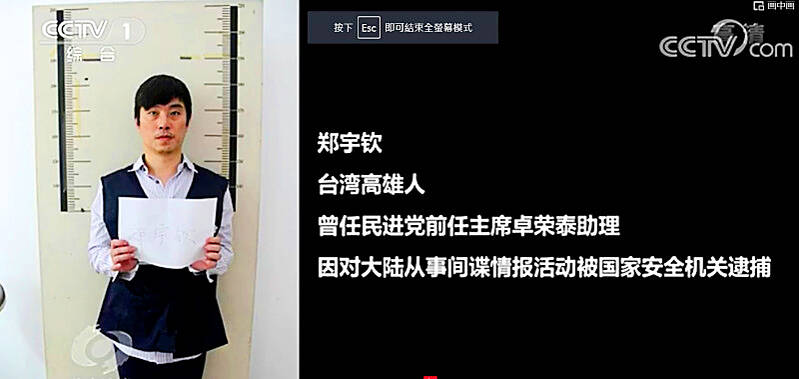
Former Czech Republic-based Taiwanese researcher Cheng Yu-chin (鄭宇欽) has been sentenced to seven years in prison on espionage-related charges, China’s Ministry of State Security announced yesterday. China said Cheng was a spy for Taiwan who “masqueraded as a professor” and that he was previously an assistant to former Cabinet secretary-general Cho Jung-tai (卓榮泰). President-elect William Lai (賴清德) on Wednesday last week announced Cho would be his premier when Lai is inaugurated next month. Today is China’s “National Security Education Day.” The Chinese ministry yesterday released a video online showing arrests over the past 10 years of people alleged to be
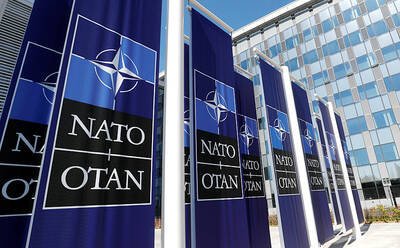
THE HAWAII FACTOR: While a 1965 opinion said an attack on Hawaii would not trigger Article 5, the text of the treaty suggests the state is covered, the report says NATO could be drawn into a conflict in the Taiwan Strait if Chinese forces attacked the US mainland or Hawaii, a NATO Defense College report published on Monday says. The report, written by James Lee, an assistant research fellow at Academia Sinica’s Institute of European and American Studies, states that under certain conditions a Taiwan contingency could trigger Article 5 of NATO, under which an attack against any member of the alliance is considered an attack against all members, necessitating a response. Article 6 of the North Atlantic Treaty specifies that an armed attack in the territory of any member in Europe,

LIKE FAMILY: People now treat dogs and cats as family members. They receive the same medical treatments and tests as humans do, a veterinary association official said The number of pet dogs and cats in Taiwan has officially outnumbered the number of human newborns last year, data from the Ministry of Agriculture’s pet registration information system showed. As of last year, Taiwan had 94,544 registered pet dogs and 137,652 pet cats, the data showed. By contrast, 135,571 babies were born last year. Demand for medical care for pet animals has also risen. As of Feb. 29, there were 5,773 veterinarians in Taiwan, 3,993 of whom were for pet animals, statistics from the Animal and Plant Health Inspection Agency showed. In 2022, the nation had 3,077 pediatricians. As of last
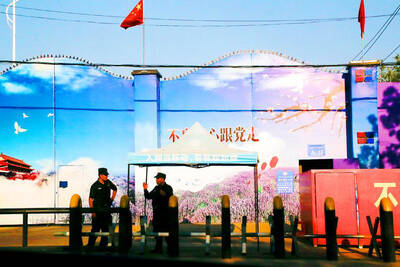
XINJIANG: Officials are conducting a report into amending an existing law or to enact a special law to prohibit goods using forced labor Taiwan is mulling an amendment prohibiting the importation of goods using forced labor, similar to the Uyghur Forced Labor Prevention Act (UFLPA) passed by the US Congress in 2021 that imposed limits on goods produced using forced labor in China’s Xinjiang region. A government official who wished to remain anonymous said yesterday that as the US customs law explicitly prohibits the importation of goods made using forced labor, in 2021 it passed the specialized UFLPA to limit the importation of cotton and other goods from China’s Xinjiang Uyghur region. Taiwan does not have the legal basis to prohibit the importation of goods


 RSS
RSS