


Chinese Nationalist Party (KMT) Chairman Ma Ying-jeou (
Ma made the proposal late Thursday night during an interview with the Chinese-language United Daily News, saying that his party would take the initiative in amending the Statute Governing the Relations Between the People of the Taiwan Area and the Mainland Area (
But he changed his tune yesterday, and denied coming up with the proposal.

PHOTO: SEAN CHAO, TAIPEI TIMES
"I did not say the KMT will take the initiative, but we will push for the amendment, and the reason I brought up the issue was because of some suggestions from experts," he said yesterday morning.
Ma later repeated that the proposal was merely one option for improving the country's economy, and criticized the Democratic Progressive Party (DPP) for ignoring public opinion.
"Most people support direct air links, especially the business sector," he said yesterday afternoon at Taipei City Hall. "But the government just can't figure out its policy priorities, and it pushes for constitutional re-engineering when what people want is a better economy."
While stressing that there are legal and safety concerns surrounding direct air links and that referendums should never be used as a tool for shifting government policies, Ma said that a referendum could be a way to reflect public opinion when the government fails to respond to decisions made in the legislature.
Legislative Speaker Wang Jin-pyng (
Responding to Ma's pressure on the government to implement cross-strait direct links, Mainland Affairs Council (MAC) Chairman Joseph Wu (
Wu said that Ma should urge China, which he said has been refusing to talk with the government on the matter, to enter negotiations with Taiwan.
"Not pushing China to talk to Taiwan, but only exerting pressure on the government, is putting the cart before the horse," Wu said at a MAC press conference yesterday.
Wu said that the government's stated policy was to implement cross-strait direct links, a fact proven by the government's white paper on cross-strait direct links released on Aug. 15, 2003.
Wu said the government welcomed the mechanism of referendums to settle any controversial issues within the nation, including the issue of direct links.
Wu, however, said the obstacles to implementing direct links were on the Chinese side, not on Taiwan's side.
The main issue is negotiation of aviation rights, as there are no direct routes between Taiwan and China, Wu said.
"How can the new routes be decided without bilateral negotiations?" Wu said.
Meanwhile, the KMT caucus yesterday said direct links between Taiwan and China must be implemented as soon as possible.
"The interruption across the Taiwan Strait has slowed down the growth of Taiwan's economy. The KMT will seek public support directly to promote direct links between Taiwan and China," said KMT Legislator Tseng Yung-chuan (
KMT Legislator Lai Shyh-bao (賴士葆) said the latest statistics show that there were some 3.5 million frequent travelers between Taiwan and China every year.
"We would be able to help these 3.5 million Taiwanese travelers save at least NT$35 billion [US$1 billion]," he said.
Taiwan Solidarity Union Legislator Lo Chih-ming (羅志明) sarcastically suggested that President Chen Shui-bian (
"At least, I think Ma is an ideal candidate for the chairmanship of the Mainland Affairs Council," Lo said.
Additional reporting by Jimmy Chuang
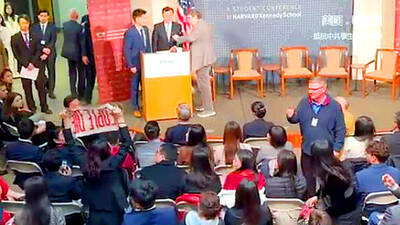
A group of Taiwanese-American and Tibetan-American students at Harvard University on Saturday disrupted Chinese Ambassador to the US Xie Feng’s (謝鋒) speech at the school, accusing him of being responsible for numerous human rights violations. Four students — two Taiwanese Americans and two from Tibet — held up banners inside a conference hall where Xie was delivering a speech at the opening ceremony of the Harvard Kennedy School China Conference 2024. In a video clip provided by the Coalition of Students Resisting the CCP (Chinese Communist Party), Taiwanese-American Cosette Wu (吳亭樺) and Tibetan-American Tsering Yangchen are seen holding banners that together read:

UNAWARE: Many people sit for long hours every day and eat unhealthy foods, putting them at greater risk of developing one of the ‘three highs,’ an expert said More than 30 percent of adults aged 40 or older who underwent a government-funded health exam were unaware they had at least one of the “three highs” — high blood pressure, high blood lipids or high blood sugar, the Health Promotion Administration (HPA) said yesterday. Among adults aged 40 or older who said they did not have any of the “three highs” before taking the health exam, more than 30 percent were found to have at least one of them, Adult Preventive Health Examination Service data from 2022 showed. People with long-term medical conditions such as hypertension or diabetes usually do not
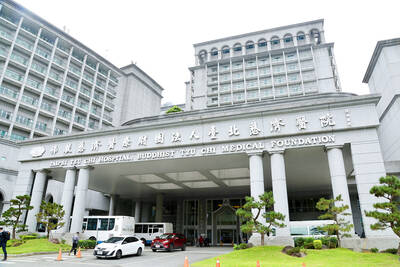
POLICE INVESTIGATING: A man said he quit his job as a nurse at Taipei Tzu Chi Hospital as he had been ‘disgusted’ by the behavior of his colleagues A man yesterday morning wrote online that he had witnessed nurses taking photographs and touching anesthetized patients inappropriately in Taipei Tzu Chi Hospital’s operating theaters. The man surnamed Huang (黃) wrote on the Professional Technology Temple bulletin board that during his six-month stint as a nurse at the hospital, he had seen nurses taking pictures of patients, including of their private parts, after they were anesthetized. Some nurses had also touched patients inappropriately and children were among those photographed, he said. Huang said this “disgusted” him “so much” that “he felt the need to reveal these unethical acts in the operating theater
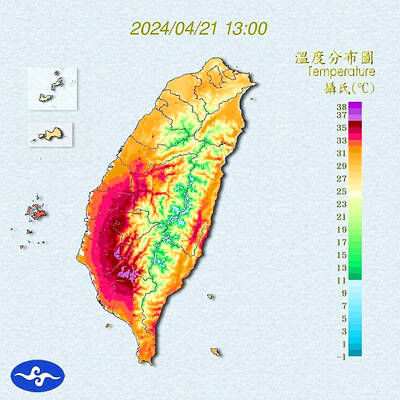
Heat advisories were in effect for nine administrative regions yesterday afternoon as warm southwesterly winds pushed temperatures above 38°C in parts of southern Taiwan, the Central Weather Administration (CWA) said. As of 3:30pm yesterday, Tainan’s Yujing District (玉井) had recorded the day’s highest temperature of 39.7°C, though the measurement will not be included in Taiwan’s official heat records since Yujing is an automatic rather than manually operated weather station, the CWA said. Highs recorded in other areas were 38.7°C in Kaohsiung’s Neimen District (內門), 38.2°C in Chiayi City and 38.1°C in Pingtung’s Sandimen Township (三地門), CWA data showed. The spell of scorching


 RSS
RSS