


The recent murders in Hualien County of two school dropouts, aged 12 and 15, whose disappearances weren't even noticed for three days, has drawn attention to a marginalized part of society.
Youth advocates and counselors say that all too often, dropouts are the product of broken homes, and become easily involved in crime and other self-destructive behavior -- and for those reasons, more must be done to help this vulnerable group.
Statistics from the Ministry of Education (MOE) for last year showed that there were 8,168 school dropouts. Out of this figure, 17.36 percent were primary school age.
In Taiwan, where education is only compulsory through the end of junior high, most school dropouts have similar backgrounds, involving dysfunctional homes.
"While we don't want to stigmatize school dropouts, a significant proportion of school dropouts at the foundation come from families who are on the less functional side," said Viviane Tien (田慧群), Vice Executive Director of the Tosun Public Interests foundation, a nonprofit organization that helps school dropouts and addresses youth issues.
Statistics from the foundation show that 74 percent of school dropouts receiving help from the foundation have parents who are divorced, and 67 percent had an upbringing in which they were left to their own devices.
According to a woman surnamed Hsu who has been a junior high counselor for more than 40 years, it is this lack of parental guidance that leads to typical behavioral patterns causing students to drop out of school. Such behaviors include an inability to keep up with schoolwork, tense relationships with teachers and peers and behavioral problems.
"When they get into trouble, no one at home knows about it or helps them out, and in the eyes of the teacher they become troublemakers," she said.
One young person the foundation is helping, a fifteen-year-old school dropout nicknamed Fanta, is an example. He comes from a single parent family, and grew up with his grandparents as his primary caregivers.
Explaining why he dropped out of school, Fanta said, "I wasn't keeping up with lessons at school, I was always behind. I didn't get on with my classmates and I wasn't getting any help from the teachers."
According to Hsu the ability to handle work is a skill which needs to be nurtured consistently starting at a young age.
"But most school dropouts didn't have someone by their side to guide them as children. Of course they won't be able to keep up with their schoolwork in junior high," she said.
For these students, whose academic ability is already limited, the traditional focus on science and math further adds to their difficulties.
The result was that students tried to "escape reality" by leaving school, Hsu said. But once they leave school, the outlook for many school dropouts remains grim.
"To earn a livelihood, they need to work, yet it is not often easy for them to find work. What's more, they are not at the stage where they can claim benefits from the government. In desperation some girls may end up in illegal trades, when they happen to meet with employers who don't care about their age," Tien said.
Stories of turning to crime are also common.
"Being largely misunderstood and having little family support, they often get involved with gangs, who they are able to relate to because of sharing similar backgrounds. Consequently they are negatively influenced and get involved in crime," Tien said.
Hsu said that one reason why schools aren't able to intervene more in cases where students drop out was that teachers are so busy.
"There are over 30 students in a class to look after. It's a case of having the intention but not the resources," Hsu said.
What's more, Hsu said that often, these students were very hard to reach out to because many had already "given up on themselves."
Speaking of a student who Hsu had offered to counsel, Hsu said, "The student told me not to waste my time on her, but to help someone who could be helped."
Hsu said that society was wrong to look to schools to provide the answers for deeply-rooted problems.
"The problems were built up over years and years. Do you think it's possible to solve them in such a short period of time?" Hsu said. "The majority of the responsibility should be given to the family."
Tien also agreed that increased family support was important, saying that "parents need to believe in their children and not give up on them."
"These kids are the same as any other kids. They are still very innocent, it's just that they lacked proper guidance and support. Instead of stigmatizing these children, we need to reach out to them," she said.
Director of the Tosun Foundation Liao Cheng-hao (廖正豪) said, "Just because these kids may not be suited to traditional methods of education, doesn't mean they can't be a success in life. Look at Bill Gates, he didn't complete his university education."
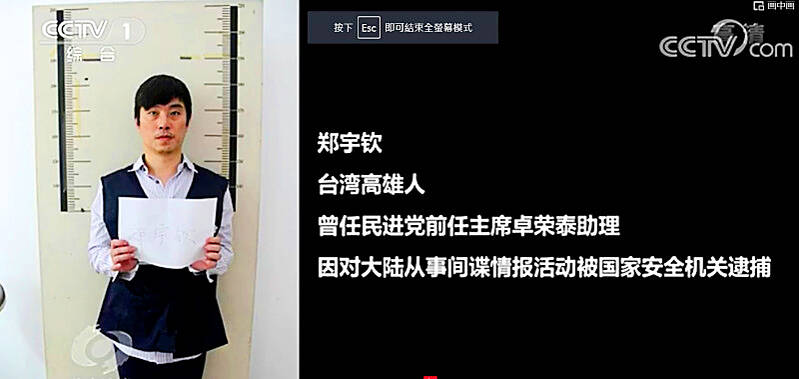
Former Czech Republic-based Taiwanese researcher Cheng Yu-chin (鄭宇欽) has been sentenced to seven years in prison on espionage-related charges, China’s Ministry of State Security announced yesterday. China said Cheng was a spy for Taiwan who “masqueraded as a professor” and that he was previously an assistant to former Cabinet secretary-general Cho Jung-tai (卓榮泰). President-elect William Lai (賴清德) on Wednesday last week announced Cho would be his premier when Lai is inaugurated next month. Today is China’s “National Security Education Day.” The Chinese ministry yesterday released a video online showing arrests over the past 10 years of people alleged to be

THE HAWAII FACTOR: While a 1965 opinion said an attack on Hawaii would not trigger Article 5, the text of the treaty suggests the state is covered, the report says NATO could be drawn into a conflict in the Taiwan Strait if Chinese forces attacked the US mainland or Hawaii, a NATO Defense College report published on Monday says. The report, written by James Lee, an assistant research fellow at Academia Sinica’s Institute of European and American Studies, states that under certain conditions a Taiwan contingency could trigger Article 5 of NATO, under which an attack against any member of the alliance is considered an attack against all members, necessitating a response. Article 6 of the North Atlantic Treaty specifies that an armed attack in the territory of any member in Europe,
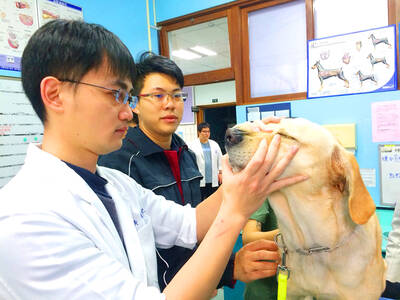
LIKE FAMILY: People now treat dogs and cats as family members. They receive the same medical treatments and tests as humans do, a veterinary association official said The number of pet dogs and cats in Taiwan has officially outnumbered the number of human newborns last year, data from the Ministry of Agriculture’s pet registration information system showed. As of last year, Taiwan had 94,544 registered pet dogs and 137,652 pet cats, the data showed. By contrast, 135,571 babies were born last year. Demand for medical care for pet animals has also risen. As of Feb. 29, there were 5,773 veterinarians in Taiwan, 3,993 of whom were for pet animals, statistics from the Animal and Plant Health Inspection Agency showed. In 2022, the nation had 3,077 pediatricians. As of last
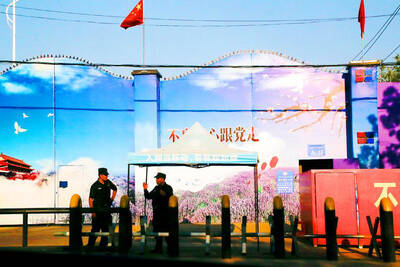
XINJIANG: Officials are conducting a report into amending an existing law or to enact a special law to prohibit goods using forced labor Taiwan is mulling an amendment prohibiting the importation of goods using forced labor, similar to the Uyghur Forced Labor Prevention Act (UFLPA) passed by the US Congress in 2021 that imposed limits on goods produced using forced labor in China’s Xinjiang region. A government official who wished to remain anonymous said yesterday that as the US customs law explicitly prohibits the importation of goods made using forced labor, in 2021 it passed the specialized UFLPA to limit the importation of cotton and other goods from China’s Xinjiang Uyghur region. Taiwan does not have the legal basis to prohibit the importation of goods


 RSS
RSS