


Taipei 101 is a building with a lot to boast about. Standing 508m high, it is the world's tallest. And at 700,000 tonnes, it must be among the heaviest.
But the sheer size of the skyscraper has raised unexpected concerns that may have far-reaching implications for the construction of other buildings and man-made megastructures.
Taipei 101 is thought to have triggered two recent earthquakes because of the stress that it exerts on the ground beneath it.
According to geologist Lin Cheng-horng (
If he is right, then it raises concerns about proposals such as Sky City 1000 in Japan, the vertical city that has been proposed to solve Tokyo's housing problems. And it is not just skyscrapers that are a problem. Dams and underground waste deposits may also cause rumblings if they become too large.
Before the construction of Taipei 101, the Taipei basin was a very stable area with no active earthquake faults at the surface. Its earthquake activity involved micro-earthquakes (less than magnitude 2) happening about once a year.
However, once Taipei 101 started to rise from the ground, things changed.
"The number of earthquakes increased to around two micro-earthquakes per year during the construction period [1997 to 2003]. Since the construction finished there have been two larger earthquakes [magnitude 3.8 and 3.2] directly beneath Taipei 101, which were big enough to feel," Lin says in his paper, published in the journal Geophysical Research Letters.
Using the construction information, Lin has calculated how much pressure Taipei 101 exerts on the ground. The weight of steel and concrete came to more than 700,000 tonnes. This is spread over an area of 15,081m2, meaning that it exerts a huge pressure of 4.7 bars on the ground below.
"The construction of Taipei 101 is totally different to many other high-rise buildings because it used hybrid structures made of both concrete and steel, to give it added protection from earthquakes and fire. Therefore it has a huge vertical loading on its foundation," Lin says.
And it is this exceptional downward stress that Lin thinks may have caused the extra earthquakes.
Other experts are more cautious about blaming the skyscraper for the earthquakes.
"A building will change the stress on the ground under the building, but this probably won't reach down to around 10km, the level where the earthquakes occurred," says John Vidale, an earthquake expert at the University of California in Los Angeles.
Zygmunt Lubkowski, an earthquake analyst for the engineering firm Arup, is concerned at the lack of data.
"Earthquakes occur on time-scales of thousands to millions of years. From just 10 years of earthquake data it is hard to tell if the extra earthquakes are just noise in the signal or due to the building," Lubkowski says.
THE HAWAII FACTOR: While a 1965 opinion said an attack on Hawaii would not trigger Article 5, the text of the treaty suggests the state is covered, the report says NATO could be drawn into a conflict in the Taiwan Strait if Chinese forces attacked the US mainland or Hawaii, a NATO Defense College report published on Monday says. The report, written by James Lee, an assistant research fellow at Academia Sinica’s Institute of European and American Studies, states that under certain conditions a Taiwan contingency could trigger Article 5 of NATO, under which an attack against any member of the alliance is considered an attack against all members, necessitating a response. Article 6 of the North Atlantic Treaty specifies that an armed attack in the territory of any member in Europe,
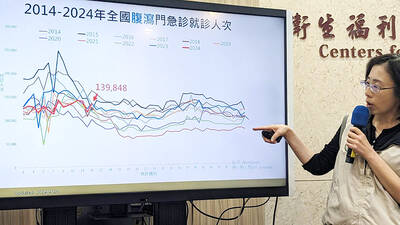
FLU SEASON: Twenty-six severe cases were reported from Tuesday last week to Monday, including a seven-year-old girl diagnosed with influenza-associated encephalopathy Nearly 140,000 people sought medical assistance for diarrhea last week, the Centers for Disease Control (CDC) said on Tuesday. From April 7 to Saturday last week, 139,848 people sought medical help for diarrhea-related illness, a 15.7 percent increase from last week’s 120,868 reports, CDC Epidemic Intelligence Center Deputy Director Lee Chia-lin (李佳琳) said. The number of people who reported diarrhea-related illness last week was the fourth highest in the same time period over the past decade, Lee said. Over the past four weeks, 203 mass illness cases had been reported, nearly four times higher than the 54 cases documented in the same period
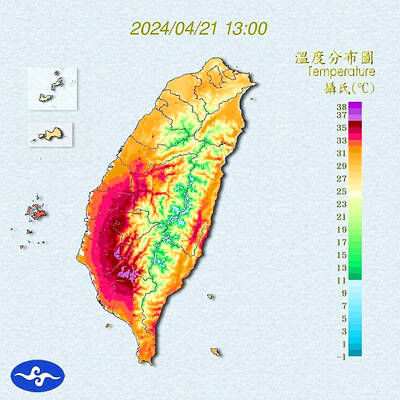
Heat advisories were in effect for nine administrative regions yesterday afternoon as warm southwesterly winds pushed temperatures above 38°C in parts of southern Taiwan, the Central Weather Administration (CWA) said. As of 3:30pm yesterday, Tainan’s Yujing District (玉井) had recorded the day’s highest temperature of 39.7°C, though the measurement will not be included in Taiwan’s official heat records since Yujing is an automatic rather than manually operated weather station, the CWA said. Highs recorded in other areas were 38.7°C in Kaohsiung’s Neimen District (內門), 38.2°C in Chiayi City and 38.1°C in Pingtung’s Sandimen Township (三地門), CWA data showed. The spell of scorching
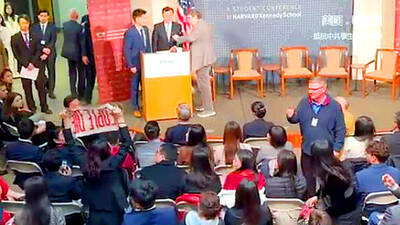
A group of Taiwanese-American and Tibetan-American students at Harvard University on Saturday disrupted Chinese Ambassador to the US Xie Feng’s (謝鋒) speech at the school, accusing him of being responsible for numerous human rights violations. Four students — two Taiwanese Americans and two from Tibet — held up banners inside a conference hall where Xie was delivering a speech at the opening ceremony of the Harvard Kennedy School China Conference 2024. In a video clip provided by the Coalition of Students Resisting the CCP (Chinese Communist Party), Taiwanese-American Cosette Wu (吳亭樺) and Tibetan-American Tsering Yangchen are seen holding banners that together read:


 RSS
RSS