


With the Dec. 3 local elections fast approaching, the Democratic Progressive Party (DPP) legislative caucus yesterday called on the Chinese Nationalist Party (KMT) to stop deflecting public attention and return its dubiously acquired party assets.
Chen Chin-jun (陳景峻), DPP caucus whip, said, "I hope the KMT will stop distracting the public's attention and face up to long-standing issues such as its illegally-gained party assets and party officials counting the years they worked for the KMT as employment in the civil service when calculating pensions."
Chen made the remarks in response to criticism made by the KMT caucus earlier yesterday morning.
KMT caucus whip Pan Wei-kang (潘維剛) used what she called the "five miracle cases" to denounce the DPP government yesterday for ignoring legislative resolutions and circumventing legislative supervision. She also demanded immediate explanations for the five examples that she had outlined.
The first one Pan pointed out was the hike in national health insurance fees. While the legislature passed a resolution on Jan. 27, 2002 stating that national health insurance premiums would not be increased, Pan said that the Executive Yuan raised health insurance fees and patient payments anyway.
The second case was the increase of government investment in the high-speed rail project. Although the legislature passed a resolution on June 20, 2002 banning the government, state-own businesses and their re-investment companies from investing in the Taiwan High-Speed Rail Corp (THSRC), Pan said that the government amended the regulation on Dec. 12, 2002, allowing commercial banks to invest in the THSRC. THSRC also "privately" raised funds of about NT$26.9 billion (US$803 million ) in January two years ago, she said.
The third was the release of Chunghwa Telecom Co's stock. She said that the legislature resolved on June 10 last year and May 27 this year that the government should immediately stop further sales of the company's stock.
However, the government offloaded 135.1 million American Depositary Receipts (ADRs), or a 14 percent stake, to overseas investors, lowering the government's holding in the nation's biggest telecommunications company to less than 50 percent.
The fourth was the merger of state-controlled Taiwan Cooperative Bank and the Farmers Bank of China, she said. The government announced on Nov. 9 that it would forge ahead with the merger plan, in contradiction of a motion that was filed by the legislature's finance committee.
The motion demanded that the controversial second stage of financial reforms be halted, the government stop releasing, swapping or transferring its stocks in state-owned financial institutions until Vice Premier Wu Rong-yi (吳榮義), who was commissioned to oversee the reform of the banking sector, comes to the committee meeting to defend the policies.
Finally, the Examination Yuan on Thursday voted in favor of a reform plan of the 18 percent preferential interest rate scheme given to civil servants, teachers and military personnel. Pan argued that the DPP government was trying to circumvent the legislature's supervision by regulating the pension plan with an executive order.
In response, Chen criticized the KMT for whistling a well-worn tune, and reiterated that the DPP is a law-abiding administration that does everything in accordance with the rules.
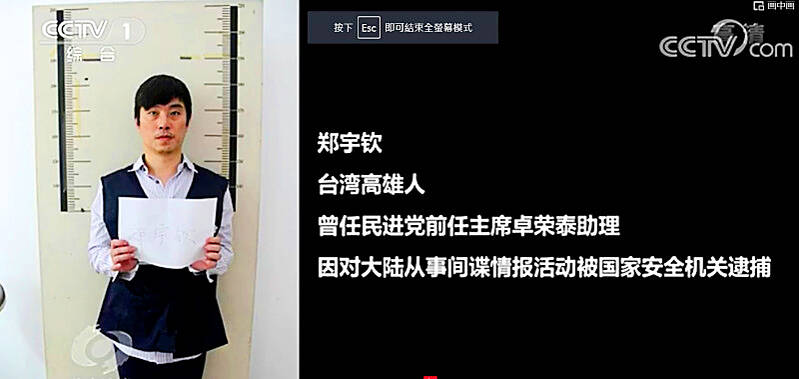
Former Czech Republic-based Taiwanese researcher Cheng Yu-chin (鄭宇欽) has been sentenced to seven years in prison on espionage-related charges, China’s Ministry of State Security announced yesterday. China said Cheng was a spy for Taiwan who “masqueraded as a professor” and that he was previously an assistant to former Cabinet secretary-general Cho Jung-tai (卓榮泰). President-elect William Lai (賴清德) on Wednesday last week announced Cho would be his premier when Lai is inaugurated next month. Today is China’s “National Security Education Day.” The Chinese ministry yesterday released a video online showing arrests over the past 10 years of people alleged to be
THE HAWAII FACTOR: While a 1965 opinion said an attack on Hawaii would not trigger Article 5, the text of the treaty suggests the state is covered, the report says NATO could be drawn into a conflict in the Taiwan Strait if Chinese forces attacked the US mainland or Hawaii, a NATO Defense College report published on Monday says. The report, written by James Lee, an assistant research fellow at Academia Sinica’s Institute of European and American Studies, states that under certain conditions a Taiwan contingency could trigger Article 5 of NATO, under which an attack against any member of the alliance is considered an attack against all members, necessitating a response. Article 6 of the North Atlantic Treaty specifies that an armed attack in the territory of any member in Europe,

LIKE FAMILY: People now treat dogs and cats as family members. They receive the same medical treatments and tests as humans do, a veterinary association official said The number of pet dogs and cats in Taiwan has officially outnumbered the number of human newborns last year, data from the Ministry of Agriculture’s pet registration information system showed. As of last year, Taiwan had 94,544 registered pet dogs and 137,652 pet cats, the data showed. By contrast, 135,571 babies were born last year. Demand for medical care for pet animals has also risen. As of Feb. 29, there were 5,773 veterinarians in Taiwan, 3,993 of whom were for pet animals, statistics from the Animal and Plant Health Inspection Agency showed. In 2022, the nation had 3,077 pediatricians. As of last

XINJIANG: Officials are conducting a report into amending an existing law or to enact a special law to prohibit goods using forced labor Taiwan is mulling an amendment prohibiting the importation of goods using forced labor, similar to the Uyghur Forced Labor Prevention Act (UFLPA) passed by the US Congress in 2021 that imposed limits on goods produced using forced labor in China’s Xinjiang region. A government official who wished to remain anonymous said yesterday that as the US customs law explicitly prohibits the importation of goods made using forced labor, in 2021 it passed the specialized UFLPA to limit the importation of cotton and other goods from China’s Xinjiang Uyghur region. Taiwan does not have the legal basis to prohibit the importation of goods


 RSS
RSS