


Chinese Nationalist Party (KMT) Legislator Joanna Lei (雷倩), yesterday accused the Executive Yuan of using legal loopholes to counter decisions made by the Legislative Yuan relating to government funding for the Taiwan High-Speed Rail Corp (THSRC).
Lei alleged that in a Ministry of Transportation and Communications expenditure review carried out on June 20, 2002, it was decided that no more government funds, inclusive of those from government-run industries, would be invested in the THSRC.
However, Lei said that since then the Executive Yuan had "time and time again" found ways of getting around the clause.
In December 2002, part 1 of Article 74 of the banking law was amended so that regulations restricting the amount and type of bonds banks can invest in incorporated a clause permitting investment of "fixed income preferred stocks."
Then, at the end of January 2003, NT$26.9 billion (US$804 million) was invested privately in the project through the allocation of "special stocks."
The Executive Yuan last month asked two government-related bodies -- the China Aviation Development Foundation and China Technical Consultant Inc -- to provide funds of NT$4.5 billion and NT$3 billion respectively to help bail out the project.
Lei said that in the most recent attempt to raise funds for the THSRC, the Economic Development and Management Bureau just last week adjusted regulations widening the scope of investment for insurance companies.
"Now they are running out of money, and they have found another way of getting funds," she said.
In response, ministry officials said that government initiatives to help with funding for the THSRC should be regarded positively, and that the completion of the project would add to the nation's economic and political development.
The head of the first division of the Bureau of Taiwan High Speed Rail, Hu Hsiang-ling (胡湘麟), said, "According to the law on the promotion of private participation in infrastructure projects, government investment should not exceed 20 percent. At present there has been an investment of NT$12.5 billion, which is only 17 percent of the total investment of NT$105 billion."
Lei said, however, that restrictions on the government providing more funding for the THSRC introduced in June 2002 took place after the law for private participation in infrastructure projects was passed, and were based on particular considerations at the time.
"Besides, through direct and indirect means, government investment has totaled NT$27.7 billion, far exceeding the 20 percent restriction," she said.
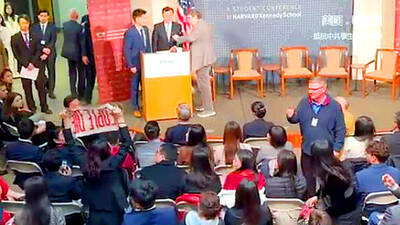
A group of Taiwanese-American and Tibetan-American students at Harvard University on Saturday disrupted Chinese Ambassador to the US Xie Feng’s (謝鋒) speech at the school, accusing him of being responsible for numerous human rights violations. Four students — two Taiwanese Americans and two from Tibet — held up banners inside a conference hall where Xie was delivering a speech at the opening ceremony of the Harvard Kennedy School China Conference 2024. In a video clip provided by the Coalition of Students Resisting the CCP (Chinese Communist Party), Taiwanese-American Cosette Wu (吳亭樺) and Tibetan-American Tsering Yangchen are seen holding banners that together read:

UNAWARE: Many people sit for long hours every day and eat unhealthy foods, putting them at greater risk of developing one of the ‘three highs,’ an expert said More than 30 percent of adults aged 40 or older who underwent a government-funded health exam were unaware they had at least one of the “three highs” — high blood pressure, high blood lipids or high blood sugar, the Health Promotion Administration (HPA) said yesterday. Among adults aged 40 or older who said they did not have any of the “three highs” before taking the health exam, more than 30 percent were found to have at least one of them, Adult Preventive Health Examination Service data from 2022 showed. People with long-term medical conditions such as hypertension or diabetes usually do not
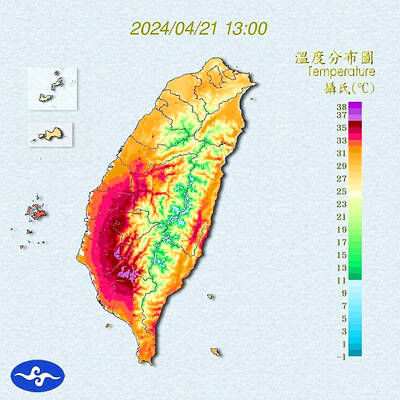
Heat advisories were in effect for nine administrative regions yesterday afternoon as warm southwesterly winds pushed temperatures above 38°C in parts of southern Taiwan, the Central Weather Administration (CWA) said. As of 3:30pm yesterday, Tainan’s Yujing District (玉井) had recorded the day’s highest temperature of 39.7°C, though the measurement will not be included in Taiwan’s official heat records since Yujing is an automatic rather than manually operated weather station, the CWA said. Highs recorded in other areas were 38.7°C in Kaohsiung’s Neimen District (內門), 38.2°C in Chiayi City and 38.1°C in Pingtung’s Sandimen Township (三地門), CWA data showed. The spell of scorching
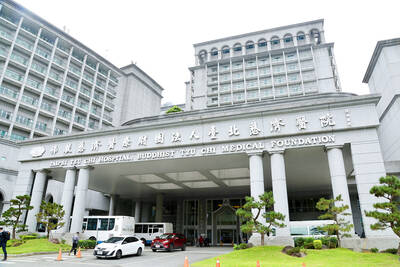
POLICE INVESTIGATING: A man said he quit his job as a nurse at Taipei Tzu Chi Hospital as he had been ‘disgusted’ by the behavior of his colleagues A man yesterday morning wrote online that he had witnessed nurses taking photographs and touching anesthetized patients inappropriately in Taipei Tzu Chi Hospital’s operating theaters. The man surnamed Huang (黃) wrote on the Professional Technology Temple bulletin board that during his six-month stint as a nurse at the hospital, he had seen nurses taking pictures of patients, including of their private parts, after they were anesthetized. Some nurses had also touched patients inappropriately and children were among those photographed, he said. Huang said this “disgusted” him “so much” that “he felt the need to reveal these unethical acts in the operating theater


 RSS
RSS