


Countries in East Asia that respect the universal values of freedom, democracy and human rights should band together to face China, which is transforming into the main security threat in the region aside from North Korea, an academic said yesterday.
The academic made the remarks at a forum held by a think tank affiliated with former president Lee Teng-hui (
The academics said globalization, which has deepened economic interaction among countries, has exacerbated geopolitical conflicts rather than creating peace or spreading universal values.
"In the East Asia region, China and North Korea are the main concerns in terms of potential conflict, said Chang Hsi-mo (張錫模), an associate professor in the Institute for Interdisciplinary Studies at National Sun Yat-sen University.
Given that North Korea has dedicated itself to developing nuclear weapons and China is expanding its military force and nurturing nationalism, they are most likely to be the initiators of conflicts in the Korean Peninsula, the Taiwan Strait and the South China Sea, which leaves other East Asian countries under the shadow of war, he added.
Kubota Nobuyuki, a professor in the Department of Education at Gakushuin Women's College, said that communist China -- which doesn't allow for the existence of organized religion -- is a country that doesn't know how to "put on the brakes".
"All [China] takes to heart is its economic and technology development and thus it always disregards values such as freedom, democracy and human rights," he said.
The forum, called "The Future of the Asia-Pacific," was hosted by the Lee Teng-hui Academy and aimed to discuss the possibility of forming an integrated "East Asia Community," a concept advocated in Japan's policy circles in recent years.
However, Cheng Ching-jen (
"China's economic development has led it to aim for hegemony in East Asia, which will surely exclude Taiwan's participation in the community," Cheng said.
Lee Min-yung (
"Also, [a sense of] community in the region is weak," Lee said.
"Nevertheless, thanks to the average level of development in Taiwan, Japan and South Korea and their historical ties, the objective conditions for forming a community among the three countries are relatively mature," he said.
Kubota Nobuyuki said that all nations must realize the importance of preserving natural resources in the 21st century, but China has not been doing this.
"Taiwan shares the same values of freedom, democracy and human rights with Japan, and thus the two countries should enhance their cooperative relations to contribute to a prosperous future in the East Asia region," he said.
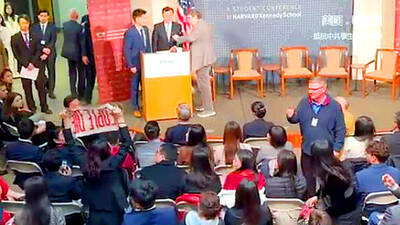
A group of Taiwanese-American and Tibetan-American students at Harvard University on Saturday disrupted Chinese Ambassador to the US Xie Feng’s (謝鋒) speech at the school, accusing him of being responsible for numerous human rights violations. Four students — two Taiwanese Americans and two from Tibet — held up banners inside a conference hall where Xie was delivering a speech at the opening ceremony of the Harvard Kennedy School China Conference 2024. In a video clip provided by the Coalition of Students Resisting the CCP (Chinese Communist Party), Taiwanese-American Cosette Wu (吳亭樺) and Tibetan-American Tsering Yangchen are seen holding banners that together read:

UNAWARE: Many people sit for long hours every day and eat unhealthy foods, putting them at greater risk of developing one of the ‘three highs,’ an expert said More than 30 percent of adults aged 40 or older who underwent a government-funded health exam were unaware they had at least one of the “three highs” — high blood pressure, high blood lipids or high blood sugar, the Health Promotion Administration (HPA) said yesterday. Among adults aged 40 or older who said they did not have any of the “three highs” before taking the health exam, more than 30 percent were found to have at least one of them, Adult Preventive Health Examination Service data from 2022 showed. People with long-term medical conditions such as hypertension or diabetes usually do not
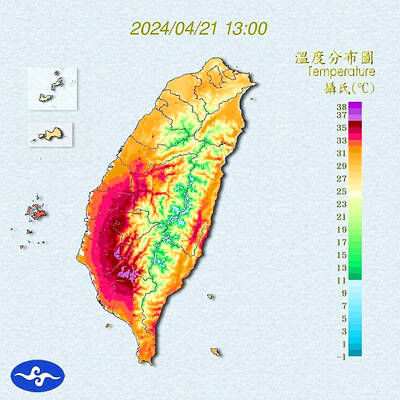
Heat advisories were in effect for nine administrative regions yesterday afternoon as warm southwesterly winds pushed temperatures above 38°C in parts of southern Taiwan, the Central Weather Administration (CWA) said. As of 3:30pm yesterday, Tainan’s Yujing District (玉井) had recorded the day’s highest temperature of 39.7°C, though the measurement will not be included in Taiwan’s official heat records since Yujing is an automatic rather than manually operated weather station, the CWA said. Highs recorded in other areas were 38.7°C in Kaohsiung’s Neimen District (內門), 38.2°C in Chiayi City and 38.1°C in Pingtung’s Sandimen Township (三地門), CWA data showed. The spell of scorching
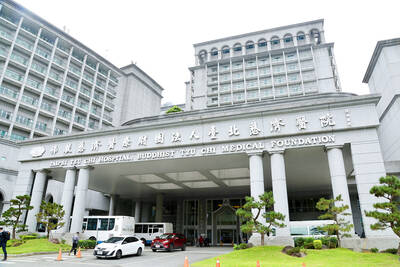
POLICE INVESTIGATING: A man said he quit his job as a nurse at Taipei Tzu Chi Hospital as he had been ‘disgusted’ by the behavior of his colleagues A man yesterday morning wrote online that he had witnessed nurses taking photographs and touching anesthetized patients inappropriately in Taipei Tzu Chi Hospital’s operating theaters. The man surnamed Huang (黃) wrote on the Professional Technology Temple bulletin board that during his six-month stint as a nurse at the hospital, he had seen nurses taking pictures of patients, including of their private parts, after they were anesthetized. Some nurses had also touched patients inappropriately and children were among those photographed, he said. Huang said this “disgusted” him “so much” that “he felt the need to reveal these unethical acts in the operating theater


 RSS
RSS