


The simply furnished ground-floor apartment tucked down a narrow, shabby street in Taipei's rundown Datong District looks like an ordinary home. Only the many posters and photographs of women displaying their breasts or legs that hang on the wall reveal its inner secrets.
About 20 years ago the women in these pictures openly greeted patrons coming to the doors of their brothels along the street; the red light district not only thrived but was legal between 1956 and 1997, and men would pay up to NT$1,000 for 15-minute visits.
The keys to the flat on Datong's Gueisuei Street are now in the hands of Wang Fang-ping (
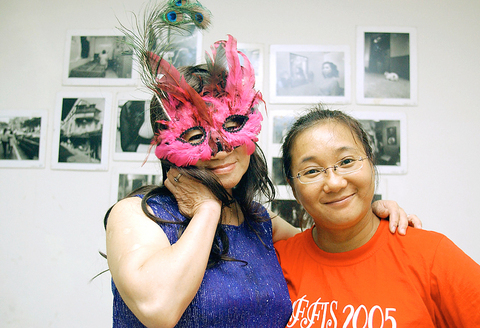
PHOTO: PATRICK LIN, AFP
Fighting for change
"Sex workers are stigmatized and they are scapegoats in society, which is unfair. I hope to change this unfair social structure by fighting for the legalization of prostitution," said Wang, whose persuasive, almost aggressive speech has been hardened from years of public advocacy.
After the Taipei City Government criminalized prostitution in 1997 the brothels along Gueisuei Street closed. But paid-for sex remains big business in Taiwan, with Wang estimating the industry to be worth at least NT$1 trillion (US$30 billion) per year. Rather than solve the problem, the ban has driven it underground, she said.
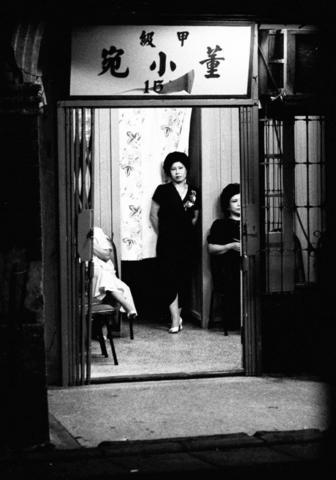
PHOTO: SAM YEH, AFP
Licensed brothels were also legal in other parts of the nation, though the numbers were declining by the time of the Taipei shutdown. Now, according to Wang, there are less than 100 licensed prostitutes in seven or eight counties.
Wang is battling to change the public and legal perceptions of prostitutes, a struggle that mirrors her own coming to terms with the sex trade.
In 1997, while she was working as a labor union leader, she saw some 100 licensed prostitutes or gongchang (
"When I first saw them on TV, I was surprised and puzzled. Why were they fighting for their rights? Why didn't they just switch to `normal' jobs?" Wang recalls.
She contacted the women and learned some surprising truths.
"They told me they chose prostitution of their free will and it was their job, their profession," Wang said.
The government and women's rights groups at that time were insisting that these women were exploited and must be rescued from prostitution. But Wang says that most if not all of the women who worked at the licensed brothels were either divorced or widowed. They had little education or job skills, and financial burdens to meet.
"They didn't steal. They didn't rob. They relied on themselves to make money. They didn't think sex work was bad. But they were forced out of their jobs in order to be `saved.' It's like breaking their legs and then saving them," Wang said, her voice rising in anger.
Jobs taken away
One of the women who took to the streets when her prostitute license was revoked was Lichun, now 64.
"Our jobs were suddenly taken away from us and we were angry. We refused to accept this. We had children to raise and loans to pay," said Lichun, who goes by one name. "We were protected [by the law] and we could choose customers when working for licensed brothels. Now the street walkers are helpless if their customers don't want to pay. They can't go to the police because they are illegal," she said.
Between 1956 and 1997, women aged over 20 could apply to the Taipei city police department for a prostitute license with the permission of their birth parents and clean health reports.
The standard charge for a 15-minute service was between NT$800 and NT$1,000, of which 30 percent went to brothel owners and 70 percent to prostitutes. They could turn down customers who refused to wear condoms.
After Chen announced a curb on the industry, the licensed prostitutes carried out protests for 19 months with Wang at the vanguard, and held 110 street demonstrations until new Taipei Mayor Ma Ying-jeou (
The brothels reopened while the women looked for new jobs, but the lights in the Datong and other brothel districts finally dimmed in 2001, though some maintained their character and the trade simply went underground.
Activism begins
Undeterred, Wang, other activists and some former prostitutes set up the Collective of Sex Workers and Supporters (COSWAS) to continue pushing to legitimize prostitution.
"Everybody knows that the sex industry exists and it's impossible to get rid of it. The government should face the reality and supervise it well," Wang said.
"Now the sex trade is forced to go underground and sex workers are marginal people in society and they have no hope," she said.
Dilapidated old districts like Datong and Wanhua are believed to remain home to many sex workers, though operating under euphemistic names such as tea houses, massage parlors and even clubs.
Last year, a total of 2,237 foreign women, including some from China, were arrested for soliciting prostitution, according to the National Police Agency. Those arrested faced detention of up to three days or fines of up to NT$30,000.
No figures were available for arrests of local women.
Wang believes that a licensed prostitute system monitored by authorities would not only protect sex workers but also counter human smuggling and underage prostitution.
"Look at Holland, Australia and Germany -- the sex industry can be managed. In Taiwan, politicians know that the sex trade is underground, but they are too hypocritical to deal with this controversial topic," she said.
To help keep the issue in the spotlight, Wang ran for lawmaker as an independent candidate last year, knowing she only had a slim chance of winning with a budget of only NT$6,000 and a platform to legalize prostitution.
Political campaign
Wang's campaign team included former sex workers like Lichun, who put on a flamboyant pink and red mask and sang karaoke to canvass votes.
"We started from zero but instead of sitting back and waiting for people to come to us, we took the first step to present our side of the story. It's not about winning or losing. I am satisfied, whether I collect 20 or 200 votes, to know some people support us and to unite these people during my campaign," said Wang, who secured 583 votes.
It was her second attempt at running for office, after unsuccessfully going for a seat on the Taipei City Council in 2002, when she collected 829 ballots.
Wang also gained some support internationally by launching a biennial festival featuring songs and dances by sex workers from different countries, as well as forums, documentaries and photo exhibitions.
With her chubby, fresh face, Wang's relaxed appearance defies the pressures she has faced over the past 16 years as a social activist.
When she was a senior at college, an air of change and vitality filled society after the then Chinese Nationalist Party (KMT) government in 1986 lifted martial law that had banned opposition parties and restricted publishing and media.
Various political and social causes started to spring up, and Wang abandoned her childhood dream to become a teacher and joined a union after graduation.
"I didn't go for a money job because I saw there were many unfair things in the society which I could help change," she said.
To prove to her blue-collar peers that she wasn't a naive college student who knew nothing about their world, she worked for a factory for eight months.
"My hands often got burnt while putting together the IC [integrated circuit] boards in the assembly line, and the smell of chemicals was terrible. I often wiped my sweat and tears together," she said.
Wang says fighting for better labor rights was deeply personal because her mother was a laborer who was widowed when Wang was just two years old.
Mother's plight
"My mother had to remarry in order to raise two children in southern Pingtung County, despite the stigma associated with remarried women at that time. She had no choice though her second marriage wasn't happy," she said.
Her mother's plight also helped her connect with prostitutes.
"I can relate to those women who put up with the stigma of prostitution so that their children wouldn't starve," she said.
After the licensed brothels were shut down, some of the women were unable to find other jobs. Some committed suicide, while many returned to sex work illegally, Wang said.
Among the less fortunate is Bailan, who now lives in the COSWAS office where Wang's staff take care of her after her brain was badly damaged by heavy drinking.
"Bailan became depressed after losing her job and started drinking. She tried running a small street stand but business was very poor. Her life was fine when she worked at a licensed brothel with a steady income," Wang said.
Lichun, the former prostitute who now works for COSWAS, said that without Wang nobody would pay attention to the former gongchang.
"Brave young people like Fang-ping speak up for us underprivileged women, otherwise no one would care," she said. "She could have become a teacher and easily earned good money. But she chose to campaign for sex workers even though there's no money."
Wang admits that she has thought of giving up.
"My mother is worried that as an activist I could get hurt in clashes during street protests. She hopes that I can get married and have children like any average woman," she said.
"I had considered quitting because we had no money and it's difficult to get things done. But I know it's wrong [to quit] because I can't keep silent knowing the plight" of the prostitutes, she added.
Even though it's a difficult campaign and it might "take 50 years to fulfill the goal [of legalizing prostitution]," Wang says that "I am happy that every little thing we do, we are moving one step forward."

A group of Taiwanese-American and Tibetan-American students at Harvard University on Saturday disrupted Chinese Ambassador to the US Xie Feng’s (謝鋒) speech at the school, accusing him of being responsible for numerous human rights violations. Four students — two Taiwanese Americans and two from Tibet — held up banners inside a conference hall where Xie was delivering a speech at the opening ceremony of the Harvard Kennedy School China Conference 2024. In a video clip provided by the Coalition of Students Resisting the CCP (Chinese Communist Party), Taiwanese-American Cosette Wu (吳亭樺) and Tibetan-American Tsering Yangchen are seen holding banners that together read:

UNAWARE: Many people sit for long hours every day and eat unhealthy foods, putting them at greater risk of developing one of the ‘three highs,’ an expert said More than 30 percent of adults aged 40 or older who underwent a government-funded health exam were unaware they had at least one of the “three highs” — high blood pressure, high blood lipids or high blood sugar, the Health Promotion Administration (HPA) said yesterday. Among adults aged 40 or older who said they did not have any of the “three highs” before taking the health exam, more than 30 percent were found to have at least one of them, Adult Preventive Health Examination Service data from 2022 showed. People with long-term medical conditions such as hypertension or diabetes usually do not
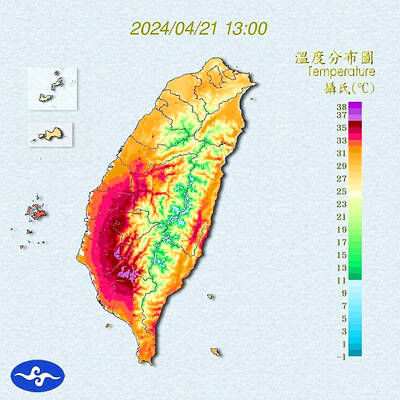
Heat advisories were in effect for nine administrative regions yesterday afternoon as warm southwesterly winds pushed temperatures above 38°C in parts of southern Taiwan, the Central Weather Administration (CWA) said. As of 3:30pm yesterday, Tainan’s Yujing District (玉井) had recorded the day’s highest temperature of 39.7°C, though the measurement will not be included in Taiwan’s official heat records since Yujing is an automatic rather than manually operated weather station, the CWA said. Highs recorded in other areas were 38.7°C in Kaohsiung’s Neimen District (內門), 38.2°C in Chiayi City and 38.1°C in Pingtung’s Sandimen Township (三地門), CWA data showed. The spell of scorching

POLICE INVESTIGATING: A man said he quit his job as a nurse at Taipei Tzu Chi Hospital as he had been ‘disgusted’ by the behavior of his colleagues A man yesterday morning wrote online that he had witnessed nurses taking photographs and touching anesthetized patients inappropriately in Taipei Tzu Chi Hospital’s operating theaters. The man surnamed Huang (黃) wrote on the Professional Technology Temple bulletin board that during his six-month stint as a nurse at the hospital, he had seen nurses taking pictures of patients, including of their private parts, after they were anesthetized. Some nurses had also touched patients inappropriately and children were among those photographed, he said. Huang said this “disgusted” him “so much” that “he felt the need to reveal these unethical acts in the operating theater


 RSS
RSS