


To tighten up defenses against avian flu, the Council of Agriculture (COA) together with Changhua County -- the nation's most densely populated bird-breeding area -- yesterday held a drill to rehearse the government's emergency response measures in the event the deadly disease is found in Taiwan.
"Because we are the rest stop for birds migrating during the winter season, we should prepare for the worst using the best efforts possible," the council's Chairman Lee Chin-lung (李金龍) said.
Taiwan is among the few countries in Asia that hasn't experienced an outbreak of bird-flu. Countries that have include Vietnam, Cambodia, Thailand and South Korea. The disease primarily affects birds, but more than 60 people -- mostly Vietnamese living in close contact with chickens -- have also died. Scientists fear the disease could mutate into a form that can be transmitted between humans, which could cause a global pandemic killing millions.
Simulation
Participants in the drill simulated culling affected birds, burying or burning the culled birds, stemming the flow of poultry and meat smuggling, and protecting their own health, as well as the health of locally raised animals and poultry.
An emphasis was placed on protecting people on the front lines of the bird-flu battle.
A professor at the Animal Vaccination Research center of National Pingtung University of Science and Technology, Lien I-yang (
Close monitoring
Lee said the council has been keeping a close eye on avian flu since the discovery of an avian flu virus in the US in 1983. He assured consumers that "our birds are flu-free and imports from infected countries have been restricted."
Premier Frank Hsieh (
"The world thinks highly of our defenses in regard to the monitoring of the disease and treatment. We are one of the few countries that can produce the medication," Hsieh said.
Hsieh, however, added that Taiwan couldn't afford to be careless, especially after what happened with SARS. Hsieh said the public's cooperation was needed to fight the disease. Strict penalties will be handed out to those involved in the smuggling or illegal collection of birds, he added.
High spending
Meanwhile, Department of Health Minister Hou Sheng-mou (侯勝茂) yesterday said his department was planning to spend NT$20 billion (US$600 million) in combating bird flu. The ministry hopes that the effort will include producing mass quantities of drugs to fight the flu, based on the recipe for Tamiflu -- a drug whose patent is owned by the Swiss company Roche.
"As far as I know, Roche is willing to respond positively to the request filed by other countries to produce generic versions of Tamiflu," he said.
According to National Health Research Institute Director Su Yi-jen (
Su made the remarks during a meeting with Democratic Progressive Party (DPP) caucus members.
According to Su, the National Health Research Institute is capable of making samples that are 99.9 percent similar to Tamiflu. It would take only three to five months for the institute to manufacture doses sufficient for 1 million people.
Currently, the nation has enough of the drug for 160,000 people, and expects to see the number to rise to 780,000, which represents 4 percent of the total population. The recommended stockpile set by the World Health Organization is 10 percent.
Meanwhile, the Taiwan Solidarity Union lawmakers yesterday said their party will request the legislature pass a resolution demanding that Roche license Taiwan to mass-produce Tamiflu.
also see story:
Editorial: Health politics and halting bird flu
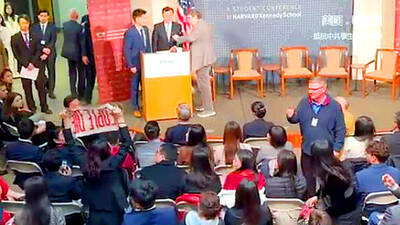
A group of Taiwanese-American and Tibetan-American students at Harvard University on Saturday disrupted Chinese Ambassador to the US Xie Feng’s (謝鋒) speech at the school, accusing him of being responsible for numerous human rights violations. Four students — two Taiwanese Americans and two from Tibet — held up banners inside a conference hall where Xie was delivering a speech at the opening ceremony of the Harvard Kennedy School China Conference 2024. In a video clip provided by the Coalition of Students Resisting the CCP (Chinese Communist Party), Taiwanese-American Cosette Wu (吳亭樺) and Tibetan-American Tsering Yangchen are seen holding banners that together read:

UNAWARE: Many people sit for long hours every day and eat unhealthy foods, putting them at greater risk of developing one of the ‘three highs,’ an expert said More than 30 percent of adults aged 40 or older who underwent a government-funded health exam were unaware they had at least one of the “three highs” — high blood pressure, high blood lipids or high blood sugar, the Health Promotion Administration (HPA) said yesterday. Among adults aged 40 or older who said they did not have any of the “three highs” before taking the health exam, more than 30 percent were found to have at least one of them, Adult Preventive Health Examination Service data from 2022 showed. People with long-term medical conditions such as hypertension or diabetes usually do not
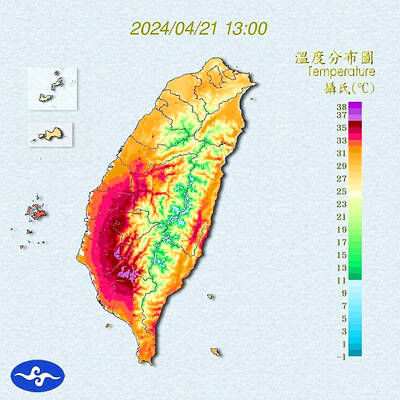
Heat advisories were in effect for nine administrative regions yesterday afternoon as warm southwesterly winds pushed temperatures above 38°C in parts of southern Taiwan, the Central Weather Administration (CWA) said. As of 3:30pm yesterday, Tainan’s Yujing District (玉井) had recorded the day’s highest temperature of 39.7°C, though the measurement will not be included in Taiwan’s official heat records since Yujing is an automatic rather than manually operated weather station, the CWA said. Highs recorded in other areas were 38.7°C in Kaohsiung’s Neimen District (內門), 38.2°C in Chiayi City and 38.1°C in Pingtung’s Sandimen Township (三地門), CWA data showed. The spell of scorching
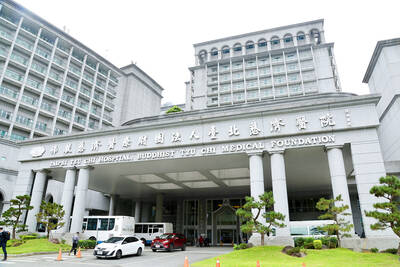
POLICE INVESTIGATING: A man said he quit his job as a nurse at Taipei Tzu Chi Hospital as he had been ‘disgusted’ by the behavior of his colleagues A man yesterday morning wrote online that he had witnessed nurses taking photographs and touching anesthetized patients inappropriately in Taipei Tzu Chi Hospital’s operating theaters. The man surnamed Huang (黃) wrote on the Professional Technology Temple bulletin board that during his six-month stint as a nurse at the hospital, he had seen nurses taking pictures of patients, including of their private parts, after they were anesthetized. Some nurses had also touched patients inappropriately and children were among those photographed, he said. Huang said this “disgusted” him “so much” that “he felt the need to reveal these unethical acts in the operating theater


 RSS
RSS