


Student and teacher groups gathered yesterday to discuss social problems that have surfaced due to the rise of tuition fees in schools and the prevalence of college degrees, blaming the lack of government educational funds and the failure of educational reforms for the problems.
Li Chun-ta (李俊達), a student at Soochow University and a member of the Youth Labor Alliance, said that he came from an economically challenged single-parent family and was forced to rely on student loans to cover the high costs of his college tuition.
"I have no choice. I need higher education, or else I won't be able to find a job. People with masters degrees are all over the place," Lee said. "Graduate school tuition fees will be even more of a burden for me in the future. I am already deeply in debt."
Kuo Ching-chun (郭清圳), director of the Laborers' Parents Association (基層勞動家長協會), called student loans a government sham to hide the gap between the rich and the poor.
"Our children should do what they can afford. If they cannot afford a college education, they should find other types of work," said Kuo, a driver with only an elementary school degree. "Education is expensive and overrated."
According to Chi Li (齊力), a professor at the Taipei Municipal University of Education, the Ministry of Education (MOE) has been limiting the number of students that enroll in the school as a method of lowering the unemployment rate of future teachers.
"The MOE is being irresponsible. The unemployment problem of certified teachers will not disappear just by limiting the number of students enrolling in the school," Chi said.
Chi also said that the MOE is allowing the marketization of tuition, meaning that college tuition is now decided by the market, causing tuition to rise much too quickly in recent years.
Huang Chih-cheng (黃致誠), director of public affairs at the National Teachers' Association, said that the government was not setting aside enough education funds.
In addition, the already limited funds given by the central government were often used inappropriately by local governments, Huang said.
"Often, part of these funds are spent elsewhere as local governments don't want to invest too much in education," Huang added.
Huang also blamed the failure of educational reforms for the abundance of college degrees and said that the reforms lifted the previously strict regulations regarding the establishment of universities and allowed many technological institutes to transform into private universities, causing the number of private institutions to rocket.
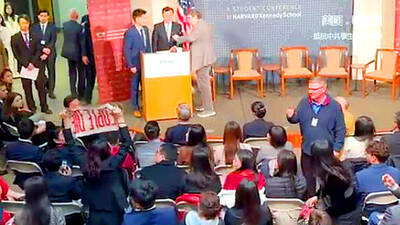
A group of Taiwanese-American and Tibetan-American students at Harvard University on Saturday disrupted Chinese Ambassador to the US Xie Feng’s (謝鋒) speech at the school, accusing him of being responsible for numerous human rights violations. Four students — two Taiwanese Americans and two from Tibet — held up banners inside a conference hall where Xie was delivering a speech at the opening ceremony of the Harvard Kennedy School China Conference 2024. In a video clip provided by the Coalition of Students Resisting the CCP (Chinese Communist Party), Taiwanese-American Cosette Wu (吳亭樺) and Tibetan-American Tsering Yangchen are seen holding banners that together read:

UNAWARE: Many people sit for long hours every day and eat unhealthy foods, putting them at greater risk of developing one of the ‘three highs,’ an expert said More than 30 percent of adults aged 40 or older who underwent a government-funded health exam were unaware they had at least one of the “three highs” — high blood pressure, high blood lipids or high blood sugar, the Health Promotion Administration (HPA) said yesterday. Among adults aged 40 or older who said they did not have any of the “three highs” before taking the health exam, more than 30 percent were found to have at least one of them, Adult Preventive Health Examination Service data from 2022 showed. People with long-term medical conditions such as hypertension or diabetes usually do not
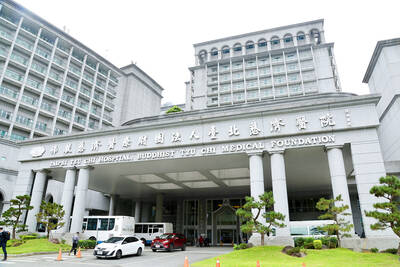
POLICE INVESTIGATING: A man said he quit his job as a nurse at Taipei Tzu Chi Hospital as he had been ‘disgusted’ by the behavior of his colleagues A man yesterday morning wrote online that he had witnessed nurses taking photographs and touching anesthetized patients inappropriately in Taipei Tzu Chi Hospital’s operating theaters. The man surnamed Huang (黃) wrote on the Professional Technology Temple bulletin board that during his six-month stint as a nurse at the hospital, he had seen nurses taking pictures of patients, including of their private parts, after they were anesthetized. Some nurses had also touched patients inappropriately and children were among those photographed, he said. Huang said this “disgusted” him “so much” that “he felt the need to reveal these unethical acts in the operating theater
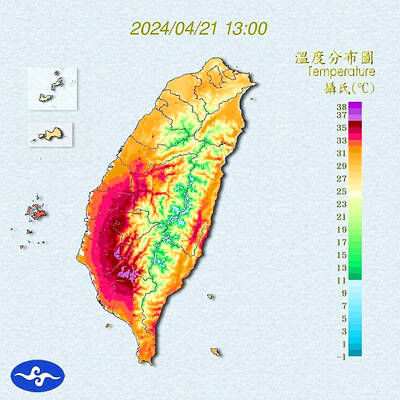
Heat advisories were in effect for nine administrative regions yesterday afternoon as warm southwesterly winds pushed temperatures above 38°C in parts of southern Taiwan, the Central Weather Administration (CWA) said. As of 3:30pm yesterday, Tainan’s Yujing District (玉井) had recorded the day’s highest temperature of 39.7°C, though the measurement will not be included in Taiwan’s official heat records since Yujing is an automatic rather than manually operated weather station, the CWA said. Highs recorded in other areas were 38.7°C in Kaohsiung’s Neimen District (內門), 38.2°C in Chiayi City and 38.1°C in Pingtung’s Sandimen Township (三地門), CWA data showed. The spell of scorching


 RSS
RSS