


China's attempts to use trade as a mechanism for undermining the Democratic Progressive Party (DPP) administration is hampering further liberalization and progress toward the normalization of cross-strait trade relations, the US-Taiwan Business Council has warned.
In a statement about China's recent detente with the Chinese Nationalist Party (KMT) and People First Party (PFP), council president Rupert Hammond-Chambers expressed concern that any process to undermine the authority of President Chen Shui-bian's (陳水扁) administration over trade negotiations will result in a political backlash in Taiwan that will slow or even halt incremental trade liberalization across the Taiwan Strait.
Hammond-Chambers said his council welcomes dialogue between China and Taiwan.
However, he noted that the unilateral announcement by the Chinese government that it will offer tariff-free treatment to certain Taiwanese fruit, following the China visits of the KMT and PFP leaders, is aimed at luring away Chen's supporters, such as fruit farmers in southern Taiwan, and planting the seeds of doubt about the DPP's ability to handle cross-strait trade.
While the council welcomes dialogue between China and Taiwan, it is clear that these initiatives are designed to undermine the position of Chen and the DPP, the statement said.
"If the DPP is to proceed with further liberalization in areas such as chip packaging and testing as well as 0.18-micron chip manufacturing, it will require a level of control over the process," it said.
Hammond-Chambers said the administration has become more cautious with regard to economic interactions with China, and will pursue policies to address the seemingly incremental erosion of its authority over cross-strait trade matters.
"The US-Taiwan Business Council believes that normalized trade across the Taiwan Strait will result in reductions in cross-strait political tension, increased efficiencies for Taiwan companies, and therefore price, quality, and time of delivery improvements for the myriad of US companies that participate in the integrated technology supply chain that links the US, Taiwan and China," he said.
"In addition, economic integration should also contribute greatly to bridging the political gap that remains between the two, and offer positive momentum to a relationship that has undergone an extended period of strain," he said.
The US-Taiwan Business Council, which comprises a large network of companies involved in business between the two countries, gives members access to people and information to help them succeed in their endeavors in Taiwan.
When asked for comment, DPP Legislator Hsiao Bi-khim (蕭美琴) said Hammond-Chamber's remarks pinpointed some key problems.
If China keeps bypassing the administration and only conducts talks with opposition parties, China will end up having a negative impact on the liberalization and normalization of cross-strait trade, she said.
Commenting on Hammond-Chamber's remarks, Taiwan Solidarity Union (TSU) deputy caucus convener David Huang (
PFP caucus whip Hwang Yih-jiau (黃義交) said his party has never sabotaged the government's authority and urged the council to tell the government to attach importance on China's market and "not oppose for the sake of opposition."
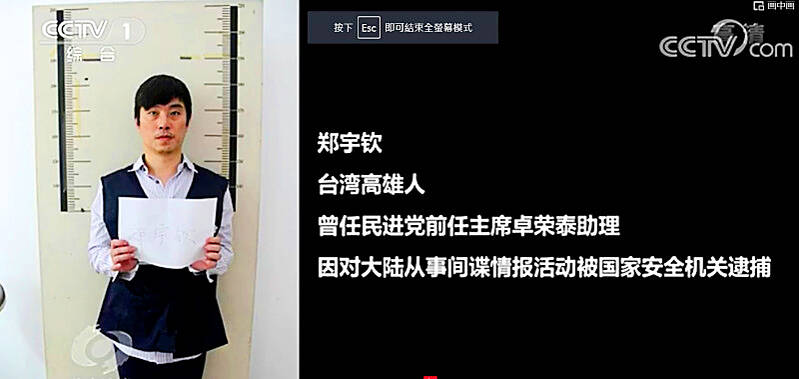
Former Czech Republic-based Taiwanese researcher Cheng Yu-chin (鄭宇欽) has been sentenced to seven years in prison on espionage-related charges, China’s Ministry of State Security announced yesterday. China said Cheng was a spy for Taiwan who “masqueraded as a professor” and that he was previously an assistant to former Cabinet secretary-general Cho Jung-tai (卓榮泰). President-elect William Lai (賴清德) on Wednesday last week announced Cho would be his premier when Lai is inaugurated next month. Today is China’s “National Security Education Day.” The Chinese ministry yesterday released a video online showing arrests over the past 10 years of people alleged to be
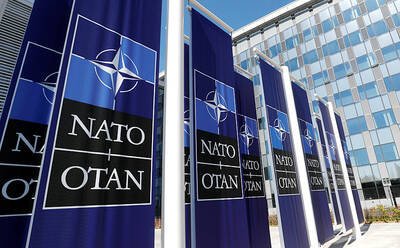
THE HAWAII FACTOR: While a 1965 opinion said an attack on Hawaii would not trigger Article 5, the text of the treaty suggests the state is covered, the report says NATO could be drawn into a conflict in the Taiwan Strait if Chinese forces attacked the US mainland or Hawaii, a NATO Defense College report published on Monday says. The report, written by James Lee, an assistant research fellow at Academia Sinica’s Institute of European and American Studies, states that under certain conditions a Taiwan contingency could trigger Article 5 of NATO, under which an attack against any member of the alliance is considered an attack against all members, necessitating a response. Article 6 of the North Atlantic Treaty specifies that an armed attack in the territory of any member in Europe,

LIKE FAMILY: People now treat dogs and cats as family members. They receive the same medical treatments and tests as humans do, a veterinary association official said The number of pet dogs and cats in Taiwan has officially outnumbered the number of human newborns last year, data from the Ministry of Agriculture’s pet registration information system showed. As of last year, Taiwan had 94,544 registered pet dogs and 137,652 pet cats, the data showed. By contrast, 135,571 babies were born last year. Demand for medical care for pet animals has also risen. As of Feb. 29, there were 5,773 veterinarians in Taiwan, 3,993 of whom were for pet animals, statistics from the Animal and Plant Health Inspection Agency showed. In 2022, the nation had 3,077 pediatricians. As of last
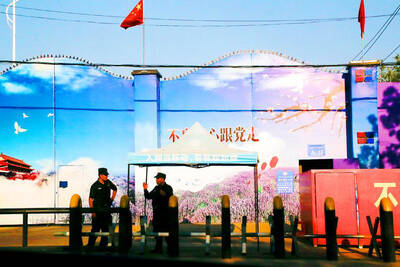
XINJIANG: Officials are conducting a report into amending an existing law or to enact a special law to prohibit goods using forced labor Taiwan is mulling an amendment prohibiting the importation of goods using forced labor, similar to the Uyghur Forced Labor Prevention Act (UFLPA) passed by the US Congress in 2021 that imposed limits on goods produced using forced labor in China’s Xinjiang region. A government official who wished to remain anonymous said yesterday that as the US customs law explicitly prohibits the importation of goods made using forced labor, in 2021 it passed the specialized UFLPA to limit the importation of cotton and other goods from China’s Xinjiang Uyghur region. Taiwan does not have the legal basis to prohibit the importation of goods


 RSS
RSS