


A bee farmer yesterday threatened to sue the Consumers' Foundation (
"We'd like to see the Consumers' Foundation admit to having used the wrong method for testing the purity of honey and invite nationally certified analyzers to do the test again, or we will sue them for compensation for our losses," said Lai Chao-sien (
Accompanied by Democratic Progressive Party (DPP) Legislator Tsai Huang-liang (
"Hundreds of telephone calls poured in to our office to complain about our honey from 12pm to 7pm," he said. "I'm afraid export orders will soon be cancelled."
The Consumers' Foundation on Tuesday alleged that most honey consumed in Taiwan is not pure, with only two of 37 honey brands passing a recent purity test.
Among the 37 samples chosen randomly from supermarkets, traditional markets, shopping malls and organic product shops, the organization found that only two samples could be considered to be first or second-grade. One of the two that passed the test was from France.
The foundation said that some bee farmers add fructose to disguise their inferior mixtures as pure honey in order to reap bigger profits.
The honey produced by Lai's farm was found by the foundation to contain more than 5 percent cane sugar.
Claiming that the test methodology used by the foundation's analyzers was wrong, Lai said that it is fairly easy to tell real honey from the artificial stuff.
"If you add water to real honey and shake it, the liquid is turbid and the bubbles are fine. There are also many bubbles which last for a long time," Lai said, while demonstrating his water test in front of TV cameras.
Fake honey, though, is exactly the opposite, he said, adding that it is incorrect to test the purity of honey by using a toothpick, as the foundation did.
It is also easy to make phony honey, Lai said, by mixing fructose with pigment and essence.
While the retail price of genuine first-grade honey ranges between NT$200 and NT$400 per kilogram, imitation honey is priced from NT$50 to as much as NT$500 for unsuspecting buyers. The cost of fake honey, however, is only about NT$13 or NT$15 per kilogram, he said.
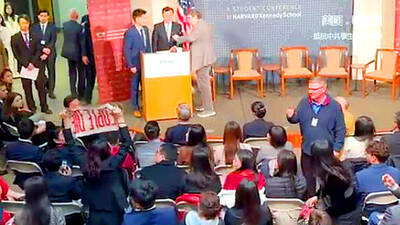
A group of Taiwanese-American and Tibetan-American students at Harvard University on Saturday disrupted Chinese Ambassador to the US Xie Feng’s (謝鋒) speech at the school, accusing him of being responsible for numerous human rights violations. Four students — two Taiwanese Americans and two from Tibet — held up banners inside a conference hall where Xie was delivering a speech at the opening ceremony of the Harvard Kennedy School China Conference 2024. In a video clip provided by the Coalition of Students Resisting the CCP (Chinese Communist Party), Taiwanese-American Cosette Wu (吳亭樺) and Tibetan-American Tsering Yangchen are seen holding banners that together read:

UNAWARE: Many people sit for long hours every day and eat unhealthy foods, putting them at greater risk of developing one of the ‘three highs,’ an expert said More than 30 percent of adults aged 40 or older who underwent a government-funded health exam were unaware they had at least one of the “three highs” — high blood pressure, high blood lipids or high blood sugar, the Health Promotion Administration (HPA) said yesterday. Among adults aged 40 or older who said they did not have any of the “three highs” before taking the health exam, more than 30 percent were found to have at least one of them, Adult Preventive Health Examination Service data from 2022 showed. People with long-term medical conditions such as hypertension or diabetes usually do not
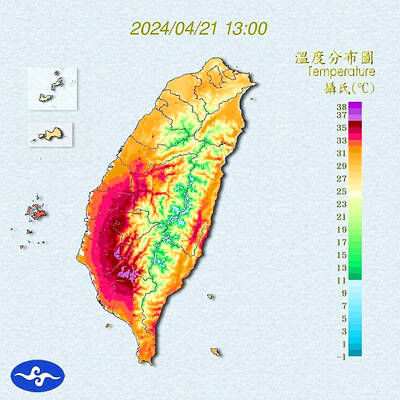
Heat advisories were in effect for nine administrative regions yesterday afternoon as warm southwesterly winds pushed temperatures above 38°C in parts of southern Taiwan, the Central Weather Administration (CWA) said. As of 3:30pm yesterday, Tainan’s Yujing District (玉井) had recorded the day’s highest temperature of 39.7°C, though the measurement will not be included in Taiwan’s official heat records since Yujing is an automatic rather than manually operated weather station, the CWA said. Highs recorded in other areas were 38.7°C in Kaohsiung’s Neimen District (內門), 38.2°C in Chiayi City and 38.1°C in Pingtung’s Sandimen Township (三地門), CWA data showed. The spell of scorching
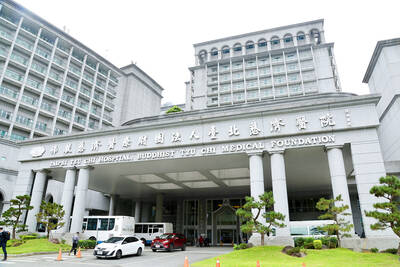
POLICE INVESTIGATING: A man said he quit his job as a nurse at Taipei Tzu Chi Hospital as he had been ‘disgusted’ by the behavior of his colleagues A man yesterday morning wrote online that he had witnessed nurses taking photographs and touching anesthetized patients inappropriately in Taipei Tzu Chi Hospital’s operating theaters. The man surnamed Huang (黃) wrote on the Professional Technology Temple bulletin board that during his six-month stint as a nurse at the hospital, he had seen nurses taking pictures of patients, including of their private parts, after they were anesthetized. Some nurses had also touched patients inappropriately and children were among those photographed, he said. Huang said this “disgusted” him “so much” that “he felt the need to reveal these unethical acts in the operating theater


 RSS
RSS