


The government's recent rejection of the license-renewal applications of seven TV channels has caused a flurry in the media industry and touched off a heated debate in the political arena.
At issue is whether the government has the right to meddle in the operating affairs of media outlets and whether the government's media-supervisory mechanism helps contain the chaotic and dis-organized condition of the media. Some even wonder whether the decision reflects the government's political interests.
The Government Information Office's (GIO) review committee decided late last Sunday night that seven TV channels did not pass the final round of review and had to stop broadcasting in two days' time.
In the meantime, "quality programs" had to be provided to fill the slots on the basis of "broadcast first, review later." Other channels that passed the review could also lose their licenses in three months' time if they fail to adhere to a self-discipline agreement devised among the TV stations themselves.
In addition to the seven TV channels, 14 more channels stop-ped broadcasting last Tuesday when their licenses expired. One of them did not complete the application process and 13 others failed to file applications for review of their licenses.
The matter has raised concerns with international media-watchdog groups such as Reporters Without Borders.
Dismay
The organization on Friday issued a statement to voice its dismay over the government's abrupt closure of the commercial stations -- including a news station, ETTV-S, and six others that focused mainly on entertainment.
The organization called on Prime Minister Frank Hsieh (謝長廷) to rescind the decision and ensure that the licenses, especially that of ETTV-S, are renewed.
"This decision clearly constitutes a serious press-freedom violation and a disturbing signal to cable-TV operators and TV executives, who will now have to work with a threat hanging over them," Reporters Without Borders said.
"It is unacceptable that the broadcast-license system should be subordinate to political interests," it said.
The organization said that the Taiwanese government should put an end to such an "arbitrary system" and create a fully independent entity to issue licenses.
ETTV-S has filed an appeal with the Taipei High Administrative Court, asking for a three-month grace period to give it time to look after its 300 employees' interests.
It has also filed an injunction against the government decision and moved its programs to another channel owned by the same group.
All six of the other stations have vowed to appeal. Some of them threaten to stage a larger demonstration if the GIO fails to respond to their requests this week.
Politics
On the political front, opposition parties have cast doubt on the government's media-reform program and cooked up various theories about what led to the GIO's decision last week.
They charge that the review process is a "black-box operation" and that the government is acting "despotically." They also threaten to refuse reviewing the GIO's annual budget during this coming legislative session.
They speculate that the GIO's rejection of ETTV-S' renewal application has been to make room for a pro-independence broadcaster which plans to launch a TV station by next year.
They also suggest that the denial of ETTV-S' renewal application is related to Hsieh's alleged personal displeasure about not receiving as much media coverage as Democratic Progressive Party (DPP) Chairman Su Tseng-chang (蘇貞昌).
Some of them even charge that the government's denial of the license renewal applications is aimed at teaching a lesson to those who refuse to produce more positive coverage of the ruling party, especially with the year-end local elections approaching.
Denial
Both the premier and GIO deny these speculations.
Hsieh said that opposition parties' doubts and allegations are an insult to both the review-committee members and the TV channels that passed the evaluation and had their license renewed.
He also said that the GIO would have committed malfeasance if it failed to review the operating licenses of media outlets because it remains the media supervisory body until the proposed National Communications Commission (NCC) has been established.
Stressing that the GIO is performing its duty in accordance with the law as enacted by the legislature, GIO Minister Pasuya Yao (姚文智) said that he is willing to step down if his office is found to have interfered with press freedom.
He said that the legislature should make efforts to amend the law if they think the supervisory mechanism is flawed.
To prove that its review and decision-making processes were handled by professionals and experts, the GIO made public the names of seven of the 12 committee members, with their consent. The Chinese Nationalist Party (KMT) caucus later released all 12 names.
Lu Shih-hsiang (
"It does not have anything to do with politics," he says.
"If there had been any political interference at all, then it was the GIO's request that we accept as many renewal applications as possible. Because of this request, we rejected fewer applications than we intended," he said.
Proof
Lu said that a business channel owned by Global TV also failed to pass the preliminary review, thus proving that the committee's decision has not been a political consideration. The chairman of the station is former DPP lawmaker Chang Chun-hung (
"If the review process was political, as they have claimed, Global TV would have passed the review," he said.
All the legislative caucuses agreed that the establishment of the NCC would be the cure-all for keeping the chaotic situation in the media in check, and vowed to push passage of the bill during the upcoming legislative session.
However, they have been bickering over the committee's structure.
While opposition caucuses insist that committee members be decided by each party's number of legislative seats, the DPP caucus argued that such a make-up would only let political power interfere in the proposed independent body.
"If the committee is to be made up of political powers, we'd rather not have it at all," said DPP caucus whip Lai Ching-te (

Former president Ma Ying-jeou’s (馬英九) mention of Taiwan’s official name during a meeting with Chinese President Xi Jinping (習近平) on Wednesday was likely a deliberate political play, academics said. “As I see it, it was intentional,” National Chengchi University Graduate Institute of East Asian Studies professor Wang Hsin-hsien (王信賢) said of Ma’s initial use of the “Republic of China” (ROC) to refer to the wider concept of “the Chinese nation.” Ma quickly corrected himself, and his office later described his use of the two similar-sounding yet politically distinct terms as “purely a gaffe.” Given Ma was reading from a script, the supposed slipup
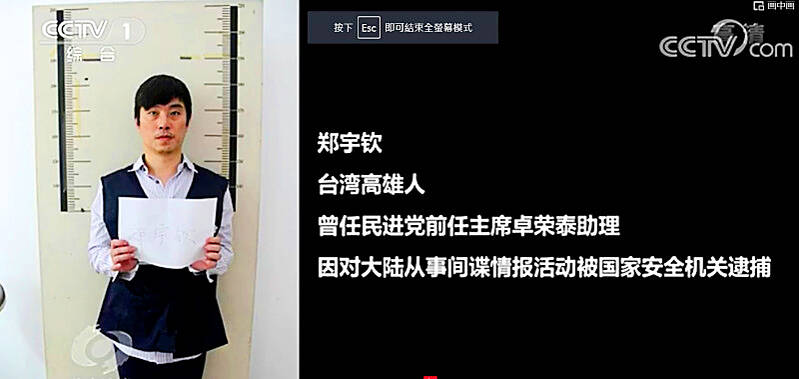
Former Czech Republic-based Taiwanese researcher Cheng Yu-chin (鄭宇欽) has been sentenced to seven years in prison on espionage-related charges, China’s Ministry of State Security announced yesterday. China said Cheng was a spy for Taiwan who “masqueraded as a professor” and that he was previously an assistant to former Cabinet secretary-general Cho Jung-tai (卓榮泰). President-elect William Lai (賴清德) on Wednesday last week announced Cho would be his premier when Lai is inaugurated next month. Today is China’s “National Security Education Day.” The Chinese ministry yesterday released a video online showing arrests over the past 10 years of people alleged to be
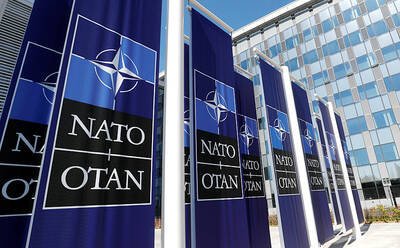
THE HAWAII FACTOR: While a 1965 opinion said an attack on Hawaii would not trigger Article 5, the text of the treaty suggests the state is covered, the report says NATO could be drawn into a conflict in the Taiwan Strait if Chinese forces attacked the US mainland or Hawaii, a NATO Defense College report published on Monday says. The report, written by James Lee, an assistant research fellow at Academia Sinica’s Institute of European and American Studies, states that under certain conditions a Taiwan contingency could trigger Article 5 of NATO, under which an attack against any member of the alliance is considered an attack against all members, necessitating a response. Article 6 of the North Atlantic Treaty specifies that an armed attack in the territory of any member in Europe,
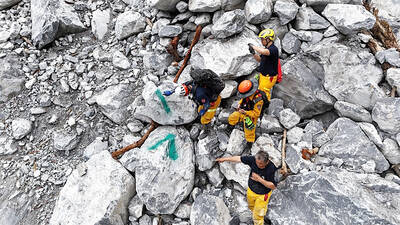
The bodies of two individuals were recovered and three additional bodies were discovered on the Shakadang Trail (砂卡礑) in Taroko National Park, eight days after the devastating earthquake in Hualien County, search-and-rescue personnel said. The rescuers reported that they retrieved the bodies of a man and a girl, suspected to be the father and daughter from the Yu (游) family, 500m from the entrance of the trail on Wednesday. The rescue team added that despite the discovery of the two bodies on Friday last week, they had been unable to retrieve them until Wednesday due to the heavy equipment needed to lift


 RSS
RSS