


President Chen Shui-bian's (
Chen's stance has been regarded by some economists as obvious reluctance to strengthen cross-strait economic ties in the near future. However, Cabinet officials said an improving local environment for investors and allowing products involving low-end technologies to be produced in China shows the government's aggressive attitude, and is a smart way to ensure national security.
On July 26, when Chen spoke to the Foreign Correspondents' Club of Japan via videoconference, he stressed the necessity of limiting the number of products and technologies exported to China.
"Do other countries sell their products freely to China without setting up regulations first? If all people believe in `business is business' only, why did the EU impose an arms embargo on China? And why did the international community, especially the Japan and the US, criticize the EU's recent move to lift the arms embargo?" Chen asked.
Chen said that the Legislative Yuan is working on the establishment of laws regulating high-tech technology transfers to China, adding that, even for products involving non-sensitive technologies, the government will still be very cautious.
However, Wu Chih-chung (
"EU regulations [the EU's 1998 Code of Conduct] prevent sensitive high technologies from flowing into China. But in Taiwan, even with similar regulations regulating the export of high-tech products and professionals, political turbulence hampers them from being implemented effectively," said Wu, who is also an assistant professor at Soochow University in Taipei.
National Science Council (NSC) Minister Wu Maw-kuen (
Using Central Taiwan Science Park as an example, Wu said that in the last two years, the government has assisted in land acquisition and offered preferential treatment.
"That's why the world's largest TFT-LCD manufacture, AU Optronics Corp, runs its business well at the park," Wu said.
Wu said that because of the park's sound environment for high-tech firms in the photoelectronic industry, firms from related industries have also been encouraged to choose central Taiwan as their base.
Statistics show that, in the last two years, the park has attracted 70 high-tech firms, which have invested NT$760 billion (US$228.2 million) and created 10,000 jobs. It's estimated that the total sales of the park's firms this year might reach NT$60 billion.
"Shifting computer assembly lines to China is okay for Taiwan, as this is after all part of globalization. Our policies are designed to keep state-of-the-art technologies, which are the result of our R&D, at home," Wu said.
However, Taiwanese economists specializing in China's economic development said that Taiwan needs to make a greater effort to protect its mature biotechnologies in the sector of agriculture.
According to Chiu Chen Lee-in (
"The Council of Agriculture (COA) has to make a list of our precious technologies developed in the past. Exporting Taiwanese agricultural products to other markets, including China, should be accompanied by well-designed regulations that ensure Taiwan's existing advantages," Chiu Chen told the Taipei Times.
Chiu Chen said China's huge market has a lot of potential for manufacturers and firms in the service industry, while Taiwan's quality fruit exports to China -- which just dropped its import tariffs on 15 kinds of Taiwanese fruit -- were not a big issue for the rising economic power.
"Once China asks Taiwan to import Chinese fruit under the framework of World Trade Organization, can we beat the products having competitive prices? That would result in a serious setback for Taiwan's agricultural industry," Chiu Chen said.
Chiu Chen said that President Chen's reluctance to strengthen economic ties with China was more a political motive rather than an economic calculation.
"In fact, the lack of a free market mechanism in China and the corruption of Chinese customs officers and officials at local levels might soon discourage Taiwanese people who are in favor of exporting agricultural products. The cost will increase sharply because of what it takes to smooth the process," Chiu Chen said.
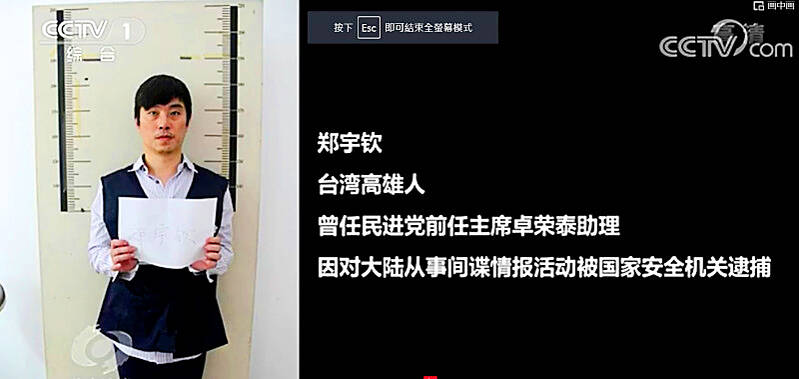
Former Czech Republic-based Taiwanese researcher Cheng Yu-chin (鄭宇欽) has been sentenced to seven years in prison on espionage-related charges, China’s Ministry of State Security announced yesterday. China said Cheng was a spy for Taiwan who “masqueraded as a professor” and that he was previously an assistant to former Cabinet secretary-general Cho Jung-tai (卓榮泰). President-elect William Lai (賴清德) on Wednesday last week announced Cho would be his premier when Lai is inaugurated next month. Today is China’s “National Security Education Day.” The Chinese ministry yesterday released a video online showing arrests over the past 10 years of people alleged to be
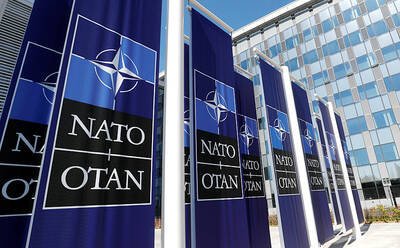
THE HAWAII FACTOR: While a 1965 opinion said an attack on Hawaii would not trigger Article 5, the text of the treaty suggests the state is covered, the report says NATO could be drawn into a conflict in the Taiwan Strait if Chinese forces attacked the US mainland or Hawaii, a NATO Defense College report published on Monday says. The report, written by James Lee, an assistant research fellow at Academia Sinica’s Institute of European and American Studies, states that under certain conditions a Taiwan contingency could trigger Article 5 of NATO, under which an attack against any member of the alliance is considered an attack against all members, necessitating a response. Article 6 of the North Atlantic Treaty specifies that an armed attack in the territory of any member in Europe,
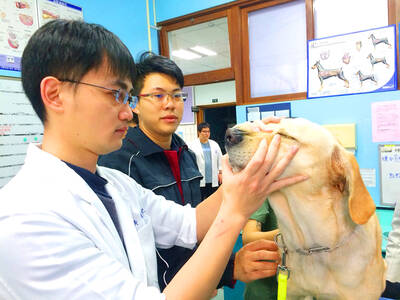
LIKE FAMILY: People now treat dogs and cats as family members. They receive the same medical treatments and tests as humans do, a veterinary association official said The number of pet dogs and cats in Taiwan has officially outnumbered the number of human newborns last year, data from the Ministry of Agriculture’s pet registration information system showed. As of last year, Taiwan had 94,544 registered pet dogs and 137,652 pet cats, the data showed. By contrast, 135,571 babies were born last year. Demand for medical care for pet animals has also risen. As of Feb. 29, there were 5,773 veterinarians in Taiwan, 3,993 of whom were for pet animals, statistics from the Animal and Plant Health Inspection Agency showed. In 2022, the nation had 3,077 pediatricians. As of last
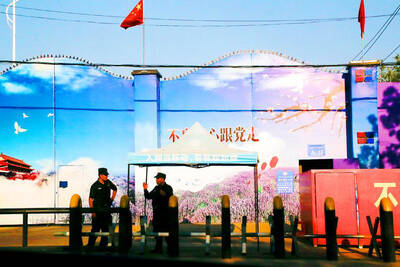
XINJIANG: Officials are conducting a report into amending an existing law or to enact a special law to prohibit goods using forced labor Taiwan is mulling an amendment prohibiting the importation of goods using forced labor, similar to the Uyghur Forced Labor Prevention Act (UFLPA) passed by the US Congress in 2021 that imposed limits on goods produced using forced labor in China’s Xinjiang region. A government official who wished to remain anonymous said yesterday that as the US customs law explicitly prohibits the importation of goods made using forced labor, in 2021 it passed the specialized UFLPA to limit the importation of cotton and other goods from China’s Xinjiang Uyghur region. Taiwan does not have the legal basis to prohibit the importation of goods


 RSS
RSS