


Former supermodel Wang Jing-ying's (王靜瑩) recent tearful allegations in the media that she was beaten by her husband have raised awareness of the seriousness of domestic violence. The charges have shattered the myth of what many saw as a fairy-tale-like marriage. But more importantly, Wang's case highlights the fact that domestic violence can happen to any woman, even the most rich and glamorous.
Once dubbed "the most beautiful China doll in Taiwan," Wang held a press conference early last week in which she accused her husband, Chen Wei-tao (陳威陶), a successful businessman, of assaulting her numerous times during their nine-month marriage. She alleged that several of the attacks occurred while she was pregnant, and that the latest beating had left her with six stitches around her right eye.
Chen has denied all accusations and is arguing that his wife suffers from severe post-partum depression and is mentally unstable.
But Wang has provided injury assessment reports and photographic evidence. She is currently waiting for a normal protection order, a process that takes two to three weeks.
Anti-domestic violence social groups and lawyers applauded Wang for her courageous decision to go public with her situation, and called on other victims to seek legal assistance as soon as possible.
"Domestic violence becomes a vicious cycle unless there is professional intervention," said Tung Fu-chuan (童富泉), director of the Center for the Prevention of Domestic Violence and Sexual Assault at the Ministry of Interior. "Victims should not put up with any abuse and assume that the situation will change for the better."
Statistics from the center show that about 20,000 women suffer from domestic violence each year, and that the number of victims grew 9 percent last year from 2003.
Domestic violence was long considered a family matter rather than a social problem. But now, a full six years since the passage of the Domestic Violence Prevention Act (家庭暴力防治法) and increased media coverage about the issue, many victims and their family members are still unwilling or too afraid to speak up and seek help.
Chang Chin-li (張錦麗), the chief operations officer of the Modern Women Foundation, said that besides treating domestic violence as a social problem rather than a family matter, a strong support system plays an important role in encouraging abused women to fight back.
"When women decide to leave their domestic turmoil behind them, they face numerous problems such as unemployment, meeting mortgage payments and taking care of their children. The government should provide a strong support system to make it easier for victims to leave their abuser," Chang said.
Yu Shiu-duan (俞秀端), a prosecutor at the Taipei District Court Prosecutor's Office, called on the public to learn more about what the law can do for them.
"The Domestic Violence Prevention Act doesn't just protect married couples and children. Foreigners and people who have already divorced their abusers can also seek legal protection under the act," Yu said.
Since the Domestic Violence Prevention Act took effect, local police stations have been equipped with officers trained to deal with domestic violence cases. Local court prosecutor offices and courts established "women and children protection" teams to provide protection to victims of domestic violence, according to Yu.
Victims can apply for a protection order to prevent further abuse. A victim may need to provide injury assessment reports, photos of the injury or injuries, tape recordings of threats or witnesses in order to file for a protection order. A protection order, which is in force for between one and two years, forbids abusers from approaching or assaulting victims.
According to Yu, the Civil Protection Clause (民事保護令) includes provisions for temporary and normal protection. A temporary order is designed to help victims who face immediate danger, and is issued within four hours. A normal protection order, on the other hand, requires two to three weeks to process, and stays in force for one to two years.
In addition to the MOI's "113" women and children's domestic abuse helpline and legal assistance from the local courts and police stations, victims of domestic abuse can also find help from various welfare groups.
The Legal Aid Foundation (法律扶助基金會) provides free service to victims of domestic violence. The Modern Women Foundation, Garden of Hope Foundation, and the Hualien Good Shepherd Center provide victims with counseling services and temporary residence in their emergency shelters.
Peng Li-cheng (彭麗真), director of the Garden of Hope Foundation's eastern branch, said that victims of domestic violence need more than legal protection.
"Emergency shelters provide a temporary home for abused women and their children so they can regain control over their lives, physically and mentally, before moving out on their own," she said.
Peng said that the government and civil groups are making a greater effort to battle domestic violence. The public should support victims like Wang who are brave enough to speak up, Peng said.
"Victims should not afraid of making a move to fight back against violence, because there is a lot of help out there," she added.
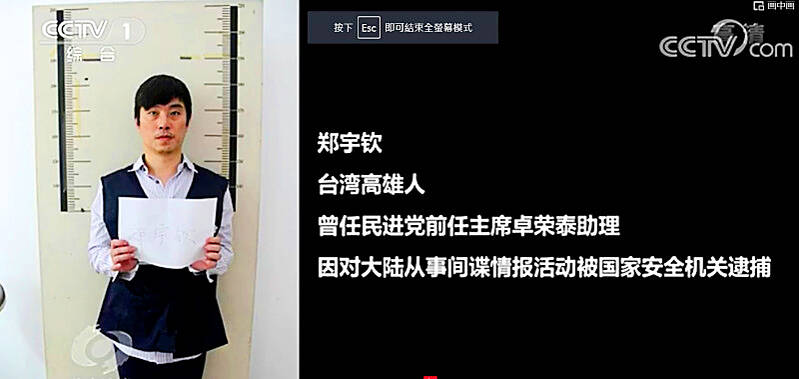
Former Czech Republic-based Taiwanese researcher Cheng Yu-chin (鄭宇欽) has been sentenced to seven years in prison on espionage-related charges, China’s Ministry of State Security announced yesterday. China said Cheng was a spy for Taiwan who “masqueraded as a professor” and that he was previously an assistant to former Cabinet secretary-general Cho Jung-tai (卓榮泰). President-elect William Lai (賴清德) on Wednesday last week announced Cho would be his premier when Lai is inaugurated next month. Today is China’s “National Security Education Day.” The Chinese ministry yesterday released a video online showing arrests over the past 10 years of people alleged to be

THE HAWAII FACTOR: While a 1965 opinion said an attack on Hawaii would not trigger Article 5, the text of the treaty suggests the state is covered, the report says NATO could be drawn into a conflict in the Taiwan Strait if Chinese forces attacked the US mainland or Hawaii, a NATO Defense College report published on Monday says. The report, written by James Lee, an assistant research fellow at Academia Sinica’s Institute of European and American Studies, states that under certain conditions a Taiwan contingency could trigger Article 5 of NATO, under which an attack against any member of the alliance is considered an attack against all members, necessitating a response. Article 6 of the North Atlantic Treaty specifies that an armed attack in the territory of any member in Europe,

LIKE FAMILY: People now treat dogs and cats as family members. They receive the same medical treatments and tests as humans do, a veterinary association official said The number of pet dogs and cats in Taiwan has officially outnumbered the number of human newborns last year, data from the Ministry of Agriculture’s pet registration information system showed. As of last year, Taiwan had 94,544 registered pet dogs and 137,652 pet cats, the data showed. By contrast, 135,571 babies were born last year. Demand for medical care for pet animals has also risen. As of Feb. 29, there were 5,773 veterinarians in Taiwan, 3,993 of whom were for pet animals, statistics from the Animal and Plant Health Inspection Agency showed. In 2022, the nation had 3,077 pediatricians. As of last

XINJIANG: Officials are conducting a report into amending an existing law or to enact a special law to prohibit goods using forced labor Taiwan is mulling an amendment prohibiting the importation of goods using forced labor, similar to the Uyghur Forced Labor Prevention Act (UFLPA) passed by the US Congress in 2021 that imposed limits on goods produced using forced labor in China’s Xinjiang region. A government official who wished to remain anonymous said yesterday that as the US customs law explicitly prohibits the importation of goods made using forced labor, in 2021 it passed the specialized UFLPA to limit the importation of cotton and other goods from China’s Xinjiang Uyghur region. Taiwan does not have the legal basis to prohibit the importation of goods


 RSS
RSS