


Taipei Times: Since your inauguration as Taiwan's representative to Germany on May 5, you've done some things your predecessors never did, like attending public events with Tibetans and Falungong members. Why is that?
Shieh Jhy-wey (謝志偉): First of all, I have to stress that the difficult process for Taiwan in transforming itself into a democratic country has shaped the thinking of my generation. My concern for human rights goes far beyond political issues. In early June, I took part in a panel discussion held by the Epoch Times, which is closely associated with the Falungong movement and fights for their religious freedoms, particularly in light of the recent anniversary of the Tiananmen Square Massacre.
When the Dalai Lama came to Berlin in June to give awards to long-time supporters of the Tibetan people, including former Czech president Vaclav Havel, I was invited to the ceremony. I took the opportunity to show my support to victims suppressed by illegitimate governments. My opinion could be said to be representative of the Taiwanese people's notion of right and wrong. Why should I avoid attending with public events?
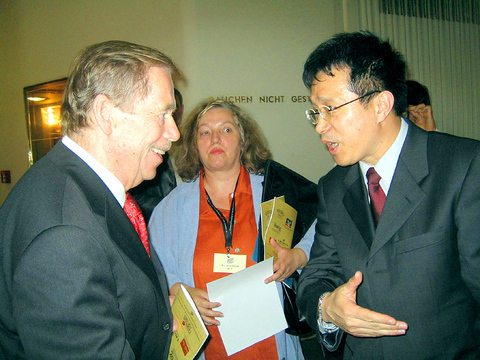
PHOTO: CHIU YU-TZU, TAIPEI TIMES
TT: Is your personal attitude linked to the Democratic Progressive Party's (DPP) ideas on diplomatic strategy?
Shieh: The diplomatic strategies adopted by the Taiwanese government -- and by extension the DPP -- are not based on the notion that conservatism is best. It's not about merely defending Taiwan's right to participate in the international community. Since we are discontent with the unfair treatment we receive in the global arena -- the result of China's unreasonable and hostile attitude -- we have to fight for justice.
For example, Taiwan's old-fashioned, conservative diplomatic policy sought to avoid the appearance of the name "Taiwan" in public. The name of Taiwan's office here in Berlin is the "Taipei Representative Office in Germany." Some German politicians said to me, "we don't forbid you calling yourself Taiwan." This shows that even though everyone can call us "Taiwan," we cannot call ourselves Taiwan. Taiwanese people's feelings about being wrongly treated must be brought to light. Their opposition to the so-called "one China policy" must be made known in the international community.
TT: In addition to China's refusal that the name "Taiwan" be used in the global political arena, can you give other examples of how Taiwan has been unfairly treated?
Shieh: Yes. Germany has unfairly treated Taiwan's top political leaders -- the president, vice president, premier, foreign affairs minister and minister of national defense are forbidden from entering Germany. Why are they on a "no admittance" blacklist? Are they criminals?
Of course we cannot expect other countries to focus on certain issues as intensely as Taiwan does. However, if you ask me why I challenge certain unreasonable policies toward Taiwan, which are basically products of a specific nation's adherence to the "one China" principle, it's because Taiwan really has nothing to lose and everything to gain. We have been victimized by unjust policies for decades. So our requests for justice now are not unreasonable or made out of the blue.
Don't forget that German history is rife with periods of discontent among a widespread portion of the society. Martin Luther once said, "Here I stand. I have no alternative. God helps me. Amen." I'm sort of in a similar situation, in that I have to fight for justice on Taiwan's behalf and say what I believe.
TT: So what are your highest priorities an the moment?
Shieh: My first priority here is to let German people know that Taiwan has changed a lot. We've fought for democracy for a long time. If we don't take actions in diplomatic fields, how can we expect the rest of the world to understand that Taiwan is being mistreated? If the Dalai Lama remained silent about how the Tibetans have been treated by China's tyrannical regime, would so many people now fight with them against injustice?
Of course, I clearly understand that Germany is like many other countries, in that they are crazy about getting access to China expanding market. However, I'm sure the German people would never abandon their core values, particularly human rights. While watching the diversity of opinions from a number of political parties campaigning for the German parliamentary elections this September, I'd say Taiwan supports those parties that stand firmly for justice.
TT: Are you confident that you can deliver the correct about Taiwan to the German government?
Shieh: Yes. I'm not like certain Taiwanese political figures who embrace China in order to confuse the international community and compromise Taiwan's democratic achievements. Could the German people imagine that in the era prior to unification in 1989, some leading political figures from West Germany shaking hands with their counterparts in the East? Probably not.
So how could one accept the notion that Taiwan's democratic system could work with that of communist China's? Before Martial Law was lifted in 1987, the real voice of the Taiwanese was rarely heard. Now the old leaders of the ROC regime want to work with China in order to damage Taiwan's democracy. We have to make this point clear in the international society.
Don't forget the words of German writer Johann Wolfgang von Goethe: "I prefer a harmful truth to a useful error. A harmful truth can only be harmful for the moment and will lead to other truths that will, of necessity, become more and more useful."
To sum up, the country's future should be decided by the Taiwanese people's will, and not by certain political figures who have betrayed the nation.
TT: Do you have practical ways to further promote the relations between Taiwan and Germany?
Shieh: Bilateral exchanges will take place on a diverse range of issues, including politics, the economy, culture, and science and technology. For example, we are establishing the Taiwan-Germany Cultural Awards for contributions to not only bilateral cultural exchanges but also long-term devotion to Taiwan studies.
In addition, we will advance exchanges on technology pertaining to renewable energy. Germany's scrapping a second nuclear power plant in May was based on existing policies. We will keep observing the nation's energy policy to see if they will change after the parliamentary elections are held in September.
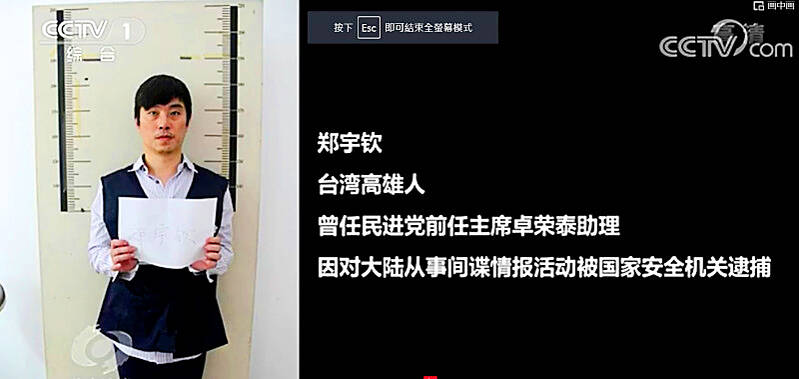
Former Czech Republic-based Taiwanese researcher Cheng Yu-chin (鄭宇欽) has been sentenced to seven years in prison on espionage-related charges, China’s Ministry of State Security announced yesterday. China said Cheng was a spy for Taiwan who “masqueraded as a professor” and that he was previously an assistant to former Cabinet secretary-general Cho Jung-tai (卓榮泰). President-elect William Lai (賴清德) on Wednesday last week announced Cho would be his premier when Lai is inaugurated next month. Today is China’s “National Security Education Day.” The Chinese ministry yesterday released a video online showing arrests over the past 10 years of people alleged to be
THE HAWAII FACTOR: While a 1965 opinion said an attack on Hawaii would not trigger Article 5, the text of the treaty suggests the state is covered, the report says NATO could be drawn into a conflict in the Taiwan Strait if Chinese forces attacked the US mainland or Hawaii, a NATO Defense College report published on Monday says. The report, written by James Lee, an assistant research fellow at Academia Sinica’s Institute of European and American Studies, states that under certain conditions a Taiwan contingency could trigger Article 5 of NATO, under which an attack against any member of the alliance is considered an attack against all members, necessitating a response. Article 6 of the North Atlantic Treaty specifies that an armed attack in the territory of any member in Europe,
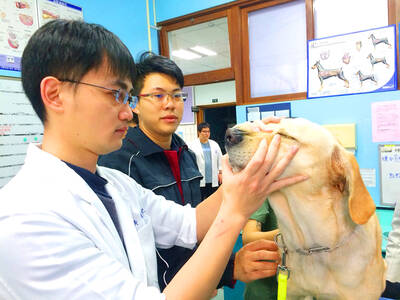
LIKE FAMILY: People now treat dogs and cats as family members. They receive the same medical treatments and tests as humans do, a veterinary association official said The number of pet dogs and cats in Taiwan has officially outnumbered the number of human newborns last year, data from the Ministry of Agriculture’s pet registration information system showed. As of last year, Taiwan had 94,544 registered pet dogs and 137,652 pet cats, the data showed. By contrast, 135,571 babies were born last year. Demand for medical care for pet animals has also risen. As of Feb. 29, there were 5,773 veterinarians in Taiwan, 3,993 of whom were for pet animals, statistics from the Animal and Plant Health Inspection Agency showed. In 2022, the nation had 3,077 pediatricians. As of last

XINJIANG: Officials are conducting a report into amending an existing law or to enact a special law to prohibit goods using forced labor Taiwan is mulling an amendment prohibiting the importation of goods using forced labor, similar to the Uyghur Forced Labor Prevention Act (UFLPA) passed by the US Congress in 2021 that imposed limits on goods produced using forced labor in China’s Xinjiang region. A government official who wished to remain anonymous said yesterday that as the US customs law explicitly prohibits the importation of goods made using forced labor, in 2021 it passed the specialized UFLPA to limit the importation of cotton and other goods from China’s Xinjiang Uyghur region. Taiwan does not have the legal basis to prohibit the importation of goods


 RSS
RSS