


The Cabinet yesterday said that officials will seriously consider the idea of men not having to wear suits to work every day.
"This is such a good idea. We will seriously consider it but the final decision will be up to the premier," Cabinet Spokesman Cho Jung-tai (卓榮泰) said.
Cho made the remarks while waiting with fellow Cabinet members for Premier Frank Hsieh's (謝長廷) arrival at a Government Officials' Training Center meeting, held yesterday morning.
less formal attire
The idea of men wearing less formal attire to work originated in Japan, which has introduced a casual dress code so that air-conditioners can be turned down, to save electricity and help the country reduce greenhouse gas emissions.
Under the measure, air-conditioners must be set at 28 degrees Celsius, and men will not have to wear a suit and tie between June 1 and Sept. 30, so that more air-conditioners can be turned down, or off.
`island wear'
To carry out this new policy, Japanese Prime Minister Junichiro Koizumi began to wear "island wear" shirts, which are popular and regarded as formal wear for men in Southeast Asia and most south Pacific island countries, to work every day.
The "island wear" shirts have become more popular recently in Japan as well.
In fact, Vice President Annette Lu (呂秀蓮) proposed the idea of replacing men's suits with "island wear" shirts three years ago, and she began to ask her guards and staff members to do so.
However, the vice president's proposal did not receive much attention three years ago.
During a recent trip to visit Taiwan's allies in the Pacific, President Chen Shui-bian (陳水扁) was also seen sporting the colorful "island wear."
"If I am allowed not to wear my suit and tie, I will be more than happy to do so," Minister of Education Tu Cheng-sheng (杜正勝) said.
"In addition to being more comfortable, this idea will help preserve our natural resources and protect the environment as well," he added.

Former president Ma Ying-jeou’s (馬英九) mention of Taiwan’s official name during a meeting with Chinese President Xi Jinping (習近平) on Wednesday was likely a deliberate political play, academics said. “As I see it, it was intentional,” National Chengchi University Graduate Institute of East Asian Studies professor Wang Hsin-hsien (王信賢) said of Ma’s initial use of the “Republic of China” (ROC) to refer to the wider concept of “the Chinese nation.” Ma quickly corrected himself, and his office later described his use of the two similar-sounding yet politically distinct terms as “purely a gaffe.” Given Ma was reading from a script, the supposed slipup
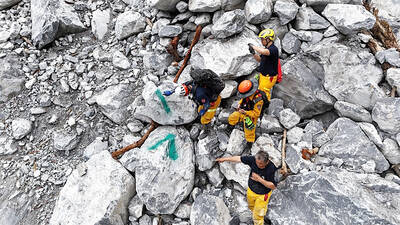
The bodies of two individuals were recovered and three additional bodies were discovered on the Shakadang Trail (砂卡礑) in Taroko National Park, eight days after the devastating earthquake in Hualien County, search-and-rescue personnel said. The rescuers reported that they retrieved the bodies of a man and a girl, suspected to be the father and daughter from the Yu (游) family, 500m from the entrance of the trail on Wednesday. The rescue team added that despite the discovery of the two bodies on Friday last week, they had been unable to retrieve them until Wednesday due to the heavy equipment needed to lift
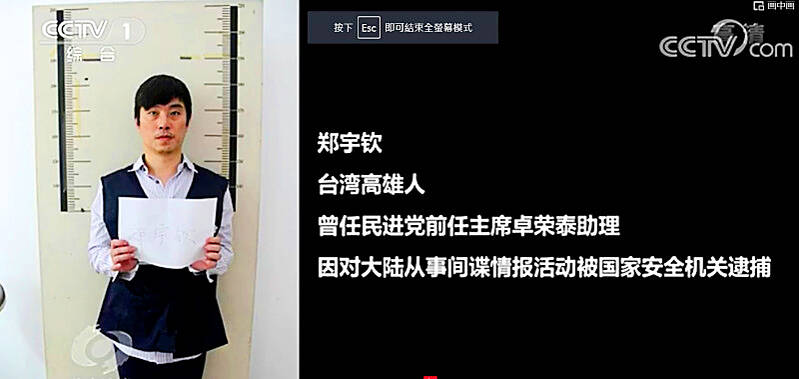
Former Czech Republic-based Taiwanese researcher Cheng Yu-chin (鄭宇欽) has been sentenced to seven years in prison on espionage-related charges, China’s Ministry of State Security announced yesterday. China said Cheng was a spy for Taiwan who “masqueraded as a professor” and that he was previously an assistant to former Cabinet secretary-general Cho Jung-tai (卓榮泰). President-elect William Lai (賴清德) on Wednesday last week announced Cho would be his premier when Lai is inaugurated next month. Today is China’s “National Security Education Day.” The Chinese ministry yesterday released a video online showing arrests over the past 10 years of people alleged to be
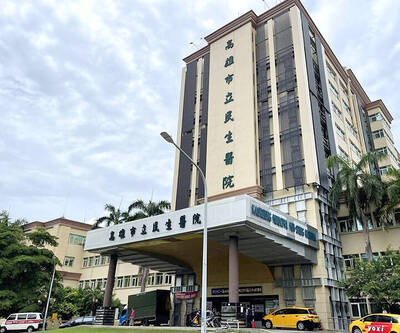
MIX-UP: Kaohsiung Municipal Min-Sheng Hospital director Yen Chia-chi was suspended from his duties after surgeons operated on the wrong patient last week The Kaohsiung Department of Health yesterday fined Kaohsiung Municipal Min-Sheng Hospital NT$500,0000 for misidentifying two patients and consequently causing one of them to undergo the wrong surgery last week. The hospital’s director Yen Chia-chi (顏家祺) was suspended from his duties. The surgeon who was scheduled to operate on the patient was given a major demerit and is subject to subsequent disciplinary actions. Demerits were given to the anesthesiologist, the nurse in the operation room, the nurse in the ward and the worker who helped transfer the patient from the ward to the operation room for having failed to verify the patient’s identity. Meanwhile, the


 RSS
RSS