


When Taiwan launched its first bid to re-enter the World Health Organization (WHO) in 1997 -- after being ousted from the UN health body 25 years earlier -- physician Wu Shuh-min (
Wu managed to recruit a hundred Taiwanese doctors, all in white, to stand at the entrance of the venue of the World Health Assembly (WHA), the WHO's highest governing body, and hold banners backing Taiwan's campaign.
That day, Wu recalled, rain and wind buffeted the doctors. After the small rally outside the assembly, Wu and his friends wanted to sit in the assembly gallery to listen to the meetings.
"But the security guards refused to let us in. I argued with their boss, who finally agreed to permit us to listen to the sessions," said Wu, now president of the Foundation of Medical Professionals Alliance in Taiwan, the country's main NGO (non-governmental organization) pushing the WHO bid.
The first year's experience participating in Taiwan's diplomatic efforts to join the WHO in Geneva left a deep impression on Wu.
As an NGO trying to contribute to Taiwan's diplomacy, Wu's foundation's difficulties began not in Switzerland, but here in Taiwan.
Before the WHA in 1997, the foundation contacted the Ministry of Foreign Affairs (MOFA), then headed by John Chiang (
"We received an icy response from MOFA," Wu said. "Its officials treated us as outsiders."
Nevertheless, Wu and MOFA discussed about 10 titles that Taiwan might use to enter the WHO.
"One title that we all knew we could not use was the `Republic of Taiwan,'" Wu said.
At that time, the Taiwanese government did not want the country's NGOs to get involved in its affairs, particularly in diplomacy.
"Government officials really disliked us," said a long-time Taiwanese NGO worker who was slighted by Taiwanese diplomats in Geneva in 1997.
"But actually NGOs can be more creative than government officials because they have less constraints," said the NGO worker, who requested anonymity.
The public used to have the impression that only elites who "wore suits and put on neckties" were capable of doing diplomatic work, said Lin Shih-chia (林世嘉), executive director of the foundation.
Lin, a graduate of National Taiwan University's Department of Public Health, has an unconventional view of what diplomacy can be like.
Lin went to Geneva with the foundation in 1997. After a two- year break, in which she worked for the Taipei City Government, Lin rejoined the foundation's annual trip to Geneva in 2000.
Since then, each year Lin has led a group of Taiwanese to chant slogans and hold banners in a square near the WHA venue. The group has called for international support for Taiwan's entry into the health body and protested against the WHO's unfair treatment of Taiwan.
While some view Taiwan's small annual demonstration in Geneva as too bold, Lin said the protests served their intended purpose.
"We were very clear why we did that," Lin said. "It was our way of expressing ourselves. We chose this manner of expression in a place like Geneva because we knew that by doing so we could draw attention."
Not all government officials disliked the country's NGO's activities in Geneva during the WHA. Some, such as Vice Minister of Foreign Affairs Michael Kau (
This year, the foundation plans to send a delegation to Geneva again. Wu, now a national policy adviser, will lobby in several European countries, including Germany, the UK and Luxembourg, before arriving in Geneva for the WHA, which starts on May 16.
Though the early years of pushing for Taiwan's entry into the WHO were hard, Wu has sensed a remarkable change in the government's attitude toward NGO participation in diplomatic affairs in recent years.
"The KMT government became more friendly to us later on because it was aware of the significance of Taiwan's entry into the WHO," Wu said. "The Democratic Progressive Party government has included NGO participation in the health bid since the establishment of an inter-ministerial WHO task force."
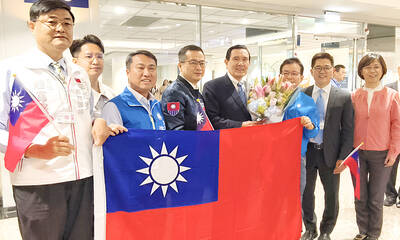
Former president Ma Ying-jeou’s (馬英九) mention of Taiwan’s official name during a meeting with Chinese President Xi Jinping (習近平) on Wednesday was likely a deliberate political play, academics said. “As I see it, it was intentional,” National Chengchi University Graduate Institute of East Asian Studies professor Wang Hsin-hsien (王信賢) said of Ma’s initial use of the “Republic of China” (ROC) to refer to the wider concept of “the Chinese nation.” Ma quickly corrected himself, and his office later described his use of the two similar-sounding yet politically distinct terms as “purely a gaffe.” Given Ma was reading from a script, the supposed slipup
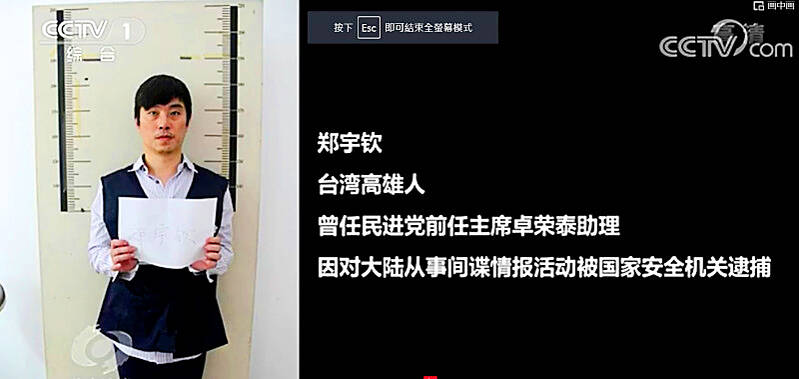
Former Czech Republic-based Taiwanese researcher Cheng Yu-chin (鄭宇欽) has been sentenced to seven years in prison on espionage-related charges, China’s Ministry of State Security announced yesterday. China said Cheng was a spy for Taiwan who “masqueraded as a professor” and that he was previously an assistant to former Cabinet secretary-general Cho Jung-tai (卓榮泰). President-elect William Lai (賴清德) on Wednesday last week announced Cho would be his premier when Lai is inaugurated next month. Today is China’s “National Security Education Day.” The Chinese ministry yesterday released a video online showing arrests over the past 10 years of people alleged to be
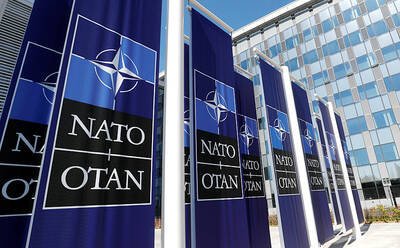
THE HAWAII FACTOR: While a 1965 opinion said an attack on Hawaii would not trigger Article 5, the text of the treaty suggests the state is covered, the report says NATO could be drawn into a conflict in the Taiwan Strait if Chinese forces attacked the US mainland or Hawaii, a NATO Defense College report published on Monday says. The report, written by James Lee, an assistant research fellow at Academia Sinica’s Institute of European and American Studies, states that under certain conditions a Taiwan contingency could trigger Article 5 of NATO, under which an attack against any member of the alliance is considered an attack against all members, necessitating a response. Article 6 of the North Atlantic Treaty specifies that an armed attack in the territory of any member in Europe,
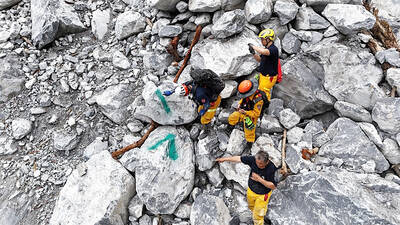
The bodies of two individuals were recovered and three additional bodies were discovered on the Shakadang Trail (砂卡礑) in Taroko National Park, eight days after the devastating earthquake in Hualien County, search-and-rescue personnel said. The rescuers reported that they retrieved the bodies of a man and a girl, suspected to be the father and daughter from the Yu (游) family, 500m from the entrance of the trail on Wednesday. The rescue team added that despite the discovery of the two bodies on Friday last week, they had been unable to retrieve them until Wednesday due to the heavy equipment needed to lift


 RSS
RSS