


An article by Taiwan's medical mission in Malawi on fingerprint identification of AIDS patients was published in the latest edition of the British medical journal The Lancet, which came out last Saturday.
It is the first time the world's leading medical journal has published a paper by an overseas Taiwanese medical mission.
`Milestone'
The Department of Health (DOH) hailed the achievement as "a milestone in our nation's history of providing medical aid for foreign countries."
Written by Dr. Yu Kwang-leung (余廣亮), Dr. Chen Chih-cheng (陳志成) and three other doctors on the team, the article, "Fingerprint identification of AIDS patients on ART," explains how a fingerprint-identification system was established at the Mzuzu Central Hospital in Malawi.
Last May Malawai's Ministry of Health launched a national anti-retroviral therapy (ART) scale-up program.
Mzuzu Central Hospital in the north of the country opened an ART clinic -- the Rainbow Clinic -- for AIDS patients on July 1.
"To ensure the effective monitoring of drug distribution and adherence among eligible patients, we have introduced a fingerprint identification system [FPIS: one computer, one fingerprint recorder, one bar-code reader, one printer and software]," the doctors wrote in the medical journal.
Fraud protection
Fingerprinting is helpful in identifying registered AIDS patients and FPIS can be an important security measure to prevent impostors from fraudulently attempting to obtain anti-retroviral (ARV) drugs, especially in a country without national ID cards or social security numbers, the doctors wrote.
Quick and accurate
For ethical considerations, the doctors wrote, FPIS uses only one fingerprint, which is matched to a registered number, to identify each patient quickly and accurately.
"FPIS can generate a specific bar-code number for each patient every time. This number can be attached to his or her own ARV drug tin and helps to trace the ARV drugs in case they are lost for sale in the market," they explained. "FPIS makes the follow-up of every patient's adherence to ARV drugs much easier and eliminates the need for laborious work such as entering and analyzing data manually."
Registration
From July to December last year a total of 1,100 eligible patients were registered at Rainbow Clinic, according to the paper.
The average cost of a standard FPIS set-up, suitable for a single clinic room, is US$2,000. Hospitals with more than one ART clinic room may need a centralized server for data storage and backup, which may result in higher costs.
Time saver
"However, we believe the digitalization of data management will save on cost in the long run ? From our experience, FPIS can be beneficial in reducing manpower requirements in ART clinics," the paper said.

THE HAWAII FACTOR: While a 1965 opinion said an attack on Hawaii would not trigger Article 5, the text of the treaty suggests the state is covered, the report says NATO could be drawn into a conflict in the Taiwan Strait if Chinese forces attacked the US mainland or Hawaii, a NATO Defense College report published on Monday says. The report, written by James Lee, an assistant research fellow at Academia Sinica’s Institute of European and American Studies, states that under certain conditions a Taiwan contingency could trigger Article 5 of NATO, under which an attack against any member of the alliance is considered an attack against all members, necessitating a response. Article 6 of the North Atlantic Treaty specifies that an armed attack in the territory of any member in Europe,
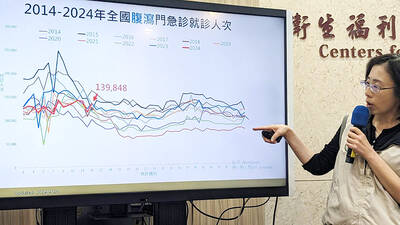
FLU SEASON: Twenty-six severe cases were reported from Tuesday last week to Monday, including a seven-year-old girl diagnosed with influenza-associated encephalopathy Nearly 140,000 people sought medical assistance for diarrhea last week, the Centers for Disease Control (CDC) said on Tuesday. From April 7 to Saturday last week, 139,848 people sought medical help for diarrhea-related illness, a 15.7 percent increase from last week’s 120,868 reports, CDC Epidemic Intelligence Center Deputy Director Lee Chia-lin (李佳琳) said. The number of people who reported diarrhea-related illness last week was the fourth highest in the same time period over the past decade, Lee said. Over the past four weeks, 203 mass illness cases had been reported, nearly four times higher than the 54 cases documented in the same period
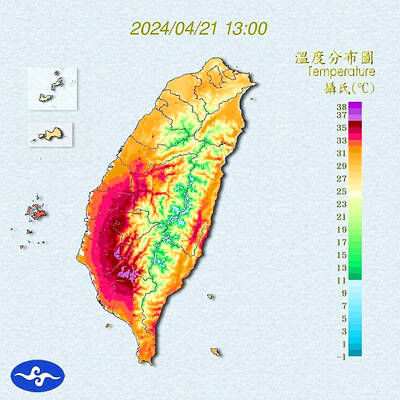
Heat advisories were in effect for nine administrative regions yesterday afternoon as warm southwesterly winds pushed temperatures above 38°C in parts of southern Taiwan, the Central Weather Administration (CWA) said. As of 3:30pm yesterday, Tainan’s Yujing District (玉井) had recorded the day’s highest temperature of 39.7°C, though the measurement will not be included in Taiwan’s official heat records since Yujing is an automatic rather than manually operated weather station, the CWA said. Highs recorded in other areas were 38.7°C in Kaohsiung’s Neimen District (內門), 38.2°C in Chiayi City and 38.1°C in Pingtung’s Sandimen Township (三地門), CWA data showed. The spell of scorching

A group of Taiwanese-American and Tibetan-American students at Harvard University on Saturday disrupted Chinese Ambassador to the US Xie Feng’s (謝鋒) speech at the school, accusing him of being responsible for numerous human rights violations. Four students — two Taiwanese Americans and two from Tibet — held up banners inside a conference hall where Xie was delivering a speech at the opening ceremony of the Harvard Kennedy School China Conference 2024. In a video clip provided by the Coalition of Students Resisting the CCP (Chinese Communist Party), Taiwanese-American Cosette Wu (吳亭樺) and Tibetan-American Tsering Yangchen are seen holding banners that together read:


 RSS
RSS