


The Democratic Progressive Party (DPP) legislative caucus yesterday made a last-ditch call to Chinese Nationalist Party (KMT) Chairman Lien Chan (
"We hope that Lien voices the nation's opposition to the `Anti-Secession' Law and asks the Chinese government to destroy all the missiles targeting us," DPP caucus whip Lai Ching-te (
Lien leaves today on an eight-day trip to China.
Lai had also asked Lien to address President Chen Shui-bian (
"If he calls President Chen `mister', he should do the same for Chinese President Hu Jintao (胡錦濤)," he said.
During the phone conversation yesterday, Lien addressed Chen as "Brother Shui-bian."
The term delivers a sense of respect in Mandarin.
Questioning the timing of Lien's visit, Lai said that he owes the public an explanation as to why the trip is being dubbed a "journey of peace."
"We are very curious about its true meaning," he said. "Is it a temporary and bogus peace because he will abandon Taiwan's sovereignty and sabotage the interests of the people of Taiwan, or is it genuine because it is based on equality and dignity, in which he will insist on safeguarding national sovereignty, the national interest, and freedom and democracy while talking with the Chinese authorities?"
Lai also urged Lien to ask his party and the KMT legislative caucus to re-open the door for cross-party negotiations and extend the legislative session to help pass significant bills, especially those concerning people's livelihoods.
"It just does not make sense for him to conduct a so-called `journey of peace' to China, while allowing his lawmakers to boycott government bills and refuse talks with the ruling party," he said.
DPP Legislator Jao Yung-ching (
The KMT and People First Party (PFP) caucuses withdrew from cross-party talks to protest an investigation into KMT Vice Chairman Chiang Pin-kung's (江丙坤) trip to China. They have refused to return to the negotiation table unless the DPP makes "goodwill gestures."
Jao said that Lien owes the public an explanation as to what his mission is, and that he felt sorry for Lien's "sarcastic" and "disdainful" attitude toward reporting to the government about his visit.
Responding to the DPP's call to resume cross-party negotiations, six KMT and PFP lawmakers, calling themselves the "G6" or "good six" alliance, said that they would make an effort to help push the passage of "non-confidential" bills.
However, they said that blame for sluggish progress does not lie solely with the lawmaking body.
They called on the Executive Yuan to take a more pro-active approach in its attempt to pass bills that it deems important.
"Only if the Executive Yuan takes the initiative to cooperate and reconcile with opposition parties can the Legislative Yuan make progress," KMT Legislator John Wu (
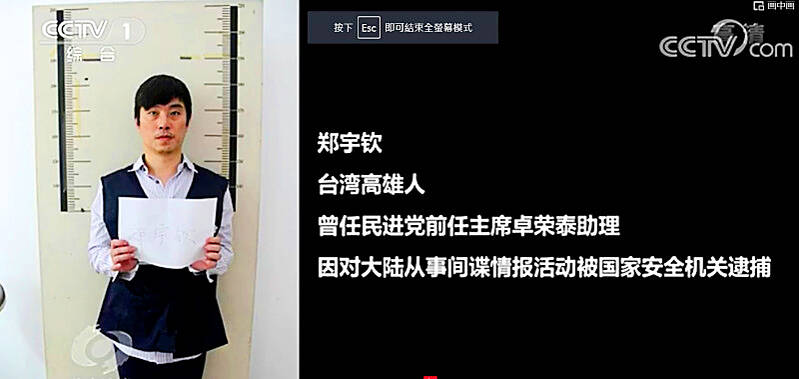
Former Czech Republic-based Taiwanese researcher Cheng Yu-chin (鄭宇欽) has been sentenced to seven years in prison on espionage-related charges, China’s Ministry of State Security announced yesterday. China said Cheng was a spy for Taiwan who “masqueraded as a professor” and that he was previously an assistant to former Cabinet secretary-general Cho Jung-tai (卓榮泰). President-elect William Lai (賴清德) on Wednesday last week announced Cho would be his premier when Lai is inaugurated next month. Today is China’s “National Security Education Day.” The Chinese ministry yesterday released a video online showing arrests over the past 10 years of people alleged to be
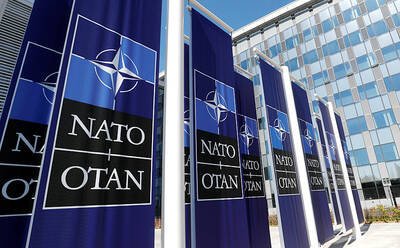
THE HAWAII FACTOR: While a 1965 opinion said an attack on Hawaii would not trigger Article 5, the text of the treaty suggests the state is covered, the report says NATO could be drawn into a conflict in the Taiwan Strait if Chinese forces attacked the US mainland or Hawaii, a NATO Defense College report published on Monday says. The report, written by James Lee, an assistant research fellow at Academia Sinica’s Institute of European and American Studies, states that under certain conditions a Taiwan contingency could trigger Article 5 of NATO, under which an attack against any member of the alliance is considered an attack against all members, necessitating a response. Article 6 of the North Atlantic Treaty specifies that an armed attack in the territory of any member in Europe,
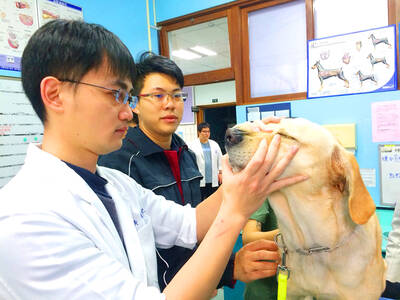
LIKE FAMILY: People now treat dogs and cats as family members. They receive the same medical treatments and tests as humans do, a veterinary association official said The number of pet dogs and cats in Taiwan has officially outnumbered the number of human newborns last year, data from the Ministry of Agriculture’s pet registration information system showed. As of last year, Taiwan had 94,544 registered pet dogs and 137,652 pet cats, the data showed. By contrast, 135,571 babies were born last year. Demand for medical care for pet animals has also risen. As of Feb. 29, there were 5,773 veterinarians in Taiwan, 3,993 of whom were for pet animals, statistics from the Animal and Plant Health Inspection Agency showed. In 2022, the nation had 3,077 pediatricians. As of last
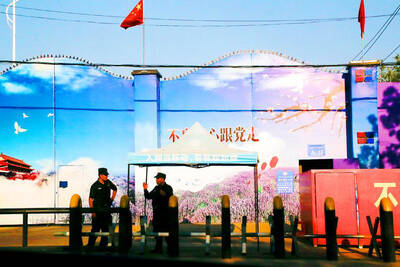
XINJIANG: Officials are conducting a report into amending an existing law or to enact a special law to prohibit goods using forced labor Taiwan is mulling an amendment prohibiting the importation of goods using forced labor, similar to the Uyghur Forced Labor Prevention Act (UFLPA) passed by the US Congress in 2021 that imposed limits on goods produced using forced labor in China’s Xinjiang region. A government official who wished to remain anonymous said yesterday that as the US customs law explicitly prohibits the importation of goods made using forced labor, in 2021 it passed the specialized UFLPA to limit the importation of cotton and other goods from China’s Xinjiang Uyghur region. Taiwan does not have the legal basis to prohibit the importation of goods


 RSS
RSS