


"I am only one, but still I am one. I cannot do everything, but still I can do something. I will not refuse to do the something I can do," Helen Keller, the renowned deaf-blind American author and lecturer, once said.
And one can't but agree with Keller after watching the film Capturing Dreams in the Dark and be in awe of Lu Wen-kuei (呂文貴), Lin Wei-chih (林偉智) and Chuang Fu-hua's (莊馥華) brilliance and persistence they display despite their developmental disabilities.
When one hears Lu play Beethoven's Moonlight Sonata, one can't believe that he is mentally retarded and totally blind. When one hears Lin pinpoint with ease any date on the calendar, one can't believe that he is congenitally blind and suffering from dereism; and when one reads the poems composed by Chuang, one finds it hard believe she is blind and suffers from paraplegia and communication difficulties.
Tales of their struggles and achievements depicted in the documentary produced by National Changhua University's special education professor Wan Ming-mei (萬明美) are examples of people who suffer from the Savant syndrome.
Savant syndrome is a rare but remarkable condition in which people with serious mental handicaps such as autism, Williams syndrome or other major mental illness have astonishing islands of brilliance that stand in stark, markedly incongruous contrast to the overall disability.
"I was deeply moved by the film and am grateful of the unknown heroes behind the set who are willing to put together the film," President Chen Shui-bian (
Chen made the remarks at the Presidential Office yesterday after watching the film with the three subjects, their teacher and families. Reporters covering the Presidential Office were also invited to watch the film.
The documentary was part of the National Science Council's sponsored research project on Savant syndrome.
The 21-year old Lu is a Paiwan Aboriginal who is blind and mentally retarded. Once isolated by his family when it was discovered he had a disability in Santimen, Pingtung County, Lu's musical talent was not discovered by his teachers until at age of 12, when he came across a piano and played without difficulty songs he had previously heard.
Lu's teachers later discovered that Lu could play many kinds of musical instruments, and play a song after hearing it only once, even though he cannot even solve the simplest math problems.
Lin, 19, although congenitally blind and mentally retarded, can pinpoint any day of the week in the past decade. Using only her sense of hearing, she can also distinguish between different types of trains, and tell how many cars there are attached to a passing train.
Chuang, 21, also suffers from visual impairment, paraplegia and communication problems after being injured in a fire at the age of 10.
By using a special tool for typing and wagging her head, blinking her eyes to express phonetic symbols, Chuang has written more than 200 poems. Some of her pieces have been published in daily newspapers.
Noting that developmentally challenged individuals have to work harder than others to achieve what they do, the president lauded the three as "life warriors" and encouraged them to keep in mind that "the most important thing of all is to keep chasing their dreams."
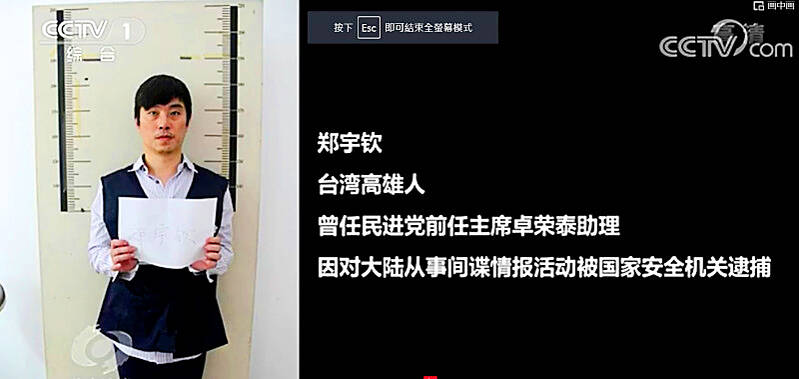
Former Czech Republic-based Taiwanese researcher Cheng Yu-chin (鄭宇欽) has been sentenced to seven years in prison on espionage-related charges, China’s Ministry of State Security announced yesterday. China said Cheng was a spy for Taiwan who “masqueraded as a professor” and that he was previously an assistant to former Cabinet secretary-general Cho Jung-tai (卓榮泰). President-elect William Lai (賴清德) on Wednesday last week announced Cho would be his premier when Lai is inaugurated next month. Today is China’s “National Security Education Day.” The Chinese ministry yesterday released a video online showing arrests over the past 10 years of people alleged to be

THE HAWAII FACTOR: While a 1965 opinion said an attack on Hawaii would not trigger Article 5, the text of the treaty suggests the state is covered, the report says NATO could be drawn into a conflict in the Taiwan Strait if Chinese forces attacked the US mainland or Hawaii, a NATO Defense College report published on Monday says. The report, written by James Lee, an assistant research fellow at Academia Sinica’s Institute of European and American Studies, states that under certain conditions a Taiwan contingency could trigger Article 5 of NATO, under which an attack against any member of the alliance is considered an attack against all members, necessitating a response. Article 6 of the North Atlantic Treaty specifies that an armed attack in the territory of any member in Europe,

LIKE FAMILY: People now treat dogs and cats as family members. They receive the same medical treatments and tests as humans do, a veterinary association official said The number of pet dogs and cats in Taiwan has officially outnumbered the number of human newborns last year, data from the Ministry of Agriculture’s pet registration information system showed. As of last year, Taiwan had 94,544 registered pet dogs and 137,652 pet cats, the data showed. By contrast, 135,571 babies were born last year. Demand for medical care for pet animals has also risen. As of Feb. 29, there were 5,773 veterinarians in Taiwan, 3,993 of whom were for pet animals, statistics from the Animal and Plant Health Inspection Agency showed. In 2022, the nation had 3,077 pediatricians. As of last

XINJIANG: Officials are conducting a report into amending an existing law or to enact a special law to prohibit goods using forced labor Taiwan is mulling an amendment prohibiting the importation of goods using forced labor, similar to the Uyghur Forced Labor Prevention Act (UFLPA) passed by the US Congress in 2021 that imposed limits on goods produced using forced labor in China’s Xinjiang region. A government official who wished to remain anonymous said yesterday that as the US customs law explicitly prohibits the importation of goods made using forced labor, in 2021 it passed the specialized UFLPA to limit the importation of cotton and other goods from China’s Xinjiang Uyghur region. Taiwan does not have the legal basis to prohibit the importation of goods


 RSS
RSS