


In an effort to highlight the importance it attaches to Aboriginals, the Democratic Progressive Party (DPP) nominated seven Aboriginal candidates for the National Assembly elections on May 14.
The selection of Aboriginal candidates to be included in the DPP's list of 150 nominees for the National Assembly elections represents the party's respect for the group by including them in the constitutional amendment process, DPP officials said.
"Aboriginal peoples are the original inhabitants of Taiwan," said DPP Chairman Su Tseng-chang (蘇貞昌), after introducing the seven Aboriginal candidates last week. "They should enjoy the right to participate in constitutional amendments."
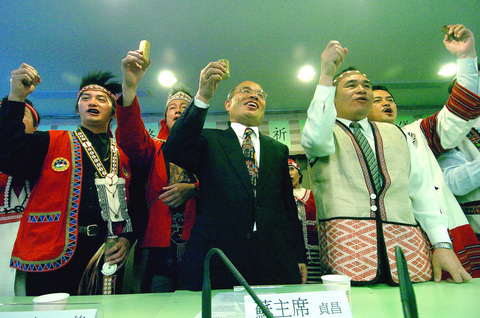
PHOTO: SEAN CHAO, TAIPEI TIMES
In a blessing ceremony held by the party last week, leaders and respected elders from the Paiwan, Amis, Saisyat, Tsou and Atayal tribes wore traditional clothes and performed tribal ceremonies to bless the Aboriginal candidates from each tribe.
Speaking at the event, Mayaw Kumu, Deputy Director of the DPP's Ethnic Affairs Department, said that the party wants to include the voice of Aboriginals in the decision-making process of constitutional revision.
The selection of Aboriginals also honored the New Partnership Treaty Between the Indigenous Peoples and Government of Taiwan, a document President Chen Shui-bian (陳水扁) signed to promote Aboriginal autonomy, Mayaw said.
"The seven Aboriginal representatives will take the opportunity to press for the establishment of an `Aboriginal clause' in the Constitution to ensure that Aboriginal peoples' treaty rights will be protected," Mayaw said.
Comparing the party's recommendation list to that of the Chinese Nationalist Party's (KMT), which nominated five Aboriginal candidates, Mayaw said that the DPP is giving a chance to younger Aboriginals to represent the younger generation.
"Participating in constitutional reform provides the younger generation with a great chance to understand more about national policies and the way politics work," he said.
"More importantly, the sprit of Aboriginal political movements can hopefully be handed to the next generation as they take part in the country's evolution and strive for Aboriginal rights in constitutional reform," Mayaw said.
The seven candidates are: Former presidential advisor Antonio Hong (鴻義章) of the Amis tribe; president of Yushan Theological College & Seminary Pusing Tali (高萬金) of the Atayal tribe; Voyu Yakumangana of the Tsou tribe and executive director of the Association for Taiwan Indigenous People's Policies; Liglove Awu of the Paiwan tribe and executive director of Millet Foundation; Icyang Parod of the Amis tribe and Chief of Aboriginal Affairs under the Taipei County Government; Dahurshi, who is general director of Saisyat Tribe Culture Development Association; and Tsong (曾智勇) of the Paiwan tribe and chief of Aboriginal Affairs under Pingtung County Government. Six of the seven candidates are male, and all are in their 30s or 40s.
Most of them have been selected from the Aboriginal rights, cultural, religious and political fields.
"I think the most important issue the Aboriginal candidates need to address is the establishment of the `Aboriginal Chapter' in the Constitution," said Liglove, the only female nominee among the group.
Voyu, who has been devoted to Aboriginal rights since college, agreed that including Aboriginal rights in the Constitution is the primary goal for Aboriginal candidates.
"The Aboriginal Chapter will address important issues such as the setup of an autonomous region for Aboriginals, resource allocation and land ownership," Voyu said.
"In addition to Aboriginal rights, I think participating in constitutional reform will raise the political status of the Aboriginal people and give us sort of a formal recognition by the country," Voyu said.
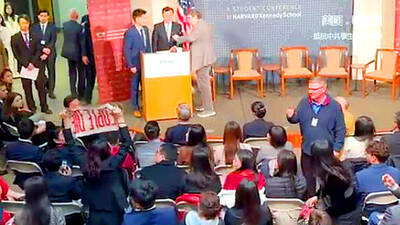
A group of Taiwanese-American and Tibetan-American students at Harvard University on Saturday disrupted Chinese Ambassador to the US Xie Feng’s (謝鋒) speech at the school, accusing him of being responsible for numerous human rights violations. Four students — two Taiwanese Americans and two from Tibet — held up banners inside a conference hall where Xie was delivering a speech at the opening ceremony of the Harvard Kennedy School China Conference 2024. In a video clip provided by the Coalition of Students Resisting the CCP (Chinese Communist Party), Taiwanese-American Cosette Wu (吳亭樺) and Tibetan-American Tsering Yangchen are seen holding banners that together read:

UNAWARE: Many people sit for long hours every day and eat unhealthy foods, putting them at greater risk of developing one of the ‘three highs,’ an expert said More than 30 percent of adults aged 40 or older who underwent a government-funded health exam were unaware they had at least one of the “three highs” — high blood pressure, high blood lipids or high blood sugar, the Health Promotion Administration (HPA) said yesterday. Among adults aged 40 or older who said they did not have any of the “three highs” before taking the health exam, more than 30 percent were found to have at least one of them, Adult Preventive Health Examination Service data from 2022 showed. People with long-term medical conditions such as hypertension or diabetes usually do not
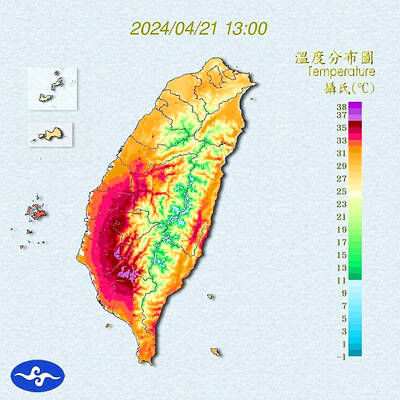
Heat advisories were in effect for nine administrative regions yesterday afternoon as warm southwesterly winds pushed temperatures above 38°C in parts of southern Taiwan, the Central Weather Administration (CWA) said. As of 3:30pm yesterday, Tainan’s Yujing District (玉井) had recorded the day’s highest temperature of 39.7°C, though the measurement will not be included in Taiwan’s official heat records since Yujing is an automatic rather than manually operated weather station, the CWA said. Highs recorded in other areas were 38.7°C in Kaohsiung’s Neimen District (內門), 38.2°C in Chiayi City and 38.1°C in Pingtung’s Sandimen Township (三地門), CWA data showed. The spell of scorching
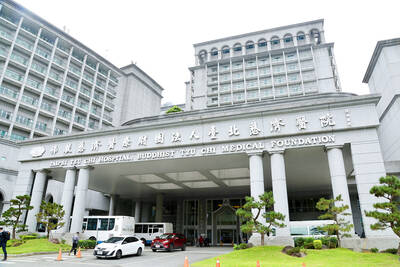
POLICE INVESTIGATING: A man said he quit his job as a nurse at Taipei Tzu Chi Hospital as he had been ‘disgusted’ by the behavior of his colleagues A man yesterday morning wrote online that he had witnessed nurses taking photographs and touching anesthetized patients inappropriately in Taipei Tzu Chi Hospital’s operating theaters. The man surnamed Huang (黃) wrote on the Professional Technology Temple bulletin board that during his six-month stint as a nurse at the hospital, he had seen nurses taking pictures of patients, including of their private parts, after they were anesthetized. Some nurses had also touched patients inappropriately and children were among those photographed, he said. Huang said this “disgusted” him “so much” that “he felt the need to reveal these unethical acts in the operating theater


 RSS
RSS