


More than half the nation's psychiatric patients do not take their medication regularly, thereby placing themselves at risk of relapsing into mental disorders, a group of psychiatrists reported yesterday.
In a survey sponsored by the pharmaceutical company Johnson & Johnson last year, 190 psychiatrists in 58 hospitals nationwide collected questionnaires from 759 patients and 673 caretakers to study patients' adherence to treatment involving long-term daily medication. The report showed that more than half of the psychiatrists who were interviewed suspected that their patients forget to take their prescription medication or stop taking their pills within one month after being diagnosed with a psychiatric disorder.
"There are high levels of non-compliance. Over 80 percent of patients do not think they are suffering from mental problems, a relatively high rate compared with the 66 percent in European countries. As might be expected, many decide to stop taking drugs and seeing doctors," said Su Tung-ping (
Su said that, unlike patients in European countries, who have access to the services of full-time health professionals in halfway homes or sanatoriums, Taiwan's psychiatric patients do not have a strong support network in their communities. It is usually employed, elderly family members who shoulder the responsibility of looking after them.
"Most of my patients are middle-aged and depend on their parents. Sometimes the aged parents do not have the energy to incorporate daily medication into their normal routines. Or they are simply unable to force patients to swallow pills," Su said.
Apart from patients' insufficient awareness of their own ailments and a lack of adequate health care, memory problems also contribute to their deviation from medication schedules. The survey indicated that more than 50 percent of psychiatrists feel that memory impairments or cognitive disorganization lead to declining patient compliance levels.
Another factor is the social stigma surrounding psychiatric patients, according to the survey. Although most patients and their families said they believe that regular medication helps to promote recovery, 63 percent of the interviewed patients said they feel embarrassed about taking medication.
"Many patients halt their medication after about a month, as soon as they feel slightly better. Yet all those delusional or anxiety disorders will slowly re-emerge," Su said.
The consequences of poor adherence to medication schedules could be grave, doctors warned.
"The patients who stop medication are four times more likely to commit suicide than those who take their medication regularly," said Chiu Nan-ying (

Former president Ma Ying-jeou’s (馬英九) mention of Taiwan’s official name during a meeting with Chinese President Xi Jinping (習近平) on Wednesday was likely a deliberate political play, academics said. “As I see it, it was intentional,” National Chengchi University Graduate Institute of East Asian Studies professor Wang Hsin-hsien (王信賢) said of Ma’s initial use of the “Republic of China” (ROC) to refer to the wider concept of “the Chinese nation.” Ma quickly corrected himself, and his office later described his use of the two similar-sounding yet politically distinct terms as “purely a gaffe.” Given Ma was reading from a script, the supposed slipup
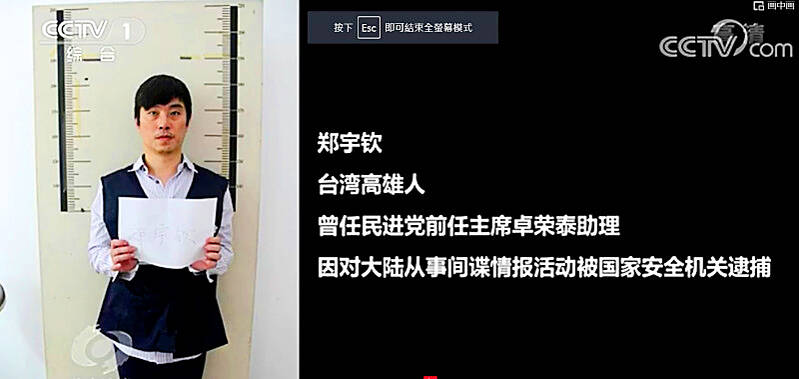
Former Czech Republic-based Taiwanese researcher Cheng Yu-chin (鄭宇欽) has been sentenced to seven years in prison on espionage-related charges, China’s Ministry of State Security announced yesterday. China said Cheng was a spy for Taiwan who “masqueraded as a professor” and that he was previously an assistant to former Cabinet secretary-general Cho Jung-tai (卓榮泰). President-elect William Lai (賴清德) on Wednesday last week announced Cho would be his premier when Lai is inaugurated next month. Today is China’s “National Security Education Day.” The Chinese ministry yesterday released a video online showing arrests over the past 10 years of people alleged to be
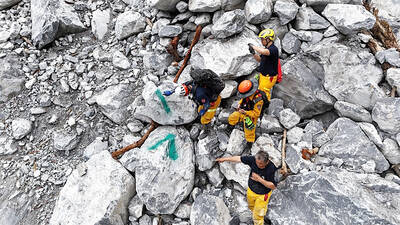
The bodies of two individuals were recovered and three additional bodies were discovered on the Shakadang Trail (砂卡礑) in Taroko National Park, eight days after the devastating earthquake in Hualien County, search-and-rescue personnel said. The rescuers reported that they retrieved the bodies of a man and a girl, suspected to be the father and daughter from the Yu (游) family, 500m from the entrance of the trail on Wednesday. The rescue team added that despite the discovery of the two bodies on Friday last week, they had been unable to retrieve them until Wednesday due to the heavy equipment needed to lift

THE HAWAII FACTOR: While a 1965 opinion said an attack on Hawaii would not trigger Article 5, the text of the treaty suggests the state is covered, the report says NATO could be drawn into a conflict in the Taiwan Strait if Chinese forces attacked the US mainland or Hawaii, a NATO Defense College report published on Monday says. The report, written by James Lee, an assistant research fellow at Academia Sinica’s Institute of European and American Studies, states that under certain conditions a Taiwan contingency could trigger Article 5 of NATO, under which an attack against any member of the alliance is considered an attack against all members, necessitating a response. Article 6 of the North Atlantic Treaty specifies that an armed attack in the territory of any member in Europe,


 RSS
RSS