


Taiwanese and German officials yesterday signed an agreement to promote academic and educational exchanges aimed at improving higher education.
At a ceremony in Taipei yesterday, representatives of the German Rectors' Conference (Hochschulrektorenkonferenz, HRK) signed an agreement with the Association of National Universities of Taiwan, the Association of Private Universities and Colleges Taiwan and the Association of Private Universities and Colleges of Technology Taiwan.
Seven HRK representatives have been visiting various higher-education institutions in Taiwan over the past five days. The German delegation consists of experts from various academic fields, including science, engineering, law, the humanities, music and medicine.
Local education officials have hailed the signing of the cooperation agreement as a breakthrough in academic collaboration between the two countries.
"[This] agreement targets the promotion of educational exchanges between teaching staff, academics, students and researchers of our two countries," Minister of Education Tu Cheng-sheng (
The Ministry of Education has pledged its full support to the agreement, which also seeks to encourage German and Taiwanese students to visit each other's countries.
In his address at the ceremony, German Institute in Taipei Director-General Ulrich Dreesen said that academic exchanges would lay the foundation for exchanges on many other levels, such as culture and trade.
The agreement places an emphasis on establishing a system in which academic credits can be transferred between the two countries, as well as regulating admissions standards between Taiwanese and German institutions.
Both sides have also agreed on a system to regulate the recognition of degrees obtained in either country, especially in the fields of music, the arts and legal studies.
One of the articles in the agreement stipulates that a host institution for exchange students should provide the home institution with a statement documenting the courses the student has completed. Cooperating institutions should also implement the necessary procedures and standards to allow for the systematic recognition of courses completed at an overseas institution.
The basis for admitting individual students will have to be hammered out between the home and host institution, with each taking into account the applicant's achievement record, goals and the compatibility of courses to be undertaken.
Prospective students should also demonstrate an appropriate level of competence in the language of instruction at their host institution.
Students taking part in exchange programs will also have the opportunity to engage in work-study and intern programs, which will be arranged by the institutions involved.
The HRK represents universities and other higher education institutions in Germany. The association has 262 member institutions, encompassing approximately 98 percent of all students enrolled in registered higher-education institutions in Germany.
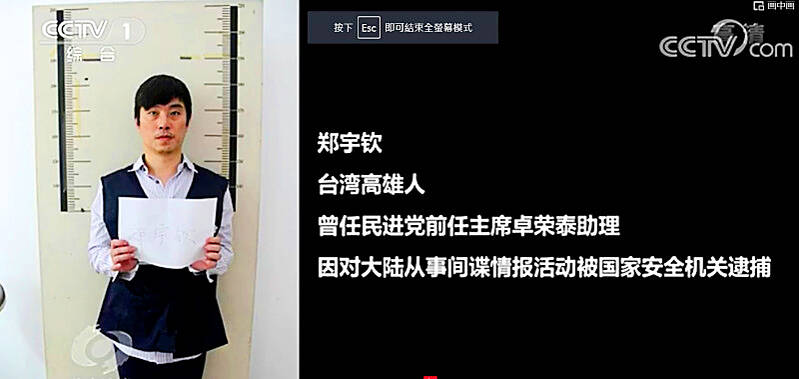
Former Czech Republic-based Taiwanese researcher Cheng Yu-chin (鄭宇欽) has been sentenced to seven years in prison on espionage-related charges, China’s Ministry of State Security announced yesterday. China said Cheng was a spy for Taiwan who “masqueraded as a professor” and that he was previously an assistant to former Cabinet secretary-general Cho Jung-tai (卓榮泰). President-elect William Lai (賴清德) on Wednesday last week announced Cho would be his premier when Lai is inaugurated next month. Today is China’s “National Security Education Day.” The Chinese ministry yesterday released a video online showing arrests over the past 10 years of people alleged to be

THE HAWAII FACTOR: While a 1965 opinion said an attack on Hawaii would not trigger Article 5, the text of the treaty suggests the state is covered, the report says NATO could be drawn into a conflict in the Taiwan Strait if Chinese forces attacked the US mainland or Hawaii, a NATO Defense College report published on Monday says. The report, written by James Lee, an assistant research fellow at Academia Sinica’s Institute of European and American Studies, states that under certain conditions a Taiwan contingency could trigger Article 5 of NATO, under which an attack against any member of the alliance is considered an attack against all members, necessitating a response. Article 6 of the North Atlantic Treaty specifies that an armed attack in the territory of any member in Europe,
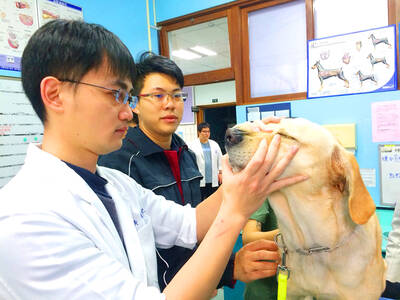
LIKE FAMILY: People now treat dogs and cats as family members. They receive the same medical treatments and tests as humans do, a veterinary association official said The number of pet dogs and cats in Taiwan has officially outnumbered the number of human newborns last year, data from the Ministry of Agriculture’s pet registration information system showed. As of last year, Taiwan had 94,544 registered pet dogs and 137,652 pet cats, the data showed. By contrast, 135,571 babies were born last year. Demand for medical care for pet animals has also risen. As of Feb. 29, there were 5,773 veterinarians in Taiwan, 3,993 of whom were for pet animals, statistics from the Animal and Plant Health Inspection Agency showed. In 2022, the nation had 3,077 pediatricians. As of last

XINJIANG: Officials are conducting a report into amending an existing law or to enact a special law to prohibit goods using forced labor Taiwan is mulling an amendment prohibiting the importation of goods using forced labor, similar to the Uyghur Forced Labor Prevention Act (UFLPA) passed by the US Congress in 2021 that imposed limits on goods produced using forced labor in China’s Xinjiang region. A government official who wished to remain anonymous said yesterday that as the US customs law explicitly prohibits the importation of goods made using forced labor, in 2021 it passed the specialized UFLPA to limit the importation of cotton and other goods from China’s Xinjiang Uyghur region. Taiwan does not have the legal basis to prohibit the importation of goods


 RSS
RSS