


Bath towels are rarely thought to pose a health hazard. But according to the Consumer Foundation, more than half of such towels on the market -- which people rub against their exposed skin each and every day -- contain dangerous chemicals that could affect the skin and respiratory system.
Last October, the foundation purchased 23 bath towels of different brands at wholesale stores, supermarkets and groceries and conducted a chemical analysis. The result showed that 66 percent of such towels contain fluorescent agents, which might cause skin problems, and 53 percent contain formaldehyde. Some bath towels that tested positive for both chemicals belong to famous brands.
The foundation strongly urged consumers to have bath towels laundered before using them -- or they could live to regret it.
Hsing Wen-hao (
Cartoon-themed towels are a particular threat. The foundation's analysis suggests that all bath towels with cartoon patterns contain fluorescent agents, compared to only one- third of towels with pure colors.
Hsing said formaldehyde was often added to towels to make them shrink-proof.
Hsing said that certain fluorescent agents might affect the skin, leading to allergic reactions. Similarly, formaldehyde might enter the skin and respiratory system, having a negative health impact.
"However, it remains unconfirmed whether such chemicals cause cancer," Hsing said.
Levels of formaldehyde measured on just 12 of the bath towels tested by the foundation were under 75ppm, Taiwan's national regulation for textiles. And Taiwan's regulations are lax by comparison with some other countries.
"Similar regulations in Japan are stricter," foundation chairman Jason Lee (
"Even in the EU, the maximum level of formaldehyde in textiles made for babies and children is only 20ppm," he said.
In addition, the foundation said that labels for some towels carry false information about the material they're made from.
Three bath towels, which were labeled 100 percent cotton actually contained other materials.
In a vivid display at a press conference yesterday, volunteers for the foundation even poured water on one such fake cotton towel to demonstrate its poor performance in absorbing water.
According to the foundation, since 1994 regulations have demanded clear descriptions for textiles.
Information about the manufacturer, size, fiber material and the appropriate washing and ironing method are required on the label.
However, a shocking 18 out of the 23 textiles tested did not have labels meeting these regulations.
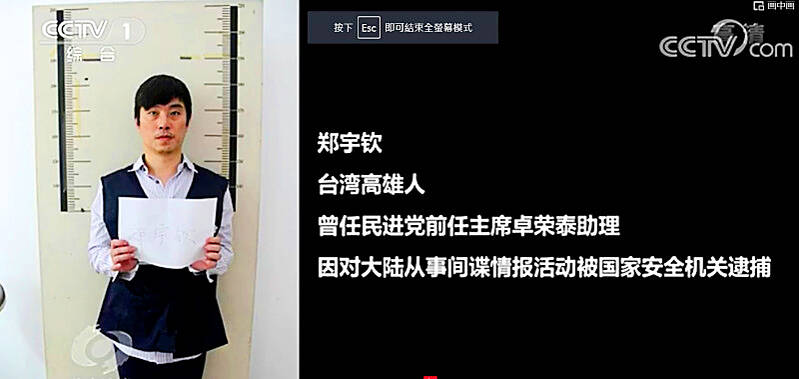
Former Czech Republic-based Taiwanese researcher Cheng Yu-chin (鄭宇欽) has been sentenced to seven years in prison on espionage-related charges, China’s Ministry of State Security announced yesterday. China said Cheng was a spy for Taiwan who “masqueraded as a professor” and that he was previously an assistant to former Cabinet secretary-general Cho Jung-tai (卓榮泰). President-elect William Lai (賴清德) on Wednesday last week announced Cho would be his premier when Lai is inaugurated next month. Today is China’s “National Security Education Day.” The Chinese ministry yesterday released a video online showing arrests over the past 10 years of people alleged to be
THE HAWAII FACTOR: While a 1965 opinion said an attack on Hawaii would not trigger Article 5, the text of the treaty suggests the state is covered, the report says NATO could be drawn into a conflict in the Taiwan Strait if Chinese forces attacked the US mainland or Hawaii, a NATO Defense College report published on Monday says. The report, written by James Lee, an assistant research fellow at Academia Sinica’s Institute of European and American Studies, states that under certain conditions a Taiwan contingency could trigger Article 5 of NATO, under which an attack against any member of the alliance is considered an attack against all members, necessitating a response. Article 6 of the North Atlantic Treaty specifies that an armed attack in the territory of any member in Europe,
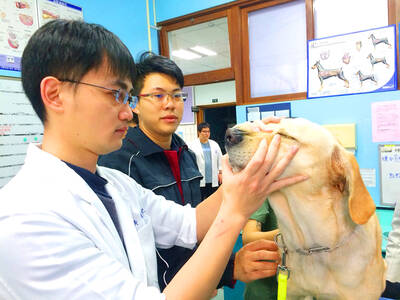
LIKE FAMILY: People now treat dogs and cats as family members. They receive the same medical treatments and tests as humans do, a veterinary association official said The number of pet dogs and cats in Taiwan has officially outnumbered the number of human newborns last year, data from the Ministry of Agriculture’s pet registration information system showed. As of last year, Taiwan had 94,544 registered pet dogs and 137,652 pet cats, the data showed. By contrast, 135,571 babies were born last year. Demand for medical care for pet animals has also risen. As of Feb. 29, there were 5,773 veterinarians in Taiwan, 3,993 of whom were for pet animals, statistics from the Animal and Plant Health Inspection Agency showed. In 2022, the nation had 3,077 pediatricians. As of last

XINJIANG: Officials are conducting a report into amending an existing law or to enact a special law to prohibit goods using forced labor Taiwan is mulling an amendment prohibiting the importation of goods using forced labor, similar to the Uyghur Forced Labor Prevention Act (UFLPA) passed by the US Congress in 2021 that imposed limits on goods produced using forced labor in China’s Xinjiang region. A government official who wished to remain anonymous said yesterday that as the US customs law explicitly prohibits the importation of goods made using forced labor, in 2021 it passed the specialized UFLPA to limit the importation of cotton and other goods from China’s Xinjiang Uyghur region. Taiwan does not have the legal basis to prohibit the importation of goods


 RSS
RSS