


A team of three World Vision Taiwan staff members returned from Sri Lanka yesterday, where they were providing aid to survivors of the tsunami that has brought widespread destruction to South Asia.
Miriam Young (
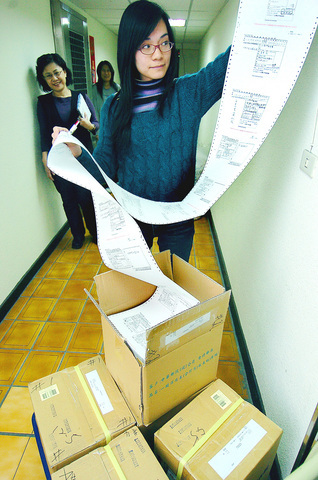
PHOTO: GEORGE TSORNG, TAIPEI TIMES
"On the second day, we left Colombo for Galle, a harbor in the south and one of the worst hit areas. As we approached the coastline, the images that met my eyes I have only seen before in World War II movies: Houses and ships were totally wrecked, and ruins were everywhere," said Lin, a marketing and resource-development manager.
The stench of rotting corpses could be detected from some distance off, and decomposition posed a public health concern.
"Given the average temperature of 35OC to 36OC, if the bodies are not processed soon enough, decomposition will take place and contagious diseases may follow," Lin said.
The team brought along staple foods purchased in Sri Lanka with money donated by Taiwanese, and distributed the goods to families in the area. Each ration, which included items such as rice, tea and canned fish, was enough to last a single family three or four days.
"During the first stage of relief efforts, the goal is to get the supplies and food to the victims. After the first 10 days comes the second stage, in which the reconstruction of infrastructure begins," said Shen, an international ministry program officer.
"Many victims simply threw out their damaged personal belongings after [Taiwan's 921] earthquake, but not the Sri Lanka victims. After the disaster, they went back to their devastated homes to pick up whatever remained -- you could see people drying off drenched books," Lin said.
Young said that there were three things survivors looked for when revisiting tsunami-hit places: missing family members, a place to stay for the night and food.
A 85-year-old grandmother whose family was torn apart by the tsunami told Yang of a horrifying experience: On Dec. 26, her daughter had just stepped out of the house to get her some water, when the tidal waves came crashing down and nothing has been the same again.
The grandmother's son-in-law suffered from a spine injury and had been hospitalized, and her daughter was missing.
Each day, she took her grandchild along to the shores looking for her daughter.
As the grandmother was narrating her story, her eyes filled with fears.
"At that moment, I was touched and offered the grandmother a hug. Unexpectedly, in return, she gave me the most heartwarming hug I have ever received. While we were hugging, she broke into a sob so heart-wrenching that I felt she was relieving herself of all the sorrows that have been stored up in her life up till that point," said Young, an editor.
Although they did not share a common language, "it really dawned on me at that moment that love transcends all languages and cultures," Young said.
The aid workers said the Sri Lankan survivors were surprised to see foreigners at first, but quickly recovered and welcomed them.
"They greeted us and kept asking if we were tired," Lin said.
Relief efforts also went beyond national, religious and organizational boundaries.
According to Shen, all aid agencies worked through the Sri Lankan government and with one another, and the spirit of team work became evident in their co-operation. All medical supplies from abroad had to be stored at government-owned warehouses, from where they were distributed by NGOs and medical teams to various shelters.
"Victims are sheltered in temples and churches by different organizations. Although World Vision is a Christian organization, we have no problem placing victims in temples of other faiths," Shen said.
In Negombo, a village on the west coast of Sri Lanka, a refuge for 1,800 children run by World Vision Taiwan was completely wiped out by the tsunami.
"The houses were destroyed, but the children were safe," Young said.
Shen said 90 percent of the families in Negombo made their living from fishing, and the tsunami deprived them of their only means of staying alive.
Infrastructure reconstruction, job creation and helping people get their lives back on track require long-haul planning and committed volunteers.
So far, World Vision Taiwan has recruited 42 volunteers who will be leaving for Sri Lanka on Jan. 15 to assist with reconstruction efforts.
All 42 will stay for at least a month, as it is a long-term relief assistance program.
"We selected these volunteers carefully. They are not people who have been momentarily touched by the tragedy, but people who are deeply committed to getting the job done under rather difficult circumstances," said Kuo Hsiu-ling (
In addition to Sri Lanka, World Vision Taiwan has also been providing aid workers to Indonesia and India.
According to World Vision Taiwan's assessment, Thailand has the best chance of recovering by itself, and the aid group has consequently focused on helping Sri Lanka, Indonesia and India.
World Vision Taiwan is the only aid agency present on the island of Pulau Nias in Indonesia. It is contemplating the establishment of a Taiwanese relief assistance village on the island.
As of yesterday, World Vision Taiwan has collected NT$45,585,147 in cash donations.
At the agency's office, stacks of postal money-transfer receipts have yet to be processed; phones are ringing off the hook and volunteers patiently answer eager donors' questions. People also stop by the agency to drop off their donations.
Although the need in disaster-hit countries is dire and workers are few, the people of Taiwan, through their generous financial donations, have touched the victims in South Asia with their love.
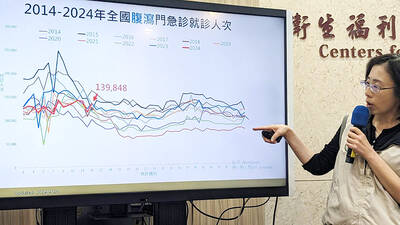
FLU SEASON: Twenty-six severe cases were reported from Tuesday last week to Monday, including a seven-year-old girl diagnosed with influenza-associated encephalopathy Nearly 140,000 people sought medical assistance for diarrhea last week, the Centers for Disease Control (CDC) said on Tuesday. From April 7 to Saturday last week, 139,848 people sought medical help for diarrhea-related illness, a 15.7 percent increase from last week’s 120,868 reports, CDC Epidemic Intelligence Center Deputy Director Lee Chia-lin (李佳琳) said. The number of people who reported diarrhea-related illness last week was the fourth highest in the same time period over the past decade, Lee said. Over the past four weeks, 203 mass illness cases had been reported, nearly four times higher than the 54 cases documented in the same period

A group of Taiwanese-American and Tibetan-American students at Harvard University on Saturday disrupted Chinese Ambassador to the US Xie Feng’s (謝鋒) speech at the school, accusing him of being responsible for numerous human rights violations. Four students — two Taiwanese Americans and two from Tibet — held up banners inside a conference hall where Xie was delivering a speech at the opening ceremony of the Harvard Kennedy School China Conference 2024. In a video clip provided by the Coalition of Students Resisting the CCP (Chinese Communist Party), Taiwanese-American Cosette Wu (吳亭樺) and Tibetan-American Tsering Yangchen are seen holding banners that together read:

UNAWARE: Many people sit for long hours every day and eat unhealthy foods, putting them at greater risk of developing one of the ‘three highs,’ an expert said More than 30 percent of adults aged 40 or older who underwent a government-funded health exam were unaware they had at least one of the “three highs” — high blood pressure, high blood lipids or high blood sugar, the Health Promotion Administration (HPA) said yesterday. Among adults aged 40 or older who said they did not have any of the “three highs” before taking the health exam, more than 30 percent were found to have at least one of them, Adult Preventive Health Examination Service data from 2022 showed. People with long-term medical conditions such as hypertension or diabetes usually do not
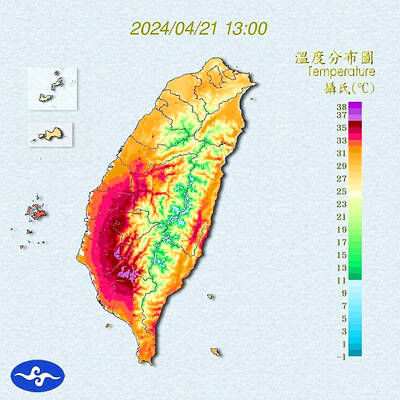
Heat advisories were in effect for nine administrative regions yesterday afternoon as warm southwesterly winds pushed temperatures above 38°C in parts of southern Taiwan, the Central Weather Administration (CWA) said. As of 3:30pm yesterday, Tainan’s Yujing District (玉井) had recorded the day’s highest temperature of 39.7°C, though the measurement will not be included in Taiwan’s official heat records since Yujing is an automatic rather than manually operated weather station, the CWA said. Highs recorded in other areas were 38.7°C in Kaohsiung’s Neimen District (內門), 38.2°C in Chiayi City and 38.1°C in Pingtung’s Sandimen Township (三地門), CWA data showed. The spell of scorching


 RSS
RSS