


An inefficient vote-allocation strategy and an excessive number of nominees were attributed by many political observers as the main reasons behind the pan-green camp's unsuccessful bid to obtain a legislative majority in yesterday's elections.
Noting that there were many Democratic Progressive Party (DPP) or Taiwan Solidarity Union (TSU) candidates who failed to win by just a few votes, former DPP public survey center chief Chen Chun-lin (

PHOTO: CHIANG YING-YING, TAIPEI TIMES
"It appears that the vote-allocation strategy adopted by the DPP and the TSU did not help the pan-green camp, but ended up having the candidates fight among themselves for votes," Chen said, saying that some constituencies ended up with a lose-lose situation for both the DPP and the TSU.
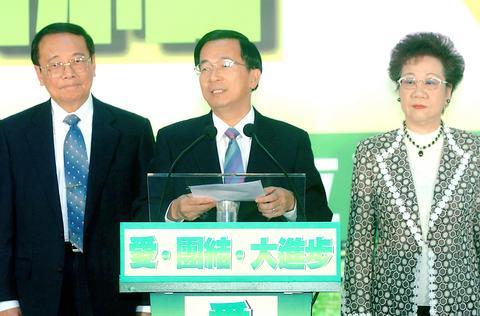
PHOTO: CHIANG YING-YING, TAIPEI TIMES
"It is clear that the DPP will have to engage in a re-assessment over its electoral maneuvers and strategies," Chen said. Chen is deputy chairman of the Research, Development and Evaluation Commission.
Agreeing with Chen's remarks, political commentator and editor-in-chief of Contemporary Monthly magazine Chin Heng-wei (
One mistake committed by the pan-green camp, said Chin, was that "the pan-green camp had unrealistic expectations that it could achieve major growth in its number of seats in the elections."
The goal of attaining a legislative majority led the DPP to nominate too many candidates in the election, Chin said, adding that it was another factor which the DPP needed to re-evaluate.
While admitting that the DPP had lost the elections since it did not meet its targeting goal of obtaining 101 seats in the new legislature, DPP caucus whip Tsai Huang-liang (
Citing statistics to support his remarks, Tsai said that the DPP this time had garnered 35.72 percent of the vote, a slight growth over the 33.38 percent of the vote in the 2001 legislative elections.
The DPP won 89 seats in yesterday's poll, two more than it won three years ago.
Noting that there were many pan-green candidates who enjoyed relatively high support rates before the election, yet obtained low votes in the poll yesterday, Tsai said these candidates' high approval rates had ended up working against them at the last minute when voters went to the polls.
Referring to the various topics talked about by Chen during the campaign period, such as the issue of changing the name of all relevant government agencies to include the word "Taiwan," Tsai added that it was possible that the voters did not have ample time to absorb and digest these issues, or to translate them into actual votes for the pan-greens in yesterday's polls.
"The DPP will re-assess its electoral maneuvers and operations after [yesterday's] elections," Tsai said.
The TSU, under the leadership of its spiritual leader, former president Lee Teng-hui (
The TSU, a pro-independence party, obtained only 12 seats in yesterday's elections.
"Overall, the TSU did not perform well," said Hsu Yung-ming (
The shrinking number of seats garnered by the TSU might put the party at risk of becoming an empty decoration, Chin said, adding that the next thing to observe was what move or gesture TSU Chairman Huang Chu-wen (
While saying "the TSU's setback will probably harm Lee a bit," Chin noted that Lee has always been an individual of high ideals. Lee has never just had his sights solely on the elections, but rather on Taiwan's overall vision and future prospects, Chin said.
Admitting that the TSU's performance in yesterday's poll landed far short of its expectations, TSU caucus whip Chen Chien-ming (陳建銘), who lost his re-election bid, said the TSU's unsatisfactory performance was a result of the results of vote-allocation strategies as well as President Chen Shui-bian's (陳水扁) slogan "salvage the weak candidates."
"As a result, those high in the front list split their votes for the weaker candidates and ended up having themselves fall behind," Chen Chien-ming said.
With the Chinese Nationalist Party (KMT) and the People First Party (PFP) of the pan-blue camp retaining their grip on the new legislature, various issues, including the one concerning the KMT's ill-gotten party assets, are unlikely to be tackled in the immediate future, Chin said.
Tsai expressed his worry that the opposition-controlled legislature will continue to make Chen a lame duck and boycott policies proposed by the government.
Noting that Chen had stated that he wanted to form a Constitutional Reform Committee and a Committee for Cross-Strait Peace and Development (
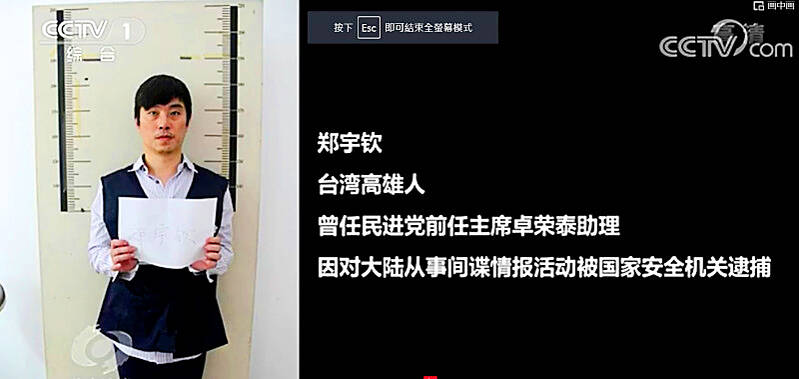
Former Czech Republic-based Taiwanese researcher Cheng Yu-chin (鄭宇欽) has been sentenced to seven years in prison on espionage-related charges, China’s Ministry of State Security announced yesterday. China said Cheng was a spy for Taiwan who “masqueraded as a professor” and that he was previously an assistant to former Cabinet secretary-general Cho Jung-tai (卓榮泰). President-elect William Lai (賴清德) on Wednesday last week announced Cho would be his premier when Lai is inaugurated next month. Today is China’s “National Security Education Day.” The Chinese ministry yesterday released a video online showing arrests over the past 10 years of people alleged to be
THE HAWAII FACTOR: While a 1965 opinion said an attack on Hawaii would not trigger Article 5, the text of the treaty suggests the state is covered, the report says NATO could be drawn into a conflict in the Taiwan Strait if Chinese forces attacked the US mainland or Hawaii, a NATO Defense College report published on Monday says. The report, written by James Lee, an assistant research fellow at Academia Sinica’s Institute of European and American Studies, states that under certain conditions a Taiwan contingency could trigger Article 5 of NATO, under which an attack against any member of the alliance is considered an attack against all members, necessitating a response. Article 6 of the North Atlantic Treaty specifies that an armed attack in the territory of any member in Europe,

LIKE FAMILY: People now treat dogs and cats as family members. They receive the same medical treatments and tests as humans do, a veterinary association official said The number of pet dogs and cats in Taiwan has officially outnumbered the number of human newborns last year, data from the Ministry of Agriculture’s pet registration information system showed. As of last year, Taiwan had 94,544 registered pet dogs and 137,652 pet cats, the data showed. By contrast, 135,571 babies were born last year. Demand for medical care for pet animals has also risen. As of Feb. 29, there were 5,773 veterinarians in Taiwan, 3,993 of whom were for pet animals, statistics from the Animal and Plant Health Inspection Agency showed. In 2022, the nation had 3,077 pediatricians. As of last

XINJIANG: Officials are conducting a report into amending an existing law or to enact a special law to prohibit goods using forced labor Taiwan is mulling an amendment prohibiting the importation of goods using forced labor, similar to the Uyghur Forced Labor Prevention Act (UFLPA) passed by the US Congress in 2021 that imposed limits on goods produced using forced labor in China’s Xinjiang region. A government official who wished to remain anonymous said yesterday that as the US customs law explicitly prohibits the importation of goods made using forced labor, in 2021 it passed the specialized UFLPA to limit the importation of cotton and other goods from China’s Xinjiang Uyghur region. Taiwan does not have the legal basis to prohibit the importation of goods


 RSS
RSS