


Taipei Times: President Chen Shui-bian (
Lin Yu-tee (
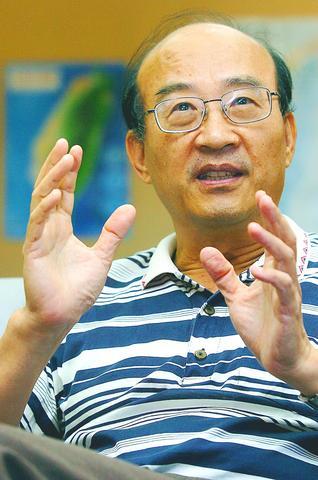
PHOTO: GEORGE TSORNG, TAIPEI TIMES
TT: What do you think of the opposition camps daring Chen to enshrine the "one country on either side of the Taiwan Strait" theory in the new constitution he is trumpeting?
Lin: It's a good idea to enshrine the theory in the new constitution, but I'd dare the opposition parties to support such a politically sensitive constitutional reform. It's a highly challenging task, even a mission impossible, for the ruling Democratic Progressive Party (DPP) to push for such constitutional reform, because the opposition parties enjoy the majority in the legislature.
We know for a fact that China will oppose such reform because it's our enemy. I suspect the US would respect the decision of the Taiwanese people, because democracy is the founding spirit of the US and it's that democratic spirit that wins the respect of the world and keeps it going around.
TT: Do you think Chen would breach the "five noes" promise he made during his inaugural speech in 2000 if the "one country on either side of the Taiwan Strait" policy is eventually enshrined in the new constitution?
Lin: The "five noes" principle has one precondition, and that is China must not have the intention to use military force against Taiwan. President Chen is not bound by the pledge if the premise is breached.
Frankly speaking, I'm not very much pleased with the president's pledge because it's an unnecessary statement. It's like the fabric wrapped around the "golden lotus" feet of Chinese women during the Ching Dynasty: it's not only asphyxiating but also stinky. It doesn't win the appreciation of China and it also disappoints his base supporters.
TT: Don't you think Chen, as the head of state, is obligated to take various complicated elements into consideration during his decision-making process, instead of rushing to a conclusion and pleasing only one particular group?
Lin: I agree. I suspect the US government might have struck a deal with him, pledging to facilitate cross-strait negotiations if he agreed to make the "five noes" promise during his inauguration speech.
I'd really hate to say that the president has been fooled by the US government, but what I've seen over the years is that the US government failed to make any efforts to precipitate cross-strait talks.
Another thing that really upsets me is that the president's inauguration speech has to be approved by the US government. Such a move, in my view, is gravely humiliating to the national dignity.
TT: Before the "one country on either side of the Taiwan Strait" theory is enshrined in the new constitution, do you think it's legitimate to test examinees only on Taiwan's history and geography in January's civil service examination?
Lin: There's no doubt about testing only on Taiwan in the "national" history and geography test, no matter whether the theory is enshrined in the constitution or not.
It doesn't make any sense that the "national" history and geography test should cover China. If the territory of the Republic of China covers China as some have claimed, I'd like to know why the Examination Yuan, the nation's highest examination body, cannot hold national civil service examinations in Beijing for Chinese civil servants? If they cannot answer this question, they should just keep their mouth shut.
TT: The Examination Yuan has made a resolution that the history and geography test in January's civil service examination should follow the "regulations and precedents." What are your thoughts on this?
Lin: Precedents are not binding in nature and some precedents just don't make sense and are illegitimate. If they insist on my following the so-called "precedents," I can always find a way to go around it because I'll just follow the former practices that 100 percent of the questions are about Taiwan.
TT: As the head of January's civil-servant examination committee, could you specify exactly what your plan is regarding the history and geography test in January's exam?
Lin: What I plan to do is quite clear and simple. Unless someone can come up with convincing reasons to counter the plan, I'll forge ahead as planned. In other words, the test of "national" history and geography will cover only Taiwan's history and geography as well as topics related to Taiwan. I welcome anyone to report me to the police if they can prove that I violate any existing law by doing this.
TT: Would you tell the committee members your preferred number of questions on the test?
Lin: The only thing I'll tell them is that the scope of the test must be related to Taiwan. According to the "former practices," there are a total of 80 questions in the test, and all of them are multiple choice. While 40 of them are on civic education, 20 are on national history and the remaining 20 are on national geography.
To be more specific, at least 50 percent of the 40 questions on history and geography should be about Taiwan.
TT: Some have criticized your management style, saying that you've been using the incident to manipulate the media and that you should have remained low-key like your predecessors. What do you think of the criticism?
Lin: I've never ever taken the initiative to contact the media, unlike some Examination Yuan members. I eventually agreed to accept interviews because I was asked by the Secretary's Office to do so.
As head of January's civil servant examination committee, I felt obligated to clear up the confusion so that examinees will know exactly what to expect and how to prepare for the exam. I'd have committed malfeasance if I'd failed to do so, pointed out the mistakes we made and repeated the past. To be honest, I have no idea why I've caused so much media attention. Maybe I have some appealing selli ng points, who knows.
TT: Some have argued that no one has ever had any problem with the national history and geography test over the years until you came aboard. Do you have anything to say to them?
Lin: I have the same question for them: how come no one never had any problem with China's 1,000-year-old monarchy until Sun Yat-sen? (
TT: You caused a similar stir last year when you, as the convener of a local civil servant examination committee's history and geography test sub-committee, tested examinees on only Taiwan's history and geography. What do you think of another controversy taking place the same year, by using Hoklo (commonly known as Taiwanese) questions in Chinese literature tests?
Lin: I don't know why the issue of Hoklo questions drew so much criticism, as the Chinese Nationalist Party (KMT) have used Mandarin to test Taiwanese in all civil service exams over the years. Like Taiwanese people learning Mandarin, Hakka and Aboriginal peoples who cried foul over the tests should make efforts to learn Hoklo.
TT: Seeking to settle the year-long controversy, the Examination Yuan later reached a resolution and spelled out a "four noes" principle for future national examinations. What do you think of the decision?
Lin: The decision is nothing but ballocks. Take one of the principles: I agree that it's not suitable to test examinees on knowledge of obscure pieces of classical Chinese literature, but what are the objective standards of "obscure?"
TT: So you wouldn't follow the "four noes" principle?
Lin: I'd follow it only if it made sense.
TT: What do you think of the criticism that you're inconsistent in your words and actions?
Lin: I'm a straightforward person and I'm proud of it. It's my candor that got me into trouble, especially during the KMT era.
While it takes a doctorate degreeholder about three years to become a full professor, it takes me 12 years. Everybody knows it's because of political reasons, but what can I do except continue to write and teach? What can a civilian do to stand up against an authoritarian regime?
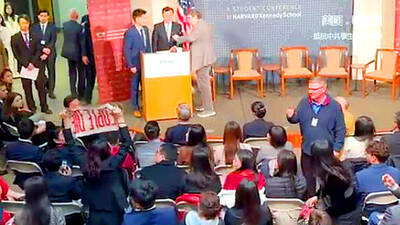
A group of Taiwanese-American and Tibetan-American students at Harvard University on Saturday disrupted Chinese Ambassador to the US Xie Feng’s (謝鋒) speech at the school, accusing him of being responsible for numerous human rights violations. Four students — two Taiwanese Americans and two from Tibet — held up banners inside a conference hall where Xie was delivering a speech at the opening ceremony of the Harvard Kennedy School China Conference 2024. In a video clip provided by the Coalition of Students Resisting the CCP (Chinese Communist Party), Taiwanese-American Cosette Wu (吳亭樺) and Tibetan-American Tsering Yangchen are seen holding banners that together read:

UNAWARE: Many people sit for long hours every day and eat unhealthy foods, putting them at greater risk of developing one of the ‘three highs,’ an expert said More than 30 percent of adults aged 40 or older who underwent a government-funded health exam were unaware they had at least one of the “three highs” — high blood pressure, high blood lipids or high blood sugar, the Health Promotion Administration (HPA) said yesterday. Among adults aged 40 or older who said they did not have any of the “three highs” before taking the health exam, more than 30 percent were found to have at least one of them, Adult Preventive Health Examination Service data from 2022 showed. People with long-term medical conditions such as hypertension or diabetes usually do not
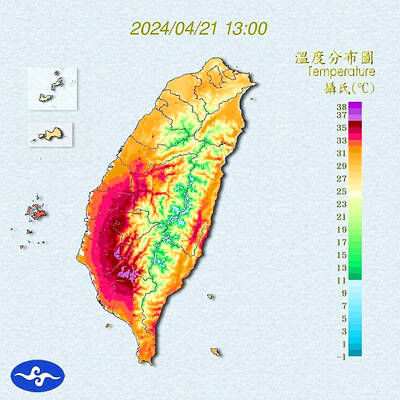
Heat advisories were in effect for nine administrative regions yesterday afternoon as warm southwesterly winds pushed temperatures above 38°C in parts of southern Taiwan, the Central Weather Administration (CWA) said. As of 3:30pm yesterday, Tainan’s Yujing District (玉井) had recorded the day’s highest temperature of 39.7°C, though the measurement will not be included in Taiwan’s official heat records since Yujing is an automatic rather than manually operated weather station, the CWA said. Highs recorded in other areas were 38.7°C in Kaohsiung’s Neimen District (內門), 38.2°C in Chiayi City and 38.1°C in Pingtung’s Sandimen Township (三地門), CWA data showed. The spell of scorching
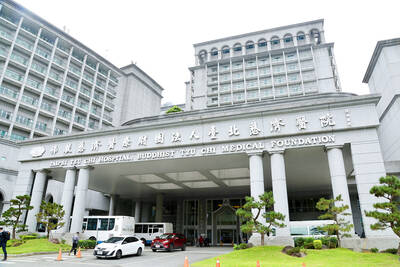
POLICE INVESTIGATING: A man said he quit his job as a nurse at Taipei Tzu Chi Hospital as he had been ‘disgusted’ by the behavior of his colleagues A man yesterday morning wrote online that he had witnessed nurses taking photographs and touching anesthetized patients inappropriately in Taipei Tzu Chi Hospital’s operating theaters. The man surnamed Huang (黃) wrote on the Professional Technology Temple bulletin board that during his six-month stint as a nurse at the hospital, he had seen nurses taking pictures of patients, including of their private parts, after they were anesthetized. Some nurses had also touched patients inappropriately and children were among those photographed, he said. Huang said this “disgusted” him “so much” that “he felt the need to reveal these unethical acts in the operating theater


 RSS
RSS