


For years now, Kinmen County has been talking about building a bridge to the southern Chinese province of Fujian. Last week, the topic was brought up again, but to no avail. It is, like all other cross-strait projects, mired in political conflict.
While the bridge, dubbed the "Kinmen peace bridge," is unlikely to materialize in the near future, it is at the very least an indication of Kinmen's particular role in cross-strait relations. Situated between Taiwan and China, Kinmen is just 2km off the southeastern coast of Fujian; while 280km of the Taiwan Strait separates it from Taiwan.
Even today, Beijing views Kinmen and Matsu as nominally a part of Fujian Province, whereas the rest of the nation is considered to be Taiwan Province. In fact, Kinmen County Commissioner Lee Chu-feng (
Kinmen is literally and symbolically a bridge between Taiwan and China. It was the experimental grounds upon which the "small three links" was given its trial run, and is likely to be the site of two new cross-strait initiatives in the next few months -- Chinese tourism and currency exchange. Chinese tourism in Taiwan has been allowed under limited conditions in the past, but Chinese currency exchange has never been offered before at local banks.
Previously, only Chinese tourists who resided or studied abroad or who arrived in Taiwan from a third country could visit the nation on a tourist visa. However, the new tourism policies slated to kick in next month -- applicable only off Kinmen and Matsu -- will allow Fujianese tourists to come directly to Taiwan's offshore islands for three-day tours.
While the policies have yet to be implemented, it is said that tourists from Fujian will start arriving in Kinmen and Matsu by early next month. In fact, five travel agencies in Kinmen have already been designated by Chinese tourism authorities to show Chinese tourists local attractions.
One of the agencies, Safety Travel, has already posted application procedures and tourism itineraries online in anticipation of increased business.
"We think that the number of Chinese tourists could increase to 100 a day, which is quite scary." said Safety Travel manager Lee Chun-lung (
"It's a lot more than what we're seeing now. We've already begun hiring new employees to help out."
"Before the new tourism policy, we had maybe one or two groups a month if we were lucky, and the paperwork was always very complicated. The number of groups we'd get each month was never consistent either," Lee said.
Kinmen County Department of Tourism head Chen Chao-chin (陳朝金) was also optimistic about newly lifted travel bans.
"It's been 50 years coming. I'm sure there are many, many people in Fujian who would like to see Kinmen," Chen said. "The tourism will bring about a chain reaction in consumption. With tourism, you will need tour buses, which means you will need oil, which means you will need a driver, and so on and so forth," he told the Taipei Times.
He explained that over the past half year, several investors had visited Kinmen in anticipation of possible business opportunities. He said once Chinese tourism kicks in, investment in hotels and other tourism facilities is also likely to increase.
"Currently, the government has capped the number of Chinese tourists at 700 per day which we can accommodate. As demand increases, however, we're planning on establishing resorts. These could accommodate up to 2,500 tourists a day," Chen said.
While Chinese tourism in Kinmen has been hailed as a kind of cultural exchange that could promote better cross-strait ties, and while Kinmen seems ready to reap the benefits of its proximity to China, concerns regarding tourist absconding have been raised. However, even with this in mind, it seems that Kinmen's unique geographical location and cultural ties to Fujian make it the ideal place to try out the newly-relaxed tourism policies.
MAC Vice Chairman Chiu Tai-san (
"Since China has formally allowed for these tourism policies, they will do their part to filter out suspect refugees. It won't be like the current tourism procedures that force the travel industry to verify the information that Chinese tourists provide on their own," Chiu said.
"In addition, because the five travel agencies handling tourism from Fujian were designated by Chinese authorities, the agencies will have easy access to information about tourists who apply to tour Kinmen. Unlike the current situation, there will be formal channels for information exchange," Chiu said.
Chen also said that he was not particularly worried about absconding tourists. "Kinmen is not that big. Most of them abscond in search of jobs, but where would they go in Kinmen? They wouldn't be able to fly to Taiwan either," Chen said, adding that Kinmen was a small enough community that strangers easily stood out.
As for offering Chinese currency exchange in Kinmen, Chiu admitted that increased tourism made the need for currency exchange even more pressing. Already, several stores on the island accept payment in Chinese currency.
For now, Chiu said that the council is uncertain about allowing Taiwanese residents to buy the Chinese yuan in Kinmen. The service would most likely be offered to tourists or businesspeople arriving in Kinmen and be available at designated sites only.
Although MAC officials stressed that there was no deadline by which they plan to establish currency exchange mechanisms in Kinmen, ties between Kinmen and Fujian seem to be drawing closer at an increasing pace.
Not only does the government need to respond with appropriate measures, it should also recognize that these developments could provide an opportunity to influence the direction of cross-strait relations.
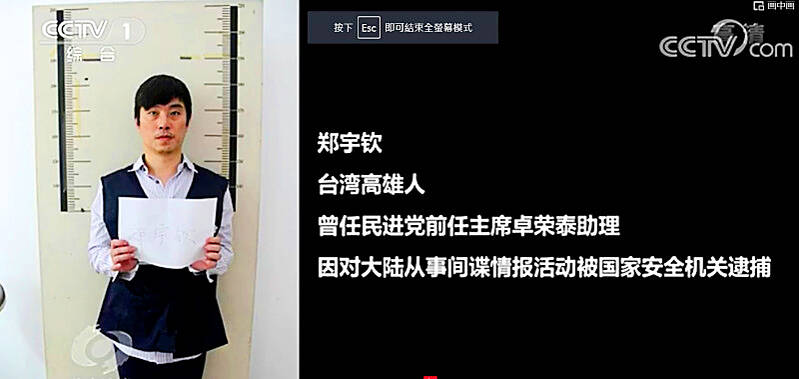
Former Czech Republic-based Taiwanese researcher Cheng Yu-chin (鄭宇欽) has been sentenced to seven years in prison on espionage-related charges, China’s Ministry of State Security announced yesterday. China said Cheng was a spy for Taiwan who “masqueraded as a professor” and that he was previously an assistant to former Cabinet secretary-general Cho Jung-tai (卓榮泰). President-elect William Lai (賴清德) on Wednesday last week announced Cho would be his premier when Lai is inaugurated next month. Today is China’s “National Security Education Day.” The Chinese ministry yesterday released a video online showing arrests over the past 10 years of people alleged to be

THE HAWAII FACTOR: While a 1965 opinion said an attack on Hawaii would not trigger Article 5, the text of the treaty suggests the state is covered, the report says NATO could be drawn into a conflict in the Taiwan Strait if Chinese forces attacked the US mainland or Hawaii, a NATO Defense College report published on Monday says. The report, written by James Lee, an assistant research fellow at Academia Sinica’s Institute of European and American Studies, states that under certain conditions a Taiwan contingency could trigger Article 5 of NATO, under which an attack against any member of the alliance is considered an attack against all members, necessitating a response. Article 6 of the North Atlantic Treaty specifies that an armed attack in the territory of any member in Europe,

LIKE FAMILY: People now treat dogs and cats as family members. They receive the same medical treatments and tests as humans do, a veterinary association official said The number of pet dogs and cats in Taiwan has officially outnumbered the number of human newborns last year, data from the Ministry of Agriculture’s pet registration information system showed. As of last year, Taiwan had 94,544 registered pet dogs and 137,652 pet cats, the data showed. By contrast, 135,571 babies were born last year. Demand for medical care for pet animals has also risen. As of Feb. 29, there were 5,773 veterinarians in Taiwan, 3,993 of whom were for pet animals, statistics from the Animal and Plant Health Inspection Agency showed. In 2022, the nation had 3,077 pediatricians. As of last

XINJIANG: Officials are conducting a report into amending an existing law or to enact a special law to prohibit goods using forced labor Taiwan is mulling an amendment prohibiting the importation of goods using forced labor, similar to the Uyghur Forced Labor Prevention Act (UFLPA) passed by the US Congress in 2021 that imposed limits on goods produced using forced labor in China’s Xinjiang region. A government official who wished to remain anonymous said yesterday that as the US customs law explicitly prohibits the importation of goods made using forced labor, in 2021 it passed the specialized UFLPA to limit the importation of cotton and other goods from China’s Xinjiang Uyghur region. Taiwan does not have the legal basis to prohibit the importation of goods


 RSS
RSS