


In a replay of the debate over changes to history textbooks, the Ministry of Education's (MOE) proposed revisions to high-school Chinese literature textbooks spurred criticism from the opposition parties and piqued academics yesterday, fueling a culture war prior to the impending legislative elections.
The ministry's plan to put more contemporary Chinese literature in textbooks was flayed by the opposition party as an official attempt to "de-Sinicize" the high school curriculum.
Since 2002, the ministry has planned to shrink the amount of classical Chinese literature by about 10 percent, and make the requisite "Basic Chinese Culture Teachings" optional. While education officials said the reduction was meant to provide students with material more in tune with contemporary society, some politicians argued that it was just another attempt at ideological transformation orchestrated by the government.
"In the mind of the Democratic Progressive Party, classical Chinese literature should be thrown away," People First Party Legislator Chin Huei-chu (
Chin also referred to President Chen Shui-bian's (
"According to Chen, he wants to change our national title in two years," Chin said. "In this context, we are strongly concerned that the proposed textbook revisions are a part of a `Taiwanization of literature' [
PROFESSIONALISM
Some academics also fear that political concerns may override literary professionalism, while some in Taiwan are eagerly trying to carve out a national identity.
"The real worry is whether our president has the power to lacerate history, geography and literature," said Chien Ming-yun (
According to some high school Chinese teachers, the public hearings the MOE held to elicit opinions on textbook change are merely occasions for "policy announcement," and not forums for open debate about issues.
NO DEBATE
"Since officials never invite teachers who disagree with them, of course they can assert that there were no objections in public hearings," said Tan Jia-hua (
The textbook change dispute has rocked what are usually sedate academic circles. High school Chinese literature teachers argue that aesthetic and ethical principles should steer the direction of textbook revisions, not political affiliations.
"As a person who will have to carry out the MOE's reform policy, I want to ask a simple question. Why should we cut down on graceful classical Chinese texts, when our students' ability to appreciate literary beauty is backsliding?" asked Hsieh Chen-chong (謝鎮仲), a Chinese literature teacher at Wanfang High School.
For scholars, the real dread is that abolishing "Chinese Culture Basic Teachings" (
"The Analects (
"Making the teachings optional in a crammed curriculum is no different from abolishing them," Ho said. The Basic Chinese Cultural Teaching comprises excerpts from four Confucian cannons -- The Analects (
Ho, a scholar in Chinese literature, contends that this ancient heritage is still part of our modern experience.
"Literature evolves with time and lives with us. There is no reason why modern students should stop studying the classics. In daily conversation, we still quote from The Analects and Mencius. These cannons are the foundation of our collective experience," Ho said.
Faced with an avalanche of criticism, the ministry rushed to sever the ties between the elections and Chinese literature education reform, saying that a smaller portion of classical Chinese literature is part of the ongoing education re-engineering.
"At every meeting we reached a consensus on easing the burden on students. Every discipline's share is more or less cut," said Lee Jan-yao (
LACK OF PROOF
In a broader context, Lee argued, a high school student needs to study various subjects to cultivate their ability of independent thinking. Even in the field of Chinese literature, no study has demonstrated that using more contemporary Chinese literature will affect a student's Chinese-language abilities.
"The 10 percent classical Chinese literature cut is a set policy," Lee said.
Despite academics' and teachers' challenging the impartiality of the textbook revisions, the ministry reiterated that all revision procedures proceeded as usual and different opinions were heard and assessed.
The National Teacher Association said that they will seek to involve more high school teachers and to present diverse opinions.
"We realized that there are some voices which were ignored," said Hong Lung-chiu (
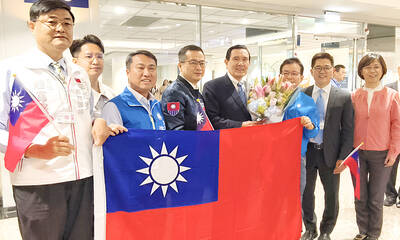
Former president Ma Ying-jeou’s (馬英九) mention of Taiwan’s official name during a meeting with Chinese President Xi Jinping (習近平) on Wednesday was likely a deliberate political play, academics said. “As I see it, it was intentional,” National Chengchi University Graduate Institute of East Asian Studies professor Wang Hsin-hsien (王信賢) said of Ma’s initial use of the “Republic of China” (ROC) to refer to the wider concept of “the Chinese nation.” Ma quickly corrected himself, and his office later described his use of the two similar-sounding yet politically distinct terms as “purely a gaffe.” Given Ma was reading from a script, the supposed slipup
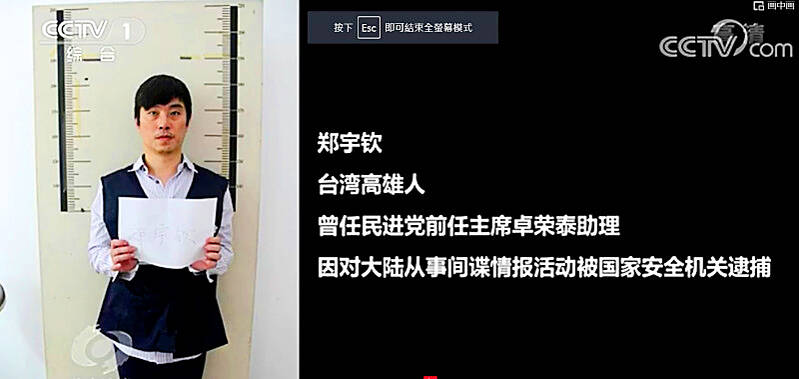
Former Czech Republic-based Taiwanese researcher Cheng Yu-chin (鄭宇欽) has been sentenced to seven years in prison on espionage-related charges, China’s Ministry of State Security announced yesterday. China said Cheng was a spy for Taiwan who “masqueraded as a professor” and that he was previously an assistant to former Cabinet secretary-general Cho Jung-tai (卓榮泰). President-elect William Lai (賴清德) on Wednesday last week announced Cho would be his premier when Lai is inaugurated next month. Today is China’s “National Security Education Day.” The Chinese ministry yesterday released a video online showing arrests over the past 10 years of people alleged to be
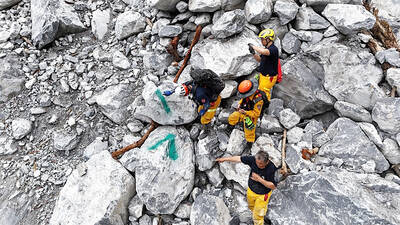
The bodies of two individuals were recovered and three additional bodies were discovered on the Shakadang Trail (砂卡礑) in Taroko National Park, eight days after the devastating earthquake in Hualien County, search-and-rescue personnel said. The rescuers reported that they retrieved the bodies of a man and a girl, suspected to be the father and daughter from the Yu (游) family, 500m from the entrance of the trail on Wednesday. The rescue team added that despite the discovery of the two bodies on Friday last week, they had been unable to retrieve them until Wednesday due to the heavy equipment needed to lift
THE HAWAII FACTOR: While a 1965 opinion said an attack on Hawaii would not trigger Article 5, the text of the treaty suggests the state is covered, the report says NATO could be drawn into a conflict in the Taiwan Strait if Chinese forces attacked the US mainland or Hawaii, a NATO Defense College report published on Monday says. The report, written by James Lee, an assistant research fellow at Academia Sinica’s Institute of European and American Studies, states that under certain conditions a Taiwan contingency could trigger Article 5 of NATO, under which an attack against any member of the alliance is considered an attack against all members, necessitating a response. Article 6 of the North Atlantic Treaty specifies that an armed attack in the territory of any member in Europe,


 RSS
RSS