


Responding to concerns regarding the naturalization of Chinese spouses in Taiwan, the Mainland Affairs Council (MAC) yesterday said it saw no reason to be overly concerned about the voting patterns of the group, saying it did not pose as a threat to national security.
"It takes upwards of 8 years for Chinese spouses to be issued a National Identification Card [and voting rights]. In that period of time, they will experience life in a democratic society. If after eight years they have not changed at all, then the government should reflect on what it needs to be doing better for the Chinese spouses," MAC Vice Chairman Chiu Tai-san (邱太三) said yesterday.

PHOTO: SEAN CHAO, TAIPEI TIMES
Chiu was responding to a Taiwan Solidarity Union (TSU) press conference that had raised concerns regarding the naturalization of the roughly 190,000 Chinese spouses currently living in Taiwan.
Chiu said that while he understood the TSU's concern about national security, he did not think that giving voting rights to Chinese spouses amounted to any sort of security threat. He said that there was little likelihood that many members of the group would decide to run for office or take the civil service examination.
He also addressed TSU fears that naturalized Chinese spouses had enough votes to put four legislators into office.
"You have to subtract about one-fifth of the number of Chinese spouses from the total, given the number of fake marriages. Also, Chinese spouses are dispersed throughout Taiwan. We are also creating single-member-voting districts in the future," Chiu said.
Meanwhile, a group of Chinese Nationalist Party (KMT) legislators yesterday said the idea of denying citizenship to Chinese spouses of local residents ran counter to the notion of upholding human rights.
KMT Legislator Chiang Chi-wen (
"If lawmakers harbor hostility toward certain groups of people, then marginalization and hatred will prevail in Taiwan society," Chiang claimed.
She added that an individual's rights protected by the nation's laws or the Constitution should not be infringed upon for political reasons.
KMT Legislator Chu Fong-chi (朱鳳芝) said that Taiwan must emulate advanced Western countries in the treatment of "new immigrants."
Chu urged legislators as well as government workers to be broad-minded toward the nation's new citizens.
"So long as the new immigrants recognize Taiwan as their new home, we should welcome them with open arms," he added.
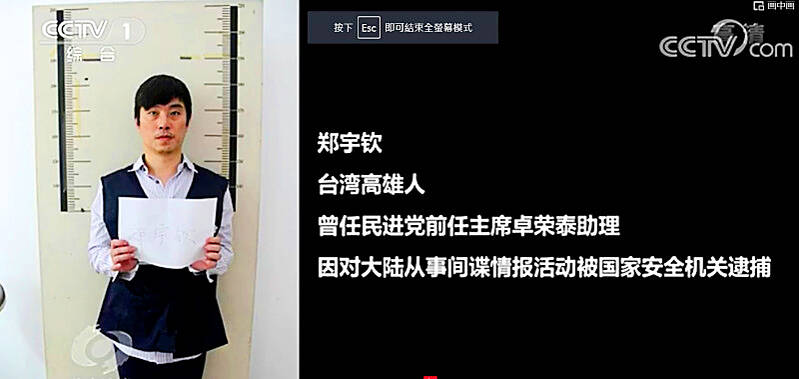
Former Czech Republic-based Taiwanese researcher Cheng Yu-chin (鄭宇欽) has been sentenced to seven years in prison on espionage-related charges, China’s Ministry of State Security announced yesterday. China said Cheng was a spy for Taiwan who “masqueraded as a professor” and that he was previously an assistant to former Cabinet secretary-general Cho Jung-tai (卓榮泰). President-elect William Lai (賴清德) on Wednesday last week announced Cho would be his premier when Lai is inaugurated next month. Today is China’s “National Security Education Day.” The Chinese ministry yesterday released a video online showing arrests over the past 10 years of people alleged to be

THE HAWAII FACTOR: While a 1965 opinion said an attack on Hawaii would not trigger Article 5, the text of the treaty suggests the state is covered, the report says NATO could be drawn into a conflict in the Taiwan Strait if Chinese forces attacked the US mainland or Hawaii, a NATO Defense College report published on Monday says. The report, written by James Lee, an assistant research fellow at Academia Sinica’s Institute of European and American Studies, states that under certain conditions a Taiwan contingency could trigger Article 5 of NATO, under which an attack against any member of the alliance is considered an attack against all members, necessitating a response. Article 6 of the North Atlantic Treaty specifies that an armed attack in the territory of any member in Europe,
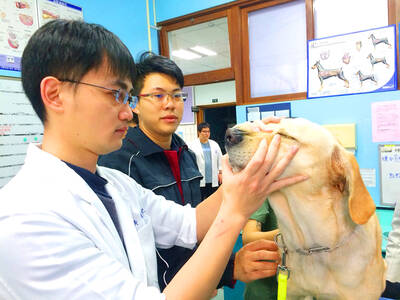
LIKE FAMILY: People now treat dogs and cats as family members. They receive the same medical treatments and tests as humans do, a veterinary association official said The number of pet dogs and cats in Taiwan has officially outnumbered the number of human newborns last year, data from the Ministry of Agriculture’s pet registration information system showed. As of last year, Taiwan had 94,544 registered pet dogs and 137,652 pet cats, the data showed. By contrast, 135,571 babies were born last year. Demand for medical care for pet animals has also risen. As of Feb. 29, there were 5,773 veterinarians in Taiwan, 3,993 of whom were for pet animals, statistics from the Animal and Plant Health Inspection Agency showed. In 2022, the nation had 3,077 pediatricians. As of last

XINJIANG: Officials are conducting a report into amending an existing law or to enact a special law to prohibit goods using forced labor Taiwan is mulling an amendment prohibiting the importation of goods using forced labor, similar to the Uyghur Forced Labor Prevention Act (UFLPA) passed by the US Congress in 2021 that imposed limits on goods produced using forced labor in China’s Xinjiang region. A government official who wished to remain anonymous said yesterday that as the US customs law explicitly prohibits the importation of goods made using forced labor, in 2021 it passed the specialized UFLPA to limit the importation of cotton and other goods from China’s Xinjiang Uyghur region. Taiwan does not have the legal basis to prohibit the importation of goods


 RSS
RSS