


Are foreign spouses from Southeast Asia Taiwan's second-class citizens?
This was the question posed by academics, social activists and government representatives at a seminar last Wednesday.
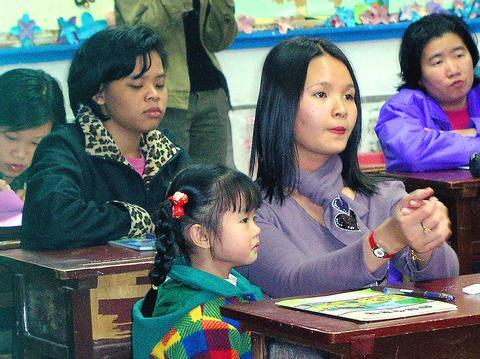
PHOTO: TAIPEI TIMES FILE PHOTO
With the increasing influx of Southeast-Asian foreign spouses, they said, the government and society at large can either ignore them and hope that they will sooner or later be assimilated into Taiwanese society; or Taiwan can strive toward becoming a future ethnic melting pot and welcome these new immigrants with open arms.
"While Taiwan's diplomatic position makes us wish that the international community would treat us fairly, Taiwanese people look down upon their own minority groups -- there should not be any second-class citizens in Taiwan," Ministry of Foreign Affairs spokesman Michel Lu (呂慶龍) said.
Lu is also the vice-chairman of the non-governmental Association for International Affairs.
According to statistics released by the Ministry of the Interior, as of September this year there were approximately 115,000 Southeast-Asian female spouses living in Taiwan.
"Of last year's registered marriages, 31.9 percent were interracial marriages and 13.4 percent of last year's infants were born to foreign mothers. Many issues may stem from these interracial marriages: communication [difficulties] among the in-laws, adjustment problems and so on," said Lin Wan-I (林萬億), a professor in social work at National Taiwan University.
Lin said that foreign women who met their husbands through commercial matchmaking services tend to be considered "less worthy" daughters-in-law in the eyes of their new in-laws.
"There is a connotation that a bride has been sold and bought, and it definitely affects the way she is treated by her mother-in-law, sisters-in-law, and even by her husband; such a spouse may be treated as if she belonged to a lower tier in a familial hierarchy," Lin said.
Some attendees at the seminar said that children born into such interracial families may face learning impediments.
"These foreign spouses, who are often the main caregivers at home, have little idea about how to raise their children. The impact of cultural differences slows down the learning process of these children; they may have difficulty in expressing themselves verbally and imitating and achieving the same vocabulary as other children of the same age," said Kathy Ke (柯宇玲), chief executive officer of the Pearl S. Buck Foundation.
Ke said there is often an aversion among foreign mothers to communicate with their children in the mother's native tongue.
"There seems to be an impression that Chinese is better than their native tongues. Therefore, these mothers are generally unwilling to teach their children to speak their native languages," she said.
From a legal perspective, Taiwan's immigration policies and regulations are definitely not on the side of foreign spouses: They are required to have lived in Taiwan for three years before they may apply for naturalization, and have to give up their original nationality. After applying for naturalization, a spouse has to wait for another year before citizenship is granted.
"Meanwhile, there is a one-year period where this spouse literally has no citizenship in any country. Before she becomes a Taiwanese citizen and receives a national ID, she is unable to exercise her legal rights in difficult situations, such as domestic violence," said Lai Shiu-ling (
Lai said it is the overall system in the country that turns foreign spouses into minorities, and it is not because they already belonged to a lower social rank in their home countries.
"Even if a spouse had a very respectable job in her home country, there is still a very slim chance that she could find the same type of job here due to many reasons: language barriers, lack of job opportunities or her professional credentials in her native country might not be transferable here. Therefore, a lot of foreign spouses end up doing labor-intensive jobs even if they have work permits that allow them to freely choose their lines of work," Lai said.
In case of a divorce, the judge will not discriminate against a foreign spouse in a dispute over custody of the children, but a lack of financial resources could sway the court's verdict against the foreign spouse.
"Normally, these foreign spouses are not financially independent -- a situation that is not favorable when it comes to some legal conflicts," Lai said.
Nene Ho, the president of the Filipinos Married to Taiwanese Association (FMTA), who has been living in Taiwan for 20 years and started the organization six years ago, talked about the challenges facing foreign spouses in Taiwan.
"When I first moved here, it was the language issue that I found the most difficult to adjust to. Most of the challenges faced by Filipino spouses I know are language barriers and financial burdens. Some wives who have married into economically disadvantaged households are expected to share the duty of being a breadwinner; it is especially true for spouses living in the south," Ho said.
According to Yu Yi-chun (尤詒君) of the Taipei City Government's Bureau of Social Affairs, the government's approach toward foreign spouses has evolved from a passive to a proactive strategy.
"In the past, the Taipei City Government's policy toward foreign spouses was one that expected foreign spouses to be assimilated into Taiwanese society. However, the government has lately been presenting a variety of cultural events which help Taiwanese people to understand and appreciate Southeast-Asian cultures. Such a shift in approach aims to prepare Taiwan to embrace cultural diversity," Yu said.
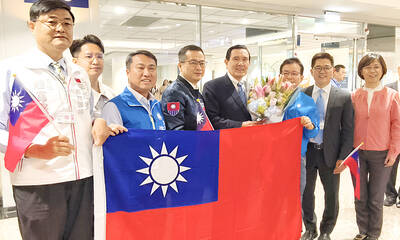
Former president Ma Ying-jeou’s (馬英九) mention of Taiwan’s official name during a meeting with Chinese President Xi Jinping (習近平) on Wednesday was likely a deliberate political play, academics said. “As I see it, it was intentional,” National Chengchi University Graduate Institute of East Asian Studies professor Wang Hsin-hsien (王信賢) said of Ma’s initial use of the “Republic of China” (ROC) to refer to the wider concept of “the Chinese nation.” Ma quickly corrected himself, and his office later described his use of the two similar-sounding yet politically distinct terms as “purely a gaffe.” Given Ma was reading from a script, the supposed slipup
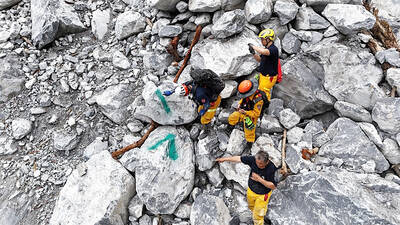
The bodies of two individuals were recovered and three additional bodies were discovered on the Shakadang Trail (砂卡礑) in Taroko National Park, eight days after the devastating earthquake in Hualien County, search-and-rescue personnel said. The rescuers reported that they retrieved the bodies of a man and a girl, suspected to be the father and daughter from the Yu (游) family, 500m from the entrance of the trail on Wednesday. The rescue team added that despite the discovery of the two bodies on Friday last week, they had been unable to retrieve them until Wednesday due to the heavy equipment needed to lift
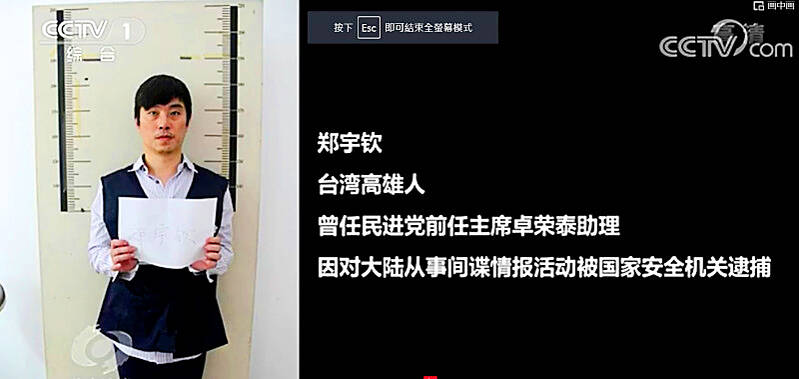
Former Czech Republic-based Taiwanese researcher Cheng Yu-chin (鄭宇欽) has been sentenced to seven years in prison on espionage-related charges, China’s Ministry of State Security announced yesterday. China said Cheng was a spy for Taiwan who “masqueraded as a professor” and that he was previously an assistant to former Cabinet secretary-general Cho Jung-tai (卓榮泰). President-elect William Lai (賴清德) on Wednesday last week announced Cho would be his premier when Lai is inaugurated next month. Today is China’s “National Security Education Day.” The Chinese ministry yesterday released a video online showing arrests over the past 10 years of people alleged to be
MIX-UP: Kaohsiung Municipal Min-Sheng Hospital director Yen Chia-chi was suspended from his duties after surgeons operated on the wrong patient last week The Kaohsiung Department of Health yesterday fined Kaohsiung Municipal Min-Sheng Hospital NT$500,0000 for misidentifying two patients and consequently causing one of them to undergo the wrong surgery last week. The hospital’s director Yen Chia-chi (顏家祺) was suspended from his duties. The surgeon who was scheduled to operate on the patient was given a major demerit and is subject to subsequent disciplinary actions. Demerits were given to the anesthesiologist, the nurse in the operation room, the nurse in the ward and the worker who helped transfer the patient from the ward to the operation room for having failed to verify the patient’s identity. Meanwhile, the


 RSS
RSS