


The official launch of an international marine research station on the Pratas Islands, known locally as the Dongsha Islands (東沙島), a disputed group in the South China Sea, has initiated a process of internationalizing related oceanic issues ranging from scientific research to ecotourism promotion.
At a round-table meeting convened by the Marine Resources Conservation Working Group under the Asia Pacific Economic Cooperation (APEC) organization last Friday, Kaohsiung Mayor Frank Hsieh (謝長廷) stressed that the Kaohsiung City Government would do its best to ensure the sustainability of the area, which administratively belongs to the city.
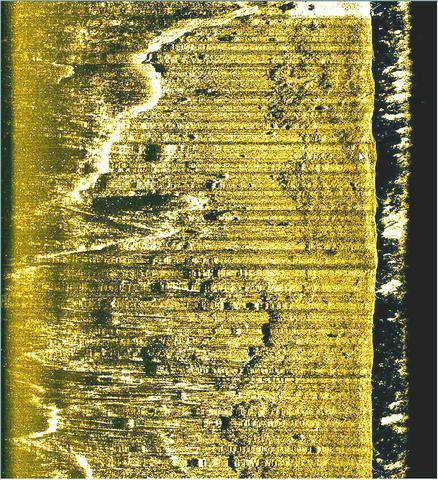
COURTESY OF KAOHSIUNG CITY MARINE BUREAU/COLLEGE OF MARINE SCIEN
"The establishment of an international scientific research station there will facilitate future international scientific collaboration, further ensuring both cultural and ecological conservation," Hsieh said.
Hsieh said that ecological catastrophes had been observed because of past inappropriate activities involving fishermen from neighboring countries. Therefore the city government is upgrading existing facilities at a service station for Taiwanese fishermen in a bid to provide more assistance to scientists interested in carrying out research there.
"We aim to explore many interesting fields, including the conservation of coral reefs, the underwater cultural heritage involving sunken boats and ecotourism," Hsieh said.
The Dongsha Islands comprise Dongsha Island and two coral reefs, the North Vereker Bank (北衛灘) and the South Vereker Bank (南衛灘). The archipelago is located in a strategically important position along the major sea route connecting the Pacific and Indian oceans. Since the end of World War II, it has been administrated by Taiwan. Prior to that, Japan guarded the area for more than three decades.
Since 1994, a group of 57 Taiwanese scientists and researchers have launched a series of scientific researches in the waters of the Dongsha Islands. According to Jeng Ming-shiou (鄭明修), a marine biologist from the Academia Sinica's Institute of Zoology, abnormal climate effects caused by El Nino in 1998 caused coral bleaching in about 300km2 of ocean.
Since then, Taiwanese scientists have recorded the reappearance of coral.
So far, more than 120 kinds of coral reef have been observed and the coverage rate has increased to about 5 percent, Jeng said.
"We've recorded more than 300 kinds of fish but believe that there are more than 1,000," Jeng told the Taipei Times.
In 1999, administration of Dongsha was official shifted to the Kaohsiung City Government, which, since then, has been actively promoting scientific research and ecotourism of the islands, which are about 440km southwest of Kaohsiung.
Two years ago, scientific research led by the Kaohsiung-based National Sun Yat-sen University (NSYSU), first took an image of a mysterious sunken merchantman at a depth between 50m and 70m near Dongsha Island. Project investigator Chen Yang-Yih (陳陽益), who is also dean of NSYSU's College of Marine Sciences, told the Taipei Times that the 200m-long cargo ship was of design common a century ago, and could possibly have belonged to one of the active European trading powers of the time, such as Spain, France, Britain, or the Netherlands.
Chen said available documents suggest that some 30 ships of a similar size went missing in the area of the Dongsha Islands.
"We hope to further study not only the sunken boat but also related history about the exploration of marine resources," Chen said.
Scientists believe that research in the area might reveal hitherto unknown details about the history of human migration around the Asia-Pacific region.
Chen said that underwater archeology-related topics near the Dongsha Islands have interested scientists from not only neighboring countries, such as Japan, the Philippines, Malaysia, and Indonesia, but also from Australia, the UK, and the US.
Chen said future possible scientific collaborative projects with other countries on marine science issues would be discussed at a four-day workshop for marine scientists, the Second International Workshop on the Protection of Underwater Cultural Heritage, which begins today in Kaohsiung.
Stressing that the responsibility of protecting and preserving the underwater cultural heritage rests with all countries, Chen said the workshop aims to provide a forum for sharing information and experience about the development of underwater archaeology in the Asia-Pacific region, particularly in the coastal waters of Taiwan as well as the Dongshas.
"We hope to gain more support from some governmental agencies in charge of cultural conservation, such as the Cabinet's Council of Cultural Affairs," Chiau Wen-yan (邱文彥), an associate professor of marine environment and engineering at NSYSU, said.
Chiau said that the 2001 UN Convention on the Protection of Underwater Cultural Heritage stresses the underwater cultural heritage is an integral part of the cultural heritage of humanity and a particularly important element in the history of peoples, countries, and their relations with each other concerning their common heritage.
The Ministry of the Interior plans to turn the waters near the Dongsha Islands into an oceanic national park. Scientists said that a comprehensive ecological survey would be essential because, so far, people remain ignorant of the abundant natural resources in the area.
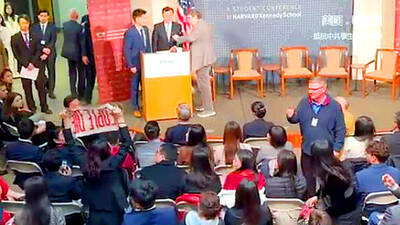
A group of Taiwanese-American and Tibetan-American students at Harvard University on Saturday disrupted Chinese Ambassador to the US Xie Feng’s (謝鋒) speech at the school, accusing him of being responsible for numerous human rights violations. Four students — two Taiwanese Americans and two from Tibet — held up banners inside a conference hall where Xie was delivering a speech at the opening ceremony of the Harvard Kennedy School China Conference 2024. In a video clip provided by the Coalition of Students Resisting the CCP (Chinese Communist Party), Taiwanese-American Cosette Wu (吳亭樺) and Tibetan-American Tsering Yangchen are seen holding banners that together read:

UNAWARE: Many people sit for long hours every day and eat unhealthy foods, putting them at greater risk of developing one of the ‘three highs,’ an expert said More than 30 percent of adults aged 40 or older who underwent a government-funded health exam were unaware they had at least one of the “three highs” — high blood pressure, high blood lipids or high blood sugar, the Health Promotion Administration (HPA) said yesterday. Among adults aged 40 or older who said they did not have any of the “three highs” before taking the health exam, more than 30 percent were found to have at least one of them, Adult Preventive Health Examination Service data from 2022 showed. People with long-term medical conditions such as hypertension or diabetes usually do not
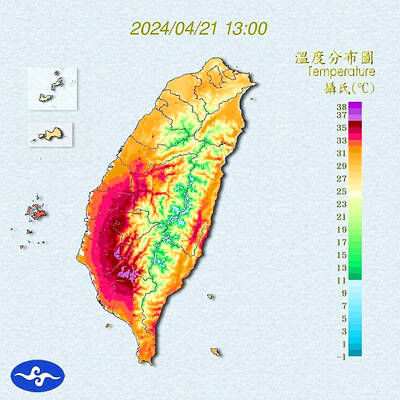
Heat advisories were in effect for nine administrative regions yesterday afternoon as warm southwesterly winds pushed temperatures above 38°C in parts of southern Taiwan, the Central Weather Administration (CWA) said. As of 3:30pm yesterday, Tainan’s Yujing District (玉井) had recorded the day’s highest temperature of 39.7°C, though the measurement will not be included in Taiwan’s official heat records since Yujing is an automatic rather than manually operated weather station, the CWA said. Highs recorded in other areas were 38.7°C in Kaohsiung’s Neimen District (內門), 38.2°C in Chiayi City and 38.1°C in Pingtung’s Sandimen Township (三地門), CWA data showed. The spell of scorching
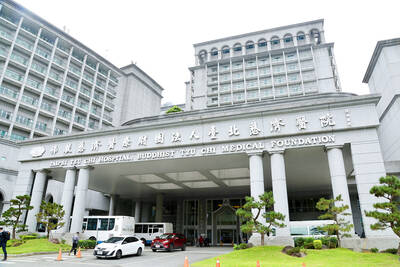
POLICE INVESTIGATING: A man said he quit his job as a nurse at Taipei Tzu Chi Hospital as he had been ‘disgusted’ by the behavior of his colleagues A man yesterday morning wrote online that he had witnessed nurses taking photographs and touching anesthetized patients inappropriately in Taipei Tzu Chi Hospital’s operating theaters. The man surnamed Huang (黃) wrote on the Professional Technology Temple bulletin board that during his six-month stint as a nurse at the hospital, he had seen nurses taking pictures of patients, including of their private parts, after they were anesthetized. Some nurses had also touched patients inappropriately and children were among those photographed, he said. Huang said this “disgusted” him “so much” that “he felt the need to reveal these unethical acts in the operating theater


 RSS
RSS