


The second wave of Taiwan's constitutional reform should follow an "appropriate procedure" and let the public enjoy the opportunity to debate and deliberate over the context of the new constitution, Chang Wen-chen (張文貞), a law professor at National Taiwan University, said yesterday.
"Over the past five decades, the Constitution became a political tool. Constitutional reforms were dominated by one party and the context of the past six constitutional amendments was made via partisan negotiations. It may solve some of the problems, but it inevitably causes more in the long run," he said.
Regardless of whether the new constitution proposed by President Chen Shui-bian (陳水扁) is an amended one or brand new, Chang said that public participation and grassroots debates should be strengthened this time around.
"Experience and studies have taught us that only through public discussion and deliberation can we genuinely transform inhabitants living under constitutional order into citizens,'" she said.
Chang made the remarks yesterday during the morning session of a one-day seminar to discuss constitutional reforms. The event was co-organized by the Cabinet's Research, Development and Evaluation Commission and the Public Law Research Institute of the National Taiwan University's College of Law.
The main theme of the session was constitutional reforms, national identification and constitutional procedure. The theme of the first afternoon session was constitutional context focusing on the governmental system and the second afternoon session dealt with constitutional context focusing on human rights.
Speaking at the opening ceremony, Presidential Office Secretary-General Su Tseng-chang (蘇貞昌) told a roomful of some 200 law students, academics and civil servants that the new constitution proposed by Chen cannot and will not be decided by one single party or individual.
"As the president has assigned me to take charge of the preparatory work for the constitutional reform, I've attended various seminars and panel discussions in northern, southern, central and eastern Taiwan," he said. "I'll organize the opinions solicited as well as those gathered today and present them to the proposed constitutional reform committee. The committee will then call a constitutional convention to decide the context of a new-constitution meeting in terms of the requirements set down by the president and responding to the aspirations of the public."
Head of the Research, Development and Evaluation Commission Yeh Jiunn-rong (
Echoing this, Chang said that the first wave of the nation's constitutional reforms conducted during the KMT era lacked "appropriate procedure," prompting the Council of Grand Justices to rule that the lawmaking body should not amend the Constitution during provisional legislative sessions.
Another ruling further requests that government agencies responsible for constitutional amendments follow an "appropriate procedure" and clearly specifies that the process of constitutional amendment should be open, transparent and have rational debates and negotiations.
The Grand Justices, however, failed to distinctively explain the definition of "appropriate procedure." Chang outlined this as preparation, motion filing, discussion and decision.
During the discussion period, Chang said that the public should be allowed to attend national public hearings, debates and public discussions -- both online and in writing.
During the decision-making process, Chang accented the importance of a "majority decision," a political decision made by the majority of the people.
"In the republican form of government, such decisions are made in accordance with the regulations of a constitution, which is no more the expression of a national will or subject to the will of the majority than a building is the expression of the will of its architect or subject to the will of its inhabitants," she said.
While the public is polarized over whether to amend the Constitution or to enact a new one, Tsai Tsung-chen (
Speaking on the future of the government system, Hawang Shiow-duan (
"I personally think that the best solution is to adjust the current system to empower the president to call ministerial meetings and to dissolve the legislature," she said.
She also proposed to amend the Referendum Law (公投法) to allow government agencies to file motions of constitutional amendment.
THE HAWAII FACTOR: While a 1965 opinion said an attack on Hawaii would not trigger Article 5, the text of the treaty suggests the state is covered, the report says NATO could be drawn into a conflict in the Taiwan Strait if Chinese forces attacked the US mainland or Hawaii, a NATO Defense College report published on Monday says. The report, written by James Lee, an assistant research fellow at Academia Sinica’s Institute of European and American Studies, states that under certain conditions a Taiwan contingency could trigger Article 5 of NATO, under which an attack against any member of the alliance is considered an attack against all members, necessitating a response. Article 6 of the North Atlantic Treaty specifies that an armed attack in the territory of any member in Europe,
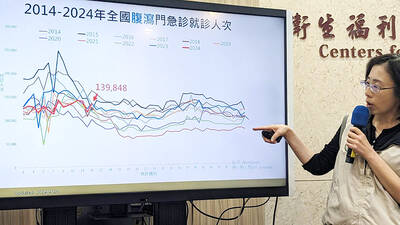
FLU SEASON: Twenty-six severe cases were reported from Tuesday last week to Monday, including a seven-year-old girl diagnosed with influenza-associated encephalopathy Nearly 140,000 people sought medical assistance for diarrhea last week, the Centers for Disease Control (CDC) said on Tuesday. From April 7 to Saturday last week, 139,848 people sought medical help for diarrhea-related illness, a 15.7 percent increase from last week’s 120,868 reports, CDC Epidemic Intelligence Center Deputy Director Lee Chia-lin (李佳琳) said. The number of people who reported diarrhea-related illness last week was the fourth highest in the same time period over the past decade, Lee said. Over the past four weeks, 203 mass illness cases had been reported, nearly four times higher than the 54 cases documented in the same period
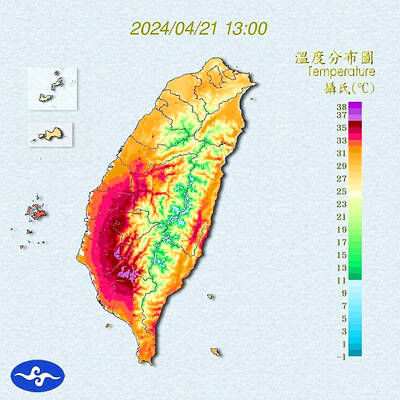
Heat advisories were in effect for nine administrative regions yesterday afternoon as warm southwesterly winds pushed temperatures above 38°C in parts of southern Taiwan, the Central Weather Administration (CWA) said. As of 3:30pm yesterday, Tainan’s Yujing District (玉井) had recorded the day’s highest temperature of 39.7°C, though the measurement will not be included in Taiwan’s official heat records since Yujing is an automatic rather than manually operated weather station, the CWA said. Highs recorded in other areas were 38.7°C in Kaohsiung’s Neimen District (內門), 38.2°C in Chiayi City and 38.1°C in Pingtung’s Sandimen Township (三地門), CWA data showed. The spell of scorching
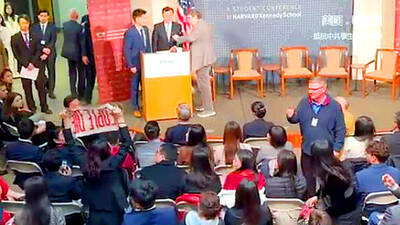
A group of Taiwanese-American and Tibetan-American students at Harvard University on Saturday disrupted Chinese Ambassador to the US Xie Feng’s (謝鋒) speech at the school, accusing him of being responsible for numerous human rights violations. Four students — two Taiwanese Americans and two from Tibet — held up banners inside a conference hall where Xie was delivering a speech at the opening ceremony of the Harvard Kennedy School China Conference 2024. In a video clip provided by the Coalition of Students Resisting the CCP (Chinese Communist Party), Taiwanese-American Cosette Wu (吳亭樺) and Tibetan-American Tsering Yangchen are seen holding banners that together read:


 RSS
RSS