


It is "extremely difficult" for the US to change its "one China" policy, said Senior Advisor to the President Koo Kwang-ming (辜 寬敏), who returned on Monday from a trip to Washington to try to persuade US officials to give up the policy.
The 80-year-old Koo met with US State Department officials, including US Deputy Secretary of State Richard Armitage, who were perplexed or angered by his advertisements in US and Taiwanese newspapers last week that urged Washington to rethink its "one China" policy.
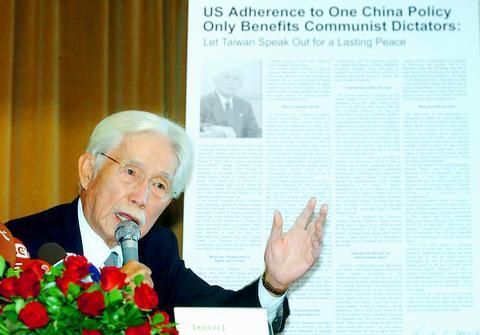
PHOTO: CHIANG YING-YING, TAIPEI TIMES
Koo's full-page ads, headlined "US adherence to one China policy only benefits communist dictators: Let Taiwan speak out for a lasting peace," appeared in the New York Times and the Washington Post on Oct. 4 and the Taipei Times on Oct. 5.
At a press conference hosted by the Taiwan North Society yesterday, Koo said he was surprised by the strong reaction to the ads.
Koo was in Washington the day his ads appeared in the two US papers. The White House called the Taipei Economic and Cultural Representative Office (TECRO) in Washington at 9:30am demanding an explanation.
The State Department made a similar call at 11:30am.
"They asked what my ads meant," Koo said, describing his ads as "a blow to the US government" that "hurt the self-esteem of State Department officials."
Both the White House and the State Department asked if the Presidential Office had authorized the advertisements, which cost Koo US$200,000.
The Presidential Office denied prior knowledge of Koo's plan to place the ads.
"The State Department should ask our government whether it supports my view that the US should not adhere to the `one China' policy anymore. Of course our government wants the US to remove the policy," Koo said.
He said President Chen Shui-bian (陳水扁) didn't know about his ad plan. After the ads appeared, Koo called Ma Yung-cheng (馬永成), a top Presidential Office staff member, three times, wanting to talk to Chen.
"Ma's aide told me he was in a meeting. Ma never replied to my call," Koo said.
Despite the uproar, Koo said he was "very satisfied" with the impact of his ads.
"Actually, almost everyone I met in Washington praised my ads and said they personally agreed with me. However, they added that as staff of the State Department, they could not support my view," Koo said.
Koo said he tried to dissuade US officials from doing what China asked of them in matters related to Taiwan.
China is happy that the strategy of getting Washington to apply pressure on Taiwan works, but "Taiwan suffers and its dislike towards the US is growing," Koo said.
"The US has been urging us to talk to China. However, if the US continues to serve as China's mouthpiece, China will not need to initiate any dialogue with us. It simply has to ask Washington to command Taiwan to do what it wishes," he said.
Koo criticized Chen's Double Ten National Day address, in which he invited China to start talks with Taiwan on the basis reached during a 1992 Hong Kong meeting. Koo said such remarks were inappropriate.
Koo said he has previously advised Chen not to offer any more olive branches to Beijing.
China froze cross-strait talks during Chen's first term but cannot afford to turn its back on Chen for another four years, Koo said, adding that Beijing will have to find a way to talk to Chen sooner or later.
Koo said he told US officials that he wished for three things.
"First, I hope TECRO's name could be changed to the Taiwan Institute in America," he said.
"Second, Washington should stop doing what China asks it to do over Taiwan. Third, I wish to be invited to attend President [George W.] Bush's inauguration ceremony if he is re-elected. I am already 80 and don't have many years left," Koo said.
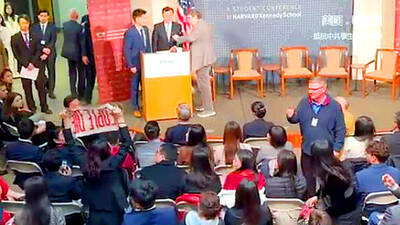
A group of Taiwanese-American and Tibetan-American students at Harvard University on Saturday disrupted Chinese Ambassador to the US Xie Feng’s (謝鋒) speech at the school, accusing him of being responsible for numerous human rights violations. Four students — two Taiwanese Americans and two from Tibet — held up banners inside a conference hall where Xie was delivering a speech at the opening ceremony of the Harvard Kennedy School China Conference 2024. In a video clip provided by the Coalition of Students Resisting the CCP (Chinese Communist Party), Taiwanese-American Cosette Wu (吳亭樺) and Tibetan-American Tsering Yangchen are seen holding banners that together read:

UNAWARE: Many people sit for long hours every day and eat unhealthy foods, putting them at greater risk of developing one of the ‘three highs,’ an expert said More than 30 percent of adults aged 40 or older who underwent a government-funded health exam were unaware they had at least one of the “three highs” — high blood pressure, high blood lipids or high blood sugar, the Health Promotion Administration (HPA) said yesterday. Among adults aged 40 or older who said they did not have any of the “three highs” before taking the health exam, more than 30 percent were found to have at least one of them, Adult Preventive Health Examination Service data from 2022 showed. People with long-term medical conditions such as hypertension or diabetes usually do not
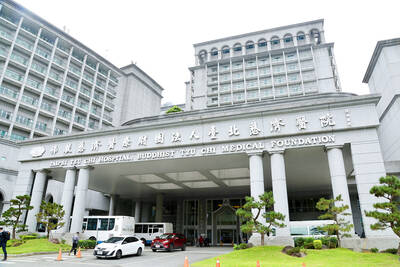
POLICE INVESTIGATING: A man said he quit his job as a nurse at Taipei Tzu Chi Hospital as he had been ‘disgusted’ by the behavior of his colleagues A man yesterday morning wrote online that he had witnessed nurses taking photographs and touching anesthetized patients inappropriately in Taipei Tzu Chi Hospital’s operating theaters. The man surnamed Huang (黃) wrote on the Professional Technology Temple bulletin board that during his six-month stint as a nurse at the hospital, he had seen nurses taking pictures of patients, including of their private parts, after they were anesthetized. Some nurses had also touched patients inappropriately and children were among those photographed, he said. Huang said this “disgusted” him “so much” that “he felt the need to reveal these unethical acts in the operating theater
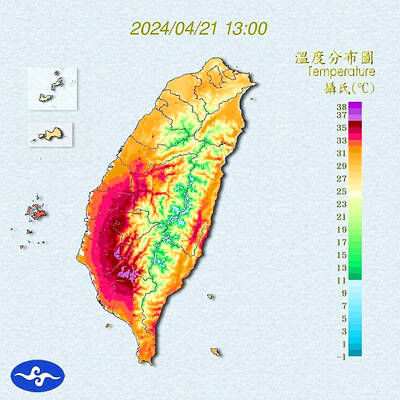
Heat advisories were in effect for nine administrative regions yesterday afternoon as warm southwesterly winds pushed temperatures above 38°C in parts of southern Taiwan, the Central Weather Administration (CWA) said. As of 3:30pm yesterday, Tainan’s Yujing District (玉井) had recorded the day’s highest temperature of 39.7°C, though the measurement will not be included in Taiwan’s official heat records since Yujing is an automatic rather than manually operated weather station, the CWA said. Highs recorded in other areas were 38.7°C in Kaohsiung’s Neimen District (內門), 38.2°C in Chiayi City and 38.1°C in Pingtung’s Sandimen Township (三地門), CWA data showed. The spell of scorching


 RSS
RSS