


Taiwan has carried out extensive research on the spread of foreign species around the nation and further research will be conducted in the next year, according to the National Science Council (NSC) yesterday.
The issue of foreign species flourishing in local ecosystems, which threaten biodiversity, have been a hot topic ever since South American fire ants were discovered in Taoyuan and Taipei.
The NSC's Wu Mau-kuen (
"Experts have worked on designing a project that helps the government control the spread of fire ants," Wu said.
Wu also said that the national task force on invasive species will be established early next month to work closely with related government agencies to strengthen measures to control the ant problem.
According to Wu, invasive species such as the fire ant not only threaten biodiversity, but also habitat quality. The NSC spent NT$12 million last year financing seven major projects on assessing and monitoring the spread of foreign organisms.
According to the NSC, the South American fire ant is just one foreign species threatening the nation. Researchers have found that the apple snail population has also threatened biodiversity. Aquatic life is threatened as a result of pesticides used to fight the snail, which flourishes in agricultural areas.
According to the Council of Agriculture, other kinds of foreign species which jeopardize Taiwan's ecological system include the Polynesian rat, the pinewood nematode, psylla chinensis, cycad aulacaspis scale, the golden mussel, the sun skink, the American rope and the water hyacinth.
These foreign species produce severe, often irreversible impacts on the agricultural sector, recreational areas and natural resources.
Wu said that the shortage of local expertise in biodiversity-related fields has been a problem for years. Before 2000, the number of researchers engaged in biodiversity research in Taiwan was less than 200.
Biological diversity is the sum total of the variety of life and its interactions. It can be subdivided into three levels: genetic diversity, species diversity and ecosystem diversity. According to Wu, most of Taiwan's biodiversity-related research focuses on endangered species.
"Relatively little effort has been made to study genetic diversity and ecosystem diversity. We need more interdisciplinary integration," Wu said.
To make up the gap in biodiversity researchers, the NSC, the Academia Sinica and the Ministry of Education will jointly come up with a plan to encourage Taiwanese students to study abroad and gain expertise in the necessary fields.
For example, Taiwan needs more experts in taxonomy, a branch of biological sciences which deals with the identification, description, naming and classification of the organisms, Wu said.
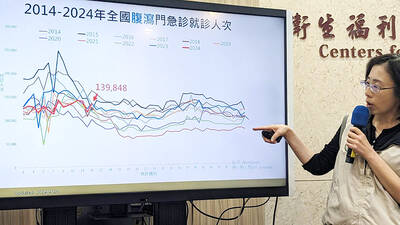
FLU SEASON: Twenty-six severe cases were reported from Tuesday last week to Monday, including a seven-year-old girl diagnosed with influenza-associated encephalopathy Nearly 140,000 people sought medical assistance for diarrhea last week, the Centers for Disease Control (CDC) said on Tuesday. From April 7 to Saturday last week, 139,848 people sought medical help for diarrhea-related illness, a 15.7 percent increase from last week’s 120,868 reports, CDC Epidemic Intelligence Center Deputy Director Lee Chia-lin (李佳琳) said. The number of people who reported diarrhea-related illness last week was the fourth highest in the same time period over the past decade, Lee said. Over the past four weeks, 203 mass illness cases had been reported, nearly four times higher than the 54 cases documented in the same period

A group of Taiwanese-American and Tibetan-American students at Harvard University on Saturday disrupted Chinese Ambassador to the US Xie Feng’s (謝鋒) speech at the school, accusing him of being responsible for numerous human rights violations. Four students — two Taiwanese Americans and two from Tibet — held up banners inside a conference hall where Xie was delivering a speech at the opening ceremony of the Harvard Kennedy School China Conference 2024. In a video clip provided by the Coalition of Students Resisting the CCP (Chinese Communist Party), Taiwanese-American Cosette Wu (吳亭樺) and Tibetan-American Tsering Yangchen are seen holding banners that together read:
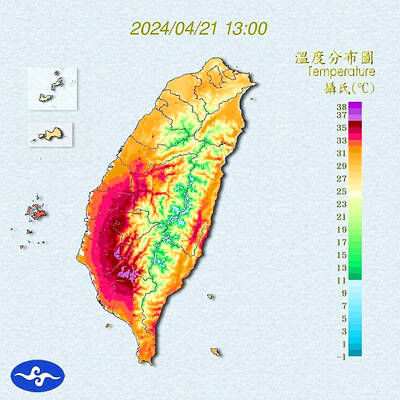
Heat advisories were in effect for nine administrative regions yesterday afternoon as warm southwesterly winds pushed temperatures above 38°C in parts of southern Taiwan, the Central Weather Administration (CWA) said. As of 3:30pm yesterday, Tainan’s Yujing District (玉井) had recorded the day’s highest temperature of 39.7°C, though the measurement will not be included in Taiwan’s official heat records since Yujing is an automatic rather than manually operated weather station, the CWA said. Highs recorded in other areas were 38.7°C in Kaohsiung’s Neimen District (內門), 38.2°C in Chiayi City and 38.1°C in Pingtung’s Sandimen Township (三地門), CWA data showed. The spell of scorching

UNAWARE: Many people sit for long hours every day and eat unhealthy foods, putting them at greater risk of developing one of the ‘three highs,’ an expert said More than 30 percent of adults aged 40 or older who underwent a government-funded health exam were unaware they had at least one of the “three highs” — high blood pressure, high blood lipids or high blood sugar, the Health Promotion Administration (HPA) said yesterday. Among adults aged 40 or older who said they did not have any of the “three highs” before taking the health exam, more than 30 percent were found to have at least one of them, Adult Preventive Health Examination Service data from 2022 showed. People with long-term medical conditions such as hypertension or diabetes usually do not


 RSS
RSS