


The Mainland Affairs Council (MAC) yesterday dismissed speculation that its administrative status would be downgraded to that of a "Mainland Affairs Office," but officials were unable to spell out the council's role under legislation mandating the restructuring of the Executive Yuan.
"In the future, the MAC will no longer exist as an [individual governmental] entity -- this is the reality. However, it will become a part of the Executive Yuan proper, which will be very large in scale in the future," MAC Chairman and Straits Exchange Foundation (SEF) Secretary-General Johnnason Liu (劉德勳) said yesterday. Liu referred to the Executive Yuan as a supervisory organ overseeing the work of agencies under its jurisdiction and not as a branch of the government.
In accordance with the Standard Organic Law of Central Government Agencies (
While the MAC is currently a commission under the Executive Yuan's supervision, structural reshuffling is expected to dismantle the council as an entity under the Executive Yuan. In the future, the brunt of the MAC's current responsibilities, primarily cross-strait affairs, will be added to the workload of the Executive Yuan and come under the direct supervision of the premier.
"The Executive Yuan's workload will include accounting, personnel, etc, and Chinese affairs will also be one of its responsibilities," Liu said. "In the future, the MAC will not become just an office at the Executive Yuan. It will still be a part of the Executive Yuan, and we are currently working on an appropriate title to reflect its structural role. This situation is unprecedented."
Liu pointed out, however, that taking on responsibility for cross-strait matters would be a first for the Executive Yuan, as the secretariat primarily handled the Cabinet's internal affairs and supervised civil servants only; the jurisdiction of cross-strait affairs, however, would of necessity reach beyond the scope of Executive Yuan employees.
Liu characterized the Executive Yuan's cross-strait workload as macroscopic planning and coordinating. However, when asked which MAC departments would be retained in the reshuffle, Liu refrained from answering, joking that he was the SEF secretary-general and directing the media to MAC spokesman Chiu Tai-san (邱太三).
However, Liu said that because the MAC will no longer exist as a commission under the Executive Yuan and will therefore be taken out of draft amendments to the Organic Law of the Executive Yuan (行政院組織法) which are due to be sent to the legislature by the end of the month, there is time to mull over possible designations for the entity. Restructuring is not expected to take effect until January 2006 and would depend on the legislature's approval of the amendments.
Liu meanwhile pointed to several legal complications that restructuring could bring for cross-strait affairs. "In the future, with the MAC dismantled, there will no longer be a governmental agency authorized to post representatives to Hong Kong and Macau," Liu said.
Whether the Executive Yuan could legally appoint representatives to Hong Kong and Macau was also an open-ended question. According to Liu, the Executive Yuan "has not said yes, but nor have they said no. It has never happened." He said that there was no applicable legal precedent that can be followed.
In addition, the abolition of the MAC would leave the SEF without a governmental supervisory agency. The SEF is nominally a civic group but executes a substantial amount of the work involved in cross-strait exchange.
"The challenge will be to ensure that the needs of cross-strait work are addressed both structurally and concretely. The Executive Yuan and each individual ministry will need to coordinate to strengthen all mainland-related work. This isn't going to be easy," Liu said.
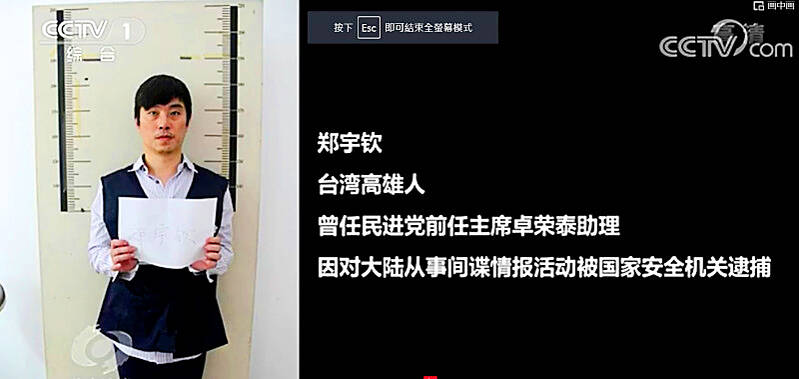
Former Czech Republic-based Taiwanese researcher Cheng Yu-chin (鄭宇欽) has been sentenced to seven years in prison on espionage-related charges, China’s Ministry of State Security announced yesterday. China said Cheng was a spy for Taiwan who “masqueraded as a professor” and that he was previously an assistant to former Cabinet secretary-general Cho Jung-tai (卓榮泰). President-elect William Lai (賴清德) on Wednesday last week announced Cho would be his premier when Lai is inaugurated next month. Today is China’s “National Security Education Day.” The Chinese ministry yesterday released a video online showing arrests over the past 10 years of people alleged to be
THE HAWAII FACTOR: While a 1965 opinion said an attack on Hawaii would not trigger Article 5, the text of the treaty suggests the state is covered, the report says NATO could be drawn into a conflict in the Taiwan Strait if Chinese forces attacked the US mainland or Hawaii, a NATO Defense College report published on Monday says. The report, written by James Lee, an assistant research fellow at Academia Sinica’s Institute of European and American Studies, states that under certain conditions a Taiwan contingency could trigger Article 5 of NATO, under which an attack against any member of the alliance is considered an attack against all members, necessitating a response. Article 6 of the North Atlantic Treaty specifies that an armed attack in the territory of any member in Europe,

LIKE FAMILY: People now treat dogs and cats as family members. They receive the same medical treatments and tests as humans do, a veterinary association official said The number of pet dogs and cats in Taiwan has officially outnumbered the number of human newborns last year, data from the Ministry of Agriculture’s pet registration information system showed. As of last year, Taiwan had 94,544 registered pet dogs and 137,652 pet cats, the data showed. By contrast, 135,571 babies were born last year. Demand for medical care for pet animals has also risen. As of Feb. 29, there were 5,773 veterinarians in Taiwan, 3,993 of whom were for pet animals, statistics from the Animal and Plant Health Inspection Agency showed. In 2022, the nation had 3,077 pediatricians. As of last
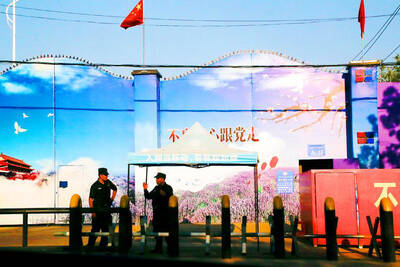
XINJIANG: Officials are conducting a report into amending an existing law or to enact a special law to prohibit goods using forced labor Taiwan is mulling an amendment prohibiting the importation of goods using forced labor, similar to the Uyghur Forced Labor Prevention Act (UFLPA) passed by the US Congress in 2021 that imposed limits on goods produced using forced labor in China’s Xinjiang region. A government official who wished to remain anonymous said yesterday that as the US customs law explicitly prohibits the importation of goods made using forced labor, in 2021 it passed the specialized UFLPA to limit the importation of cotton and other goods from China’s Xinjiang Uyghur region. Taiwan does not have the legal basis to prohibit the importation of goods


 RSS
RSS