


China may delay talks on a free trade deal with Singapore in retaliation for a visit by Singapore's future prime minister to Taiwan, Chinese media said yesterday, escalating a diplomatic spat.
The threat is the latest fallout from a visit last month by prime minister-designate Lee Hsien Loong (
"His visit has dampened the mood to negotiate the free trade area between the two countries," the China Daily quoted an unidentified commerce ministry official as saying.
Economists in Singapore voiced doubts that a delay in talks would damage the wealthy city-state's US$93 billion economy but said it could hurt in more subtle ways, casting a shadow over business deals between the Asian dynamos.
A delay in free-trade talks could be seen as a blow to trade-reliant Singapore and a personal snub to Lee, who had announced plans for the November trade talks after meeting with Chinese Premier Wen Jiabao (
Economists said assessing the impact was difficult until it became clear how much China wanted to punish Singapore for Lee's July 10-12 visit, which the Singapore government has defended as unofficial and within its sovereign right.
"It is a political issue, so whether there is a longer-term impact on trade will depend on your reading of the politics," said Manu Bhaskaran, head of economic research and partner of the Washington-based consultants Centennial Group in Singapore.
"The hope is that after making a point, relations eventually get back to normal," he said.
If China chooses to press Singapore to change its policy on relations with Taiwan, potential existed for an impact on trade, he said.
Singapore maintains a "one China" policy. Lee has said his visit did not change or contradict the policy.
Sailesh Jha, senior economist at Credit Suisse First Boston in Singapore, said Singapore was part of a global supply chain that feeds China's exports and economic growth and this would eventually restore normal ties between the two nations.
"It's a delay, sure. But I don't see it as a big deal," he said.
Trade pacts are usually lengthy processes and can take at least 12 to 24 months to seal even once an agreement is reached.
Singapore had been pushing for talks on establishing a free-trade zone with China. Beijing has been focused on striking a blanket deal to cover all 10 members of ASEAN by 2010.
Trade pacts are a cornerstone of Singapore's economic policy and few countries are more critical than China, whose trade with Singapore doubled in five years to reach US$40 billion last year, making it Singapore's second-largest trading partner.
A multi-million dollar deal by a Singapore-based company to buy 30 percent of China's largest ship repair company, Cosco Shipyard, sailed through last month without a hitch. Some analysts, however, say new deals could suffer if the row persists.
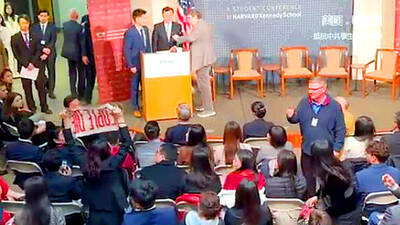
A group of Taiwanese-American and Tibetan-American students at Harvard University on Saturday disrupted Chinese Ambassador to the US Xie Feng’s (謝鋒) speech at the school, accusing him of being responsible for numerous human rights violations. Four students — two Taiwanese Americans and two from Tibet — held up banners inside a conference hall where Xie was delivering a speech at the opening ceremony of the Harvard Kennedy School China Conference 2024. In a video clip provided by the Coalition of Students Resisting the CCP (Chinese Communist Party), Taiwanese-American Cosette Wu (吳亭樺) and Tibetan-American Tsering Yangchen are seen holding banners that together read:

UNAWARE: Many people sit for long hours every day and eat unhealthy foods, putting them at greater risk of developing one of the ‘three highs,’ an expert said More than 30 percent of adults aged 40 or older who underwent a government-funded health exam were unaware they had at least one of the “three highs” — high blood pressure, high blood lipids or high blood sugar, the Health Promotion Administration (HPA) said yesterday. Among adults aged 40 or older who said they did not have any of the “three highs” before taking the health exam, more than 30 percent were found to have at least one of them, Adult Preventive Health Examination Service data from 2022 showed. People with long-term medical conditions such as hypertension or diabetes usually do not
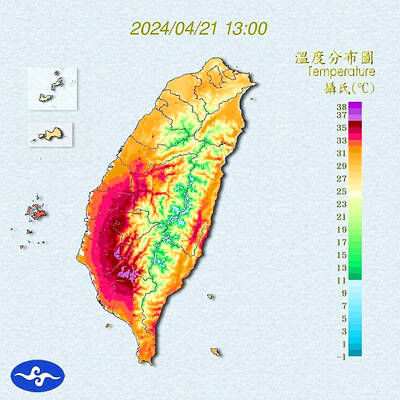
Heat advisories were in effect for nine administrative regions yesterday afternoon as warm southwesterly winds pushed temperatures above 38°C in parts of southern Taiwan, the Central Weather Administration (CWA) said. As of 3:30pm yesterday, Tainan’s Yujing District (玉井) had recorded the day’s highest temperature of 39.7°C, though the measurement will not be included in Taiwan’s official heat records since Yujing is an automatic rather than manually operated weather station, the CWA said. Highs recorded in other areas were 38.7°C in Kaohsiung’s Neimen District (內門), 38.2°C in Chiayi City and 38.1°C in Pingtung’s Sandimen Township (三地門), CWA data showed. The spell of scorching
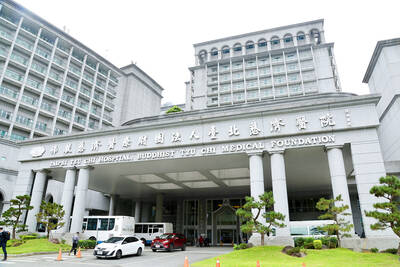
POLICE INVESTIGATING: A man said he quit his job as a nurse at Taipei Tzu Chi Hospital as he had been ‘disgusted’ by the behavior of his colleagues A man yesterday morning wrote online that he had witnessed nurses taking photographs and touching anesthetized patients inappropriately in Taipei Tzu Chi Hospital’s operating theaters. The man surnamed Huang (黃) wrote on the Professional Technology Temple bulletin board that during his six-month stint as a nurse at the hospital, he had seen nurses taking pictures of patients, including of their private parts, after they were anesthetized. Some nurses had also touched patients inappropriately and children were among those photographed, he said. Huang said this “disgusted” him “so much” that “he felt the need to reveal these unethical acts in the operating theater


 RSS
RSS