


With it now appearing certain that a Constitutional amendment on legislative downsizing will not be passed before the current legislative session ends on June 11, both the ruling and opposition caucuses have said that they plan to call for an extra legislative session next month to debate and pass the bill.
The downsizing bill would cut the number of legislative seats from the current 225 to 113 in 2008, and would also extend legislators' terms from three years to four.
The bill would also adopt a new electoral system -- known as the "single-member district and two-vote system (
The bill came close to passing on March 19, one day before the presidential election. The Democratic Progressive Party (DPP) was attempting to push the bill through when all parties were under election pressure.
However, the alliance of independent lawmakers backed out at last minute and demanded inter-party negotiations on the bill. The bill has been in negotiations since that time.
The bill will be discussed in a special sitting in mid-July if, as appears likely, any of the caucuses formally demands that the session be held.
The Fourth Nuclear Power Plant Referendum Initiative Association (
Lin, together with Academia Sinica President Lee Yuan-tseh (
All these efforts proved insufficient to push the bill through before the election.
But the association has not given up. It kicked off a walking tour around the nation yesterday to raise public awareness on legislative downsizing and to pressure the legislature to go ahead with downsizing as soon as possible.
"Before the presidential election the legislators all promised to push through the downsizing bill, but after the election they had thousands of excuses," association executive general Iap Phok-bun (
"The amendment bill has been dealt with perfunctorily and has not made any progress. It has gotten lost in the vicious struggles among the political parties," Iap said.
The association also declared that if the legislature held an extra sitting in July, Lin and other association members would return to the legislature to monitor whether the legislators were following through on their promises. Iap also said that if the legislators did not pass the bill, they would conduct a sit-in to protest the failure.
"Pass legislative downsizing first -- the part about the new electoral system can wait," Iap said.
Not everyone agrees with Iap's point of view.
The Legislative Reform Alliance (
Instead, the alliance has demanded that the plan for the two-vote system go ahead first -- and that legislators-at-large hold the same number of seats as regional legislators so that more legislators do not have to make regional interests their sole priority but instead can consider bills with the whole nation's interests in mind.
The proposed new electoral system is exactly what the caucuses differ on at the moment. Neither the Taiwan Solidarity Union (TSU) nor the alliance of independent lawmakers supports introducing single-member districts.
The TSU has said that single-member districts would eliminate small parties -- and would, in particular, mean the death of TSU.
But it's not only small parties that worry about their voices being silenced with an implementation of single-member districts -- women's groups and minority groups share similar concerns.
"It's clear that with the implementation of single-member districts, the DPP is looking to direct the country toward two-party politics. But we have seen that the US and the UK, both of which have single-member districts, are falling behind on some advanced issues compared to countries on the European continent," said Huang Chang-ling (
"For example, the participation rate of women in politics in the US and the UK is lower than that in Taiwan," Huang said.
"The current electoral system creates space for minority groups to compete, and should allow good people to participate in politics -- although sometimes it doesn't seem that any do. But still, it is important that minority groups are given space to compete in elections," Huang said.
The DPP's New Tide faction has its own ideas about the focus of the legislative reform -- although, in contrast to the women groups, it has proposed single-member districts as the solution to ongoing chaos in the legislature.
"Lin Yu-hsiung and Lee Yuan-tseh did the wrong thing when they encouraged public focus on legislative downsizing," New Tide faction Legislator Lee Wen-chung (
"I am not opposed to halving the seats, but if we do not change the electoral system and the legislative system along with downsizing, then we are as good as doing nothing. Downsizing itself won't eliminate the chaos in the legislature," Lee said.
"If we adopt single-member districts, then candidates will have to seek the support of the majority of voters, just as candidates do in elections for city mayors and county commissioners," Lee Wen-chung said.
"This can prevent candidates from manipulating tensions between groups. Candidates would be forced to promote issues that are popular with a majority of people," Lee Wen-chung said.

A group of Taiwanese-American and Tibetan-American students at Harvard University on Saturday disrupted Chinese Ambassador to the US Xie Feng’s (謝鋒) speech at the school, accusing him of being responsible for numerous human rights violations. Four students — two Taiwanese Americans and two from Tibet — held up banners inside a conference hall where Xie was delivering a speech at the opening ceremony of the Harvard Kennedy School China Conference 2024. In a video clip provided by the Coalition of Students Resisting the CCP (Chinese Communist Party), Taiwanese-American Cosette Wu (吳亭樺) and Tibetan-American Tsering Yangchen are seen holding banners that together read:

UNAWARE: Many people sit for long hours every day and eat unhealthy foods, putting them at greater risk of developing one of the ‘three highs,’ an expert said More than 30 percent of adults aged 40 or older who underwent a government-funded health exam were unaware they had at least one of the “three highs” — high blood pressure, high blood lipids or high blood sugar, the Health Promotion Administration (HPA) said yesterday. Among adults aged 40 or older who said they did not have any of the “three highs” before taking the health exam, more than 30 percent were found to have at least one of them, Adult Preventive Health Examination Service data from 2022 showed. People with long-term medical conditions such as hypertension or diabetes usually do not
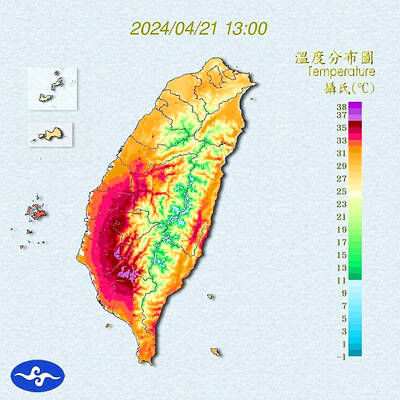
Heat advisories were in effect for nine administrative regions yesterday afternoon as warm southwesterly winds pushed temperatures above 38°C in parts of southern Taiwan, the Central Weather Administration (CWA) said. As of 3:30pm yesterday, Tainan’s Yujing District (玉井) had recorded the day’s highest temperature of 39.7°C, though the measurement will not be included in Taiwan’s official heat records since Yujing is an automatic rather than manually operated weather station, the CWA said. Highs recorded in other areas were 38.7°C in Kaohsiung’s Neimen District (內門), 38.2°C in Chiayi City and 38.1°C in Pingtung’s Sandimen Township (三地門), CWA data showed. The spell of scorching
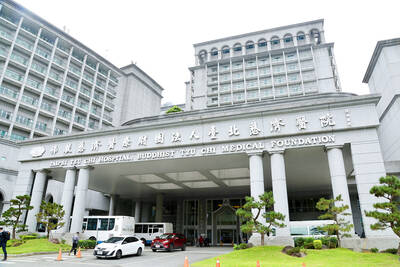
POLICE INVESTIGATING: A man said he quit his job as a nurse at Taipei Tzu Chi Hospital as he had been ‘disgusted’ by the behavior of his colleagues A man yesterday morning wrote online that he had witnessed nurses taking photographs and touching anesthetized patients inappropriately in Taipei Tzu Chi Hospital’s operating theaters. The man surnamed Huang (黃) wrote on the Professional Technology Temple bulletin board that during his six-month stint as a nurse at the hospital, he had seen nurses taking pictures of patients, including of their private parts, after they were anesthetized. Some nurses had also touched patients inappropriately and children were among those photographed, he said. Huang said this “disgusted” him “so much” that “he felt the need to reveal these unethical acts in the operating theater


 RSS
RSS