


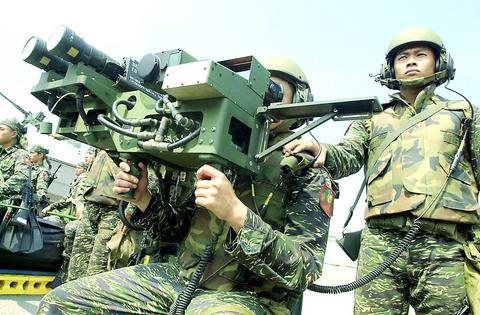
The proposal by US House Representatives, both Republicans, Dana Rohrabacher and Jim Ryun last weekend that Taiwan send its Marines to Iraq has placed the nation's Marine Corps in the spotlight -- even if the proposal is seemingly unworkable.
Pro-China legislators were among those most vehemently opposed to the idea.
TAIPEI TIMES FILE PHOTO
"Whenever a country requests another country to dispatch its troops, the bottom line is that they must recognize each other as a country. Would this mean that, at this moment, the US recognizes Taiwan as a country instead of as part of China?" asked People First Party (PFP) Legislator Sun Ta-chien (
Retired Admiral Nelson Ku (顧崇廉), now a PFP lawmaker, said that there was no reason for Taiwanese Marines to join operations in Iraq.
"`For whom' and `for what' are the bottom lines for the military in carrying out its missions," Ku said. "However, we cannot find any reasonable answers to these questions in regard to this issue."
Ku said that to join the alliance, Taiwanese troops would have to train with other troops so they could familiarize themselves with alliance tactics.
He also said it was very important to establish who would foot the bill.
"If coalition members don't pay, then the Taiwanese people will. However, I think it would be rather difficult to persuade Taiwanese to pay for all of this at this moment," Ku said. "We cannot fight for nothing. It is not our military's job to protect other countries."
Fearless
But Rohrabacher and Ryun's proposal at least brought a degree of international credibility to Taiwan's Marines, whose slogan is "Fearless of pain, hardship and death."
The nation has 39,000 Marines, based in Tsoying, Kaohsiung City. But most of this number is made up of conscripts completing their two-year compulsory military service.
The Marine Corps has four divisions -- infantry, armor, artillery and amphibious reconnaissance. Airborne and hovercraft divisions are also now under development.
In the infantry division, the Marines have a "security company" which is res-ponsible for guarding naval bases and other functions normally assigned to military police.
The company also functions as a combat unit and is responsible for supporting air defense, counter-intelligence and other missions.
To become a marine, a recruit must attend a two-month boot camp in the corps' training center in Pingtung County. After that, the recruit is assigned to advanced training programs according to his or her abilities. The total amount of time spent on training is approximately six months.
In 2001 the Marines invited US military personnel to observe exercises. The US military officials complimented their Taiwanese counterparts, saying that parts of the training program were tougher than the US Marines' schedule.
Weapons
Taiwan's Marines are equipped with a wide range of weapons, including T-74 machine guns, XT-86 combat rifles, T-77 submachine guns, T-65 rifles, Colt 45mm pistols, 300 US M-60 A3 tanks, 200 US M-41 tanks, a total of 700 LVT armored vehicles, US V-150 and domestically built amphibious assault vehicles, US M-24 armored personnel carriers and LTH-6 carriers armed with 105mm cannons.
As to nautical hardware, the Marines boast 46 landing ships, 130 transportation craft and 210 armored landing craft. In addition, the navy's two Newport Class landing ships, leased from the US, allow the Marines to launch attacks 8km from shore. These ships can carry 420 Marines, 500 tonnes of vehicles, four small landing craft and two helicopters.
The Newport Class landing ship is also able to drop Marines and armored vehicles via a 100m-long retractable bridge or a 34m-long retractable bridge if the vessel has trouble docking during combat.
In addition to combat missions, the Marines also monitor airspace on behalf of the navy. The Marines can spot aircraft approaching bases from more than 30km away and can track 64 different objects at the same time.
Special forces
For years the Marines were renowned for their Amphibious Reconnaissance and Patrol Unit (ARPU) and Special Service Company (SSC). However, in October 1999, the SSC was brought under the ARPU's command.
Marines special force members, most of whom are Aboriginal, are career soldiers. A special force member must be between 170cm and 180cm in height, weigh between 60kg and 80kg, have an IQ of 110 or above and not need to wear glasses. In addition, the ARPU does not allow its member to sport tattoos.
The special forces' daily physical training regimen involves swimming in full combat gear and a lengthy run. In addition, every member is a qualified martial-arts practitioner who is also trained in special combat skills such as demolitions, lock-picking, scuba diving, combat tactics, weapons training and jump training.
At the same time, team members must have a basic knowledge of how to operate different modes of transport, including vehicles, aircraft and ships.
In addition to weapons used by the Marines, the ARPU is also equipped with Uzi submachine guns, M733 rifles, Glock 17 pistols, SSG-2000 sniper rifles, night-vision gear and GPS navigation systems.
Weakening?
However, attempts to change the military into a "high-tech" force led to reforms in basic physical training -- except for the ARPU -- which worries a number of people in the military.
"If the government decides to send our Marines to join the US in Iraq, it would suggest to me that the government really hasn't got any idea what's going on. Could our Marines survive in the desert? I really doubt it," retired Vice Admiral Lan Ning-li (
Lan said that before 1991, the period of compulsory military service for those in the navy, air force or Marines was three years. Back in that era, he said, even retired Marines would be asked to march at least 70km during regular recalls.
"There is a school of thought that says these new, easier regulations are weakening our forces somewhat," Lan said. "That is why I am worried that our Marines may let us down if we send them to the battlefield now."
Lan said the real problem was that the Marines do not receive the attention they deserve.
"For instance, they do not have state-of-the-art weapons. Many of their weapons are actually leftovers from World War II," he said. "In addition, constant government cutbacks to marine numbers is making the problem go from bad to worse."
Responding to Lan's complaints, Marines headquarters said there was still a daily physical training program, including a 3km run, for all Marines, and that the reduced physical training did not make a significant difference to the force.
"Honor is the most important thing for soldiers, especially for Marines," said one senior marine at the headquarters, who wished to remain anonymous.
In the meantime, the officer said that the Marine Corps was also focusing on mental conditioning and training programs utilizing advanced technology.
"We need Marines who can work under pressure," the officer said. "In addition, we need everybody to know how to use a computer, because these days many weapons are guided by computers."

A group of Taiwanese-American and Tibetan-American students at Harvard University on Saturday disrupted Chinese Ambassador to the US Xie Feng’s (謝鋒) speech at the school, accusing him of being responsible for numerous human rights violations. Four students — two Taiwanese Americans and two from Tibet — held up banners inside a conference hall where Xie was delivering a speech at the opening ceremony of the Harvard Kennedy School China Conference 2024. In a video clip provided by the Coalition of Students Resisting the CCP (Chinese Communist Party), Taiwanese-American Cosette Wu (吳亭樺) and Tibetan-American Tsering Yangchen are seen holding banners that together read:

UNAWARE: Many people sit for long hours every day and eat unhealthy foods, putting them at greater risk of developing one of the ‘three highs,’ an expert said More than 30 percent of adults aged 40 or older who underwent a government-funded health exam were unaware they had at least one of the “three highs” — high blood pressure, high blood lipids or high blood sugar, the Health Promotion Administration (HPA) said yesterday. Among adults aged 40 or older who said they did not have any of the “three highs” before taking the health exam, more than 30 percent were found to have at least one of them, Adult Preventive Health Examination Service data from 2022 showed. People with long-term medical conditions such as hypertension or diabetes usually do not

POLICE INVESTIGATING: A man said he quit his job as a nurse at Taipei Tzu Chi Hospital as he had been ‘disgusted’ by the behavior of his colleagues A man yesterday morning wrote online that he had witnessed nurses taking photographs and touching anesthetized patients inappropriately in Taipei Tzu Chi Hospital’s operating theaters. The man surnamed Huang (黃) wrote on the Professional Technology Temple bulletin board that during his six-month stint as a nurse at the hospital, he had seen nurses taking pictures of patients, including of their private parts, after they were anesthetized. Some nurses had also touched patients inappropriately and children were among those photographed, he said. Huang said this “disgusted” him “so much” that “he felt the need to reveal these unethical acts in the operating theater
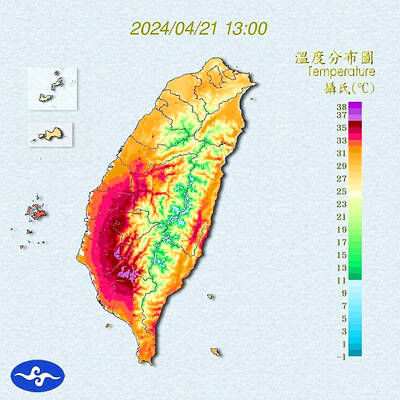
Heat advisories were in effect for nine administrative regions yesterday afternoon as warm southwesterly winds pushed temperatures above 38°C in parts of southern Taiwan, the Central Weather Administration (CWA) said. As of 3:30pm yesterday, Tainan’s Yujing District (玉井) had recorded the day’s highest temperature of 39.7°C, though the measurement will not be included in Taiwan’s official heat records since Yujing is an automatic rather than manually operated weather station, the CWA said. Highs recorded in other areas were 38.7°C in Kaohsiung’s Neimen District (內門), 38.2°C in Chiayi City and 38.1°C in Pingtung’s Sandimen Township (三地門), CWA data showed. The spell of scorching


 RSS
RSS