


Two major fresh milk suppliers yesterday rebutted the findings of a Department of Health survey which claimed their brands had exceeded dioxin levels considered safe by the EU.
Department officials came under the scrutiny of environmentalists and legislators on Monday over the department's initial reluctance to release information about dioxin levels. The report, which was eventually released on April 13, said that the dioxin levels of three brands of milk exceeded the EU limit of 2 picograms of the World Health Organization's toxicity equivalent per gram of fat (denoted as 2pg WHO-TEQ/g fat).
The department said that sampling of fresh milk over the last two years showed that products marketed by Uni-President (
In May last year, the report said, dioxin levels for Uni-President and Tunghai Rangeland's milk was 3.28pg WHO-TEQ/g fat and 2.45pg WHO-TEQ/g fat respectively.
"Under pressure from not only environmental groups but also consumers, we decided to make the results of the survey available to the public. Consumers have the right to decide what they want to buy," said Chen Lu-hung (陳陸宏), director-general of the department's Bureau of Food Sanitation.
Officials stressed that only 3 percent of dioxins in the average Taiwanese comes from fresh milk and that it was impossible to absorb threatening levels even if people drank 10 times the normal amount of fresh milk.
But yesterday's news resulted in a downturn in fresh milk sales.
Uni-President executive vice president Lo Chih-hsien (
"According to the report, the dioxin level of our products dropped down to 1.88pg WHO-TEQ/g fat. We need to find out why the results varied so dramatically within an interval of only three months," Lo said.
Lo added that dioxin residue can be found in many kinds of food, including seafood and meat.
Tunghai Rangeland (東海牧場) is the only university-run milk production firm in the country. Yang Shyi-kuen (
"Under these circumstances, we don't see strong scientific evidence supporting any differences between the brands that were sampled," Yang said.
The university yesterday urged the department to conduct more comprehensive surveys.
The university added it was considering filing for compensation if its reputation was found to have been damaged by the report's findings.
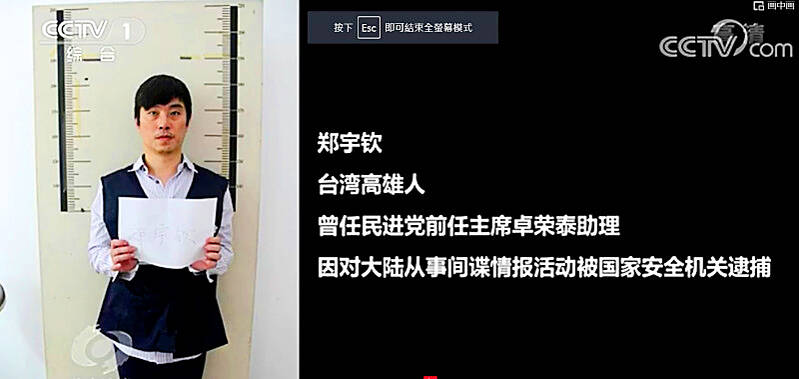
Former Czech Republic-based Taiwanese researcher Cheng Yu-chin (鄭宇欽) has been sentenced to seven years in prison on espionage-related charges, China’s Ministry of State Security announced yesterday. China said Cheng was a spy for Taiwan who “masqueraded as a professor” and that he was previously an assistant to former Cabinet secretary-general Cho Jung-tai (卓榮泰). President-elect William Lai (賴清德) on Wednesday last week announced Cho would be his premier when Lai is inaugurated next month. Today is China’s “National Security Education Day.” The Chinese ministry yesterday released a video online showing arrests over the past 10 years of people alleged to be
THE HAWAII FACTOR: While a 1965 opinion said an attack on Hawaii would not trigger Article 5, the text of the treaty suggests the state is covered, the report says NATO could be drawn into a conflict in the Taiwan Strait if Chinese forces attacked the US mainland or Hawaii, a NATO Defense College report published on Monday says. The report, written by James Lee, an assistant research fellow at Academia Sinica’s Institute of European and American Studies, states that under certain conditions a Taiwan contingency could trigger Article 5 of NATO, under which an attack against any member of the alliance is considered an attack against all members, necessitating a response. Article 6 of the North Atlantic Treaty specifies that an armed attack in the territory of any member in Europe,
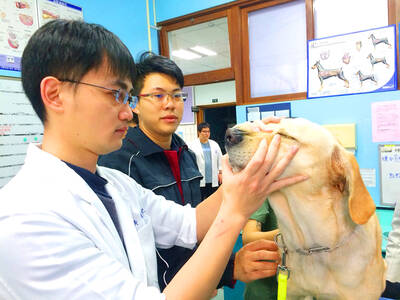
LIKE FAMILY: People now treat dogs and cats as family members. They receive the same medical treatments and tests as humans do, a veterinary association official said The number of pet dogs and cats in Taiwan has officially outnumbered the number of human newborns last year, data from the Ministry of Agriculture’s pet registration information system showed. As of last year, Taiwan had 94,544 registered pet dogs and 137,652 pet cats, the data showed. By contrast, 135,571 babies were born last year. Demand for medical care for pet animals has also risen. As of Feb. 29, there were 5,773 veterinarians in Taiwan, 3,993 of whom were for pet animals, statistics from the Animal and Plant Health Inspection Agency showed. In 2022, the nation had 3,077 pediatricians. As of last

XINJIANG: Officials are conducting a report into amending an existing law or to enact a special law to prohibit goods using forced labor Taiwan is mulling an amendment prohibiting the importation of goods using forced labor, similar to the Uyghur Forced Labor Prevention Act (UFLPA) passed by the US Congress in 2021 that imposed limits on goods produced using forced labor in China’s Xinjiang region. A government official who wished to remain anonymous said yesterday that as the US customs law explicitly prohibits the importation of goods made using forced labor, in 2021 it passed the specialized UFLPA to limit the importation of cotton and other goods from China’s Xinjiang Uyghur region. Taiwan does not have the legal basis to prohibit the importation of goods


 RSS
RSS