


The Supreme Court yesterday said it could find no fault with the case of Hsu Tzu-chiang (
Hsu was indicted for the Sept. 1, 1995, kidnapping and murder of Huang Chun-shu (
The Supreme Court had been requested by the Council of Grand Justices to review Hsu's conviction as the result of a motion filed by Hsu's defense counsel last December to have the conviction overturned as unconstitutional.
The major argument for Hsu's defense concerns whether co-suspects' testimony should be used as evidence.
Chen Yi-lung wrote a confession admitting that he had deliberately incriminated Hsu because he had a grudge against him and hoped to delay the trial. However, the High Court decided not to take this evidence into consideration when it heard the case, and upheld the death penalty passed on Hsu by the lower court.
In refusing to hear Chen's evidence, the High Court breached Hsu's human rights, his defense team claims.
Without Chen's accusation there is not evidence with which to convict Chen, his defense team says.
But despite Chen's testimony, the Supreme Court said that there was no other evidence to prove Hsu's innocence. As a result, judges cannot suspend his death penalty simply because Chen decided to retract his testimony.
"The High Court judges had good reason to pass the death sentence on Hsu. The Supreme Court did not find anything improper within the High Court's verdict," the official response of the Supreme Court read.
The response will be used for reference while the grand justices work on the constitutional interpretation question.
In addition to the application for a constitutional interpretation, Hsu's defense team also filed another request to the Taiwan High Court for an extraordinary retrial but this request had yet to be answered as of press time yesterday.
Hsu's conviction was handed down by the Supreme Court on April 27, 2000.
His defense counsels petitioned State Public Prosecutor General Lu Jen-fa (
Lu finally approved the fifth petition to make the first extraordinary appeal in 2001, but that appeal was rejected by the Supreme Court on March 21, 2002.
After that, Lu filed another three appeals to the Supreme Court, and on May 6 this year, his fourth extraordinary appeal was rejected again.
Defense petitions cited a Control Yuan investigation report released in January, 2001, that concluded Hsu's conviction was flawed and unlawful.
In the report, the Control Yuan also suggested Lu make extraordinary appeals for Hsu.
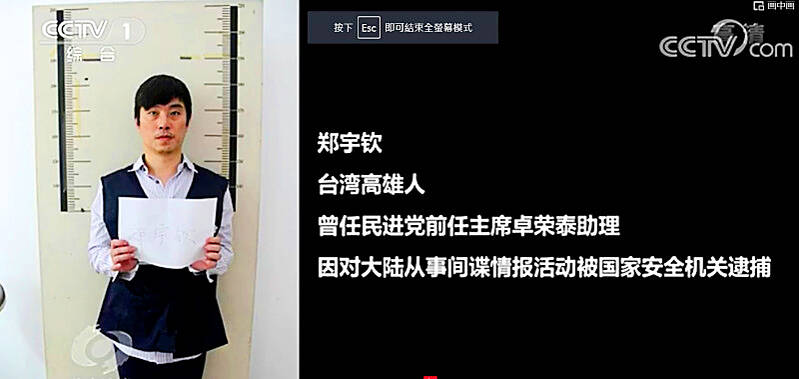
Former Czech Republic-based Taiwanese researcher Cheng Yu-chin (鄭宇欽) has been sentenced to seven years in prison on espionage-related charges, China’s Ministry of State Security announced yesterday. China said Cheng was a spy for Taiwan who “masqueraded as a professor” and that he was previously an assistant to former Cabinet secretary-general Cho Jung-tai (卓榮泰). President-elect William Lai (賴清德) on Wednesday last week announced Cho would be his premier when Lai is inaugurated next month. Today is China’s “National Security Education Day.” The Chinese ministry yesterday released a video online showing arrests over the past 10 years of people alleged to be

THE HAWAII FACTOR: While a 1965 opinion said an attack on Hawaii would not trigger Article 5, the text of the treaty suggests the state is covered, the report says NATO could be drawn into a conflict in the Taiwan Strait if Chinese forces attacked the US mainland or Hawaii, a NATO Defense College report published on Monday says. The report, written by James Lee, an assistant research fellow at Academia Sinica’s Institute of European and American Studies, states that under certain conditions a Taiwan contingency could trigger Article 5 of NATO, under which an attack against any member of the alliance is considered an attack against all members, necessitating a response. Article 6 of the North Atlantic Treaty specifies that an armed attack in the territory of any member in Europe,
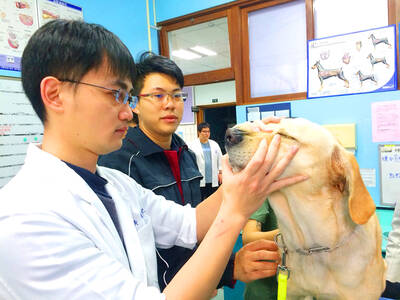
LIKE FAMILY: People now treat dogs and cats as family members. They receive the same medical treatments and tests as humans do, a veterinary association official said The number of pet dogs and cats in Taiwan has officially outnumbered the number of human newborns last year, data from the Ministry of Agriculture’s pet registration information system showed. As of last year, Taiwan had 94,544 registered pet dogs and 137,652 pet cats, the data showed. By contrast, 135,571 babies were born last year. Demand for medical care for pet animals has also risen. As of Feb. 29, there were 5,773 veterinarians in Taiwan, 3,993 of whom were for pet animals, statistics from the Animal and Plant Health Inspection Agency showed. In 2022, the nation had 3,077 pediatricians. As of last

XINJIANG: Officials are conducting a report into amending an existing law or to enact a special law to prohibit goods using forced labor Taiwan is mulling an amendment prohibiting the importation of goods using forced labor, similar to the Uyghur Forced Labor Prevention Act (UFLPA) passed by the US Congress in 2021 that imposed limits on goods produced using forced labor in China’s Xinjiang region. A government official who wished to remain anonymous said yesterday that as the US customs law explicitly prohibits the importation of goods made using forced labor, in 2021 it passed the specialized UFLPA to limit the importation of cotton and other goods from China’s Xinjiang Uyghur region. Taiwan does not have the legal basis to prohibit the importation of goods


 RSS
RSS