


Taipei Times: What is the Bush administration's view of President Chen Shui-bian's (陳水扁) re-election?
Doug Bandow: I am sure that from the simple point of stability, the administration doesn't want trouble. So I suspect most people in the administration would have preferred a Chinese Nationalist Party (KMT) victory, just on the theory that it [would have been] less troublesome -- not on substance of argument, not on the merit. They have a lot on their plate. Iraq is a complete disaster; the North Korean problem is not solved. They don't need any problems in the Taiwan Strait.
Now the perception in Washington is that if Chen steps out of place and pokes the China beast, then ... who needs this? This is understandable. Washington feels it has handed out a security guarantee -- and the country then uses that security guarantee and surprises them.

PHOTO: CHIANG YING-YING, TAIPEI TIMES
But I do think that there are some disagreements in the administration. There had been a reservoir of goodwill toward Taiwan, and it's just been that in the last few years that reservoir is running a bit dry, because they've been so focused on other things. And they really perceive that they need China. They don't want a veto of UN resolutions. They are very concerned about Korea -- they correctly perceive that China has the most leverage against North Korea. It may not be enough to solve the issue, but if you are looking within the region, probably Beijing has the most [influence]. So I think it will be [helpful for the] US that the China-Taiwan relationship remain smooth, and that Taiwan be very low key. Then they can cooperate with you on other issues.
TT: If Democrat presidential hopeful John Kerry is elected, what do you think the administration's approach to Taiwan will be?
Bandow: I think a starting point for policy with Kerry is [former US president Bill] Clinton. I don't think Kerry has ever thought deeply about Taiwan. He has thought about China, I am sure, because it is hard not to think about China. It is interesting because his current anti-China campaign and rhetoric in some sense should be helpful to Taiwan. But again I look at the Clinton experience, which was that the moment Clinton was elected, everything changed around. I think Kerry would be more difficult for Taiwan. People perceive that China is relatively more important. And to some degree it will depend on Congress. They will uphold policy that will uphold the Taiwan Relations Act, but you won't have the same level of affinity, and there will be probably more rhetoric, more distance from the administration in Taiwan, and there will be more pressure on the referendum and constitutional amendments.
TT: Do you have advice for Chen?
Bandow: If Chen can communicate clearly to the administration that he recognizes Washington's concerns and that he understands the need for stability, then this would make Washington feel better, [knowing] that Chen really understands the concerns of Washington. And then there's the extent to which Chen can indicate that he is willing to change policy -- that you'll still hold a referendum but be willing to change the wording of the referendum.
I think the emphasis is on constitutional change. The fear clearly is constitutional change, at some point. It means you have to define what Taiwan is, what the community is, the issues of name and flag. But if you communicate to Washington that constitutional changes will be carried out [within a] narrow framework, then we won't raise all these other issues. Right now, Washington needs to perceive that it has been heard.
There's criticism of Taiwan even by conservative activists who were previously pro-Taiwan. This is significant, because this is the Taiwan base in American politics, and you are getting criticism there. You sure are getting some distance from people who ought to be your friends. So you should want to reassure them.
The second thing is the notion of trying to demonstrate to Washington that Taiwan is an asset. I think [the argument] could be humanitarian or it could be other things. It could be the notion that the US wants democracy around the world. Taiwan shows how a country can move to democracy: Within 20 years, Taiwan has moved from martial law and end of a dictatorship into elections, and the opposition wins, and you can weather all kinds of controversy.
Washington can use symbols of democratic change and Taiwan is a role model for that. China matters a lot -- the UN veto, North Korea and economic interaction -- and Taiwan doesn't have that same [leverage]. At the moment the US is desperate for better relations with China, and in that context Taiwan is in danger. Taiwan is in danger of being marginalized.
You've got to realize that this administration has a very short attention span, and right now it is in a lot of trouble with Iraq, and the Bush administration wants to be re-elected. When they look at Taiwan they look at it very superficially.
That is why it is critical for Chen to communicate to Washington, "I heard you." And small things are very symbolic. Like the Washington Post interview with Chen and Chen's administration putting out statements. [Washington has] the perception that Chen, poking at the China beast, seems to be a bit reckless, so everything is interpreted in that framework.
TT: How do you think the international community perceives post-election opposition to the election result?
Bandow: For the international community, what is important is that there is the perception of a fair process. So there is a perception that the charges are being investigated. I do think that there is enough legitimacy there -- there is a court-ordered recount and an investigation into the shooting. But the tough question is the KMT, and whether they can accept an adverse result after the recount and the investigation into the shooting.
If they don't, I worry that the other countries will worry not about the fairness of the procedure but the stability of the country. I've talked to a lot of Americans who think that the shooting looks pretty weird, but I am yet to find an American who thought that if he was to stage a shooting he would stage it on a moving vehicle. But the perception of the process is more important than the result.
TT: To what extent has democracy and the rule of law been tarnished by the ongoing dispute?
Bandow: I think what is critical is an acceptance of the result. That what happened after the election, in terms of the huge rhetoric, violence or what have you, is forgotten by the inauguration if a recount is held. If Chen won and the investigation bears it out, then the opposition has to accept that. What happened in the US in the end is that the Democrats accepted that the process works. President George W Bush -- they may not like him, but he is inaugurated, he is president, he is legal, no one is filing law suits saying he can't sign laws.
Yet the KMT does not accept the result. There are continuing controversies and protests. I hope that the KMT does think about the stability of Taiwan's political system, and that it is not in Taiwan's interest to continue delegitimizing the system, especially where a potentially hostile China is right across the Strait.
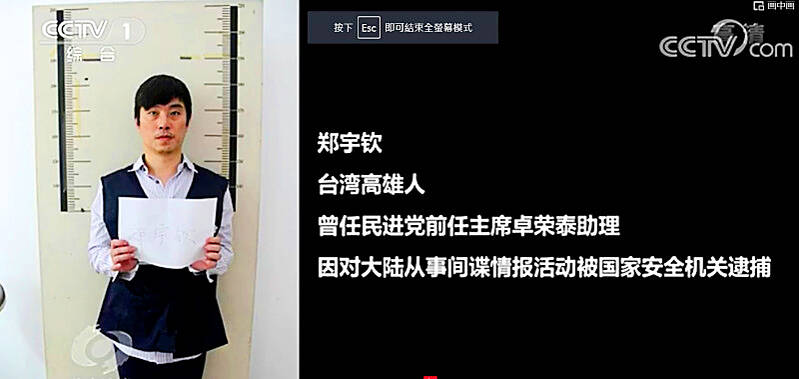
Former Czech Republic-based Taiwanese researcher Cheng Yu-chin (鄭宇欽) has been sentenced to seven years in prison on espionage-related charges, China’s Ministry of State Security announced yesterday. China said Cheng was a spy for Taiwan who “masqueraded as a professor” and that he was previously an assistant to former Cabinet secretary-general Cho Jung-tai (卓榮泰). President-elect William Lai (賴清德) on Wednesday last week announced Cho would be his premier when Lai is inaugurated next month. Today is China’s “National Security Education Day.” The Chinese ministry yesterday released a video online showing arrests over the past 10 years of people alleged to be
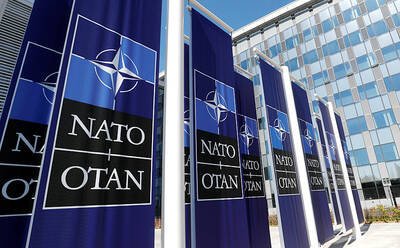
THE HAWAII FACTOR: While a 1965 opinion said an attack on Hawaii would not trigger Article 5, the text of the treaty suggests the state is covered, the report says NATO could be drawn into a conflict in the Taiwan Strait if Chinese forces attacked the US mainland or Hawaii, a NATO Defense College report published on Monday says. The report, written by James Lee, an assistant research fellow at Academia Sinica’s Institute of European and American Studies, states that under certain conditions a Taiwan contingency could trigger Article 5 of NATO, under which an attack against any member of the alliance is considered an attack against all members, necessitating a response. Article 6 of the North Atlantic Treaty specifies that an armed attack in the territory of any member in Europe,
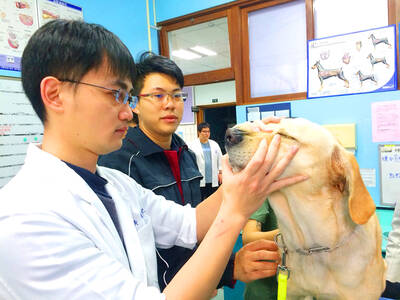
LIKE FAMILY: People now treat dogs and cats as family members. They receive the same medical treatments and tests as humans do, a veterinary association official said The number of pet dogs and cats in Taiwan has officially outnumbered the number of human newborns last year, data from the Ministry of Agriculture’s pet registration information system showed. As of last year, Taiwan had 94,544 registered pet dogs and 137,652 pet cats, the data showed. By contrast, 135,571 babies were born last year. Demand for medical care for pet animals has also risen. As of Feb. 29, there were 5,773 veterinarians in Taiwan, 3,993 of whom were for pet animals, statistics from the Animal and Plant Health Inspection Agency showed. In 2022, the nation had 3,077 pediatricians. As of last
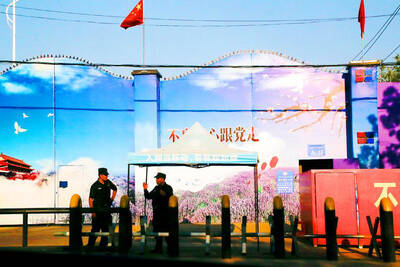
XINJIANG: Officials are conducting a report into amending an existing law or to enact a special law to prohibit goods using forced labor Taiwan is mulling an amendment prohibiting the importation of goods using forced labor, similar to the Uyghur Forced Labor Prevention Act (UFLPA) passed by the US Congress in 2021 that imposed limits on goods produced using forced labor in China’s Xinjiang region. A government official who wished to remain anonymous said yesterday that as the US customs law explicitly prohibits the importation of goods made using forced labor, in 2021 it passed the specialized UFLPA to limit the importation of cotton and other goods from China’s Xinjiang Uyghur region. Taiwan does not have the legal basis to prohibit the importation of goods


 RSS
RSS