


In anticipation of the delivery of the first bullet trains from their Japan-ese manufacturer at the end of the month, high-speed railway authorities yesterday reiterated that construction was on schedule and that the service would be inaugurated by October of next year, as promised.
"Since we signed a contract with the government in July 1998, we've had to overcome many difficulties, but I trust that we will continue doing just that," said Nita Ing (殷琪), chairwoman of the Taiwan High Speed Railway Corp (THSRC).
According to THSRC officials, the first batch of bullet trains, 700T models manufactured by Japanese Kawasaki Heavy Industries, will be shipped from the factory in Kobe on May 18. The train cars are scheduled to arrive at Kaohsiung harbor on May 25, and to be transported to THSRC's main workshop in Kaohsiung to be assembled on May 29.
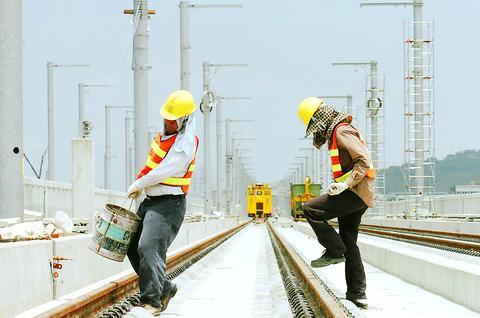
PHOTO: CHIEN JUNG-FENG, TAIPEI TIMES
Testing of the 12 cars will begin in September on tracks between the Tainan and Kaohsiung stations, a distance of roughly 60km.
However, the THSRC's fundraising woes have often raised questions as to whether the bullet-train service would be delayed. Ing said yesterday that in terms of funding, THSRC's five major shareholders still needed to put up another NT$14.5 billion before completion of the project. However, of the NT$7.5 needed before July, only NT$2.1 billion has been raised.
THSRC spokesman Edward Lin (林天送) said that the company had incurred additional costs unaccounted for in the original contract. He said the total cost of construction amounted to NT$464.8 billion for THSRC's account. Of that amount, NT$323.3 billion will be covered through bank loans and another NT$133.2 billion as free capital from stock sales. The remaining NT$9.3 billion, however, are additional costs that must be covered through selling shares.
Ing said that the company planned to hold a roadshow abroad at the beginning of next year in a bid to attract overseas investors.
In addition the company must also deal with an International Chamber of Commerce ruling last month which ordered it to pay US$73 million in compensation to a European business group.
However, the THSRC's plans go beyond the construction of trains and stations -- developing the areas around the stations is another component of a 50-year contract signed with the government.
"We are planning a total of five new towns, working with an area of about 1,500 hectares," said Charles Hseuh (
The land surrounding key stations, including Tainan, Hsinchu and Taoyuan, are to be transformed into new "town centers." The new towns will be geared towards increasing development in the area and will feature luxury hotels, shopping malls, Club Taiwan and even science parks.
The Hsinchu station will be the first to begin development of town centers, starting the bidding process for land use at the end of this year.
"It will take about 10 to 15 years for the development of these towns, and another 20 to 30 years for them to reach maturity," Hseuh said.
The bullet-train system runs north-south for 345km between Taipei and Kaohsiung. Running at a speed of up to 300kph, the trains will reduce travel time between the two cities to just 80 minutes.

THE HAWAII FACTOR: While a 1965 opinion said an attack on Hawaii would not trigger Article 5, the text of the treaty suggests the state is covered, the report says NATO could be drawn into a conflict in the Taiwan Strait if Chinese forces attacked the US mainland or Hawaii, a NATO Defense College report published on Monday says. The report, written by James Lee, an assistant research fellow at Academia Sinica’s Institute of European and American Studies, states that under certain conditions a Taiwan contingency could trigger Article 5 of NATO, under which an attack against any member of the alliance is considered an attack against all members, necessitating a response. Article 6 of the North Atlantic Treaty specifies that an armed attack in the territory of any member in Europe,
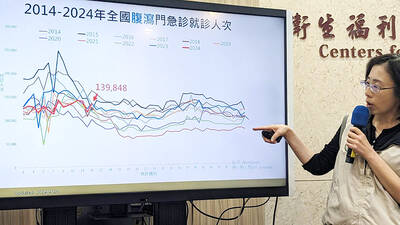
FLU SEASON: Twenty-six severe cases were reported from Tuesday last week to Monday, including a seven-year-old girl diagnosed with influenza-associated encephalopathy Nearly 140,000 people sought medical assistance for diarrhea last week, the Centers for Disease Control (CDC) said on Tuesday. From April 7 to Saturday last week, 139,848 people sought medical help for diarrhea-related illness, a 15.7 percent increase from last week’s 120,868 reports, CDC Epidemic Intelligence Center Deputy Director Lee Chia-lin (李佳琳) said. The number of people who reported diarrhea-related illness last week was the fourth highest in the same time period over the past decade, Lee said. Over the past four weeks, 203 mass illness cases had been reported, nearly four times higher than the 54 cases documented in the same period
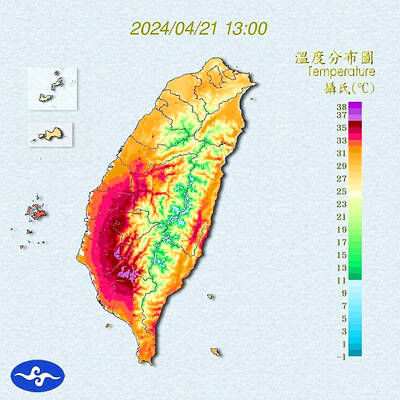
Heat advisories were in effect for nine administrative regions yesterday afternoon as warm southwesterly winds pushed temperatures above 38°C in parts of southern Taiwan, the Central Weather Administration (CWA) said. As of 3:30pm yesterday, Tainan’s Yujing District (玉井) had recorded the day’s highest temperature of 39.7°C, though the measurement will not be included in Taiwan’s official heat records since Yujing is an automatic rather than manually operated weather station, the CWA said. Highs recorded in other areas were 38.7°C in Kaohsiung’s Neimen District (內門), 38.2°C in Chiayi City and 38.1°C in Pingtung’s Sandimen Township (三地門), CWA data showed. The spell of scorching

A group of Taiwanese-American and Tibetan-American students at Harvard University on Saturday disrupted Chinese Ambassador to the US Xie Feng’s (謝鋒) speech at the school, accusing him of being responsible for numerous human rights violations. Four students — two Taiwanese Americans and two from Tibet — held up banners inside a conference hall where Xie was delivering a speech at the opening ceremony of the Harvard Kennedy School China Conference 2024. In a video clip provided by the Coalition of Students Resisting the CCP (Chinese Communist Party), Taiwanese-American Cosette Wu (吳亭樺) and Tibetan-American Tsering Yangchen are seen holding banners that together read:


 RSS
RSS